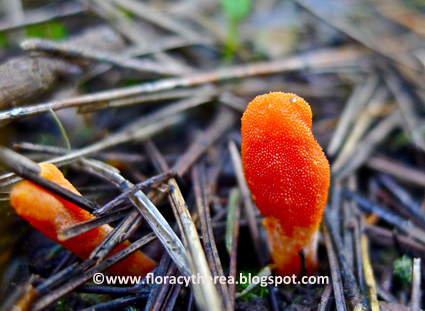
Cordyceps militaris
The military man with the club head
A miniature fungus that attacks various insects, mummifies their dead bodies, turns them into mycelium, and develops its fruiting body there.
Each species of antlion seems to specialize in a different insect. In some cases, the victim (ant) is guided by the dominant individual to take a specific position on a high branch before dying. This position obviously favors the propagation of the brainworm, allowing its spores to spread over a greater distance.
It is considered rather rare in Europe, perhaps because its size often makes it go unnoticed, hidden as it is in piles of dead leaves.
It is also considered rare in Greece, with only one recorded sighting in Xanthi (Konstantinidis 2009). According to Michael Kuο (mushroomexpert.com), mushroom lovers who are lucky enough to find this fungus are so excited that they are unable to photograph it. I admit that I was quite lucky to find it in Kythira and I completely agree with Michael about the initial excitement!!!
Related species such as cordyceps sinensis, which is abundant in the Tibetan plateaus, is considered a panacea in traditional Chinese medicine. It is so valuable that for many centuries it was reserved exclusively for the imperial family and Chinese nobles. It was used as a tonic for the lungs and kidneys, to increase sperm production, and to treat various respiratory conditions.
In the West, its much-vaunted therapeutic value was only recognized in the 18th century in Paris, when a Jesuit monk brought it back with him from a visit to the imperial court of China.
Recent research shows that the fruit body and mycelium contain substances with strong anti-aging properties (Cao & Wen, 1993). They also have a powerful effect on the immune system, boosting it even in severe clinical cases of advanced cancer. (Zhou & Lin, 1995) Cordyceps also has cardiotonic properties, helping to treat problems caused by high cholesterol and triglycerides (Geng et al. 1985), and has strong aphrodisiac properties (Wan et. al. 1988).
The Chinese consume the fungus together with its dead host, after leaving it in an alcoholic beverage for a few days. In the West, the mycelium of this species is cultivated without the insect. This makes modern products somewhat easier to swallow for the average Western consumer.
The name of the genus comes from the ancient Greek word κορδύλη = bump, lump, and the Latin cepa = head.