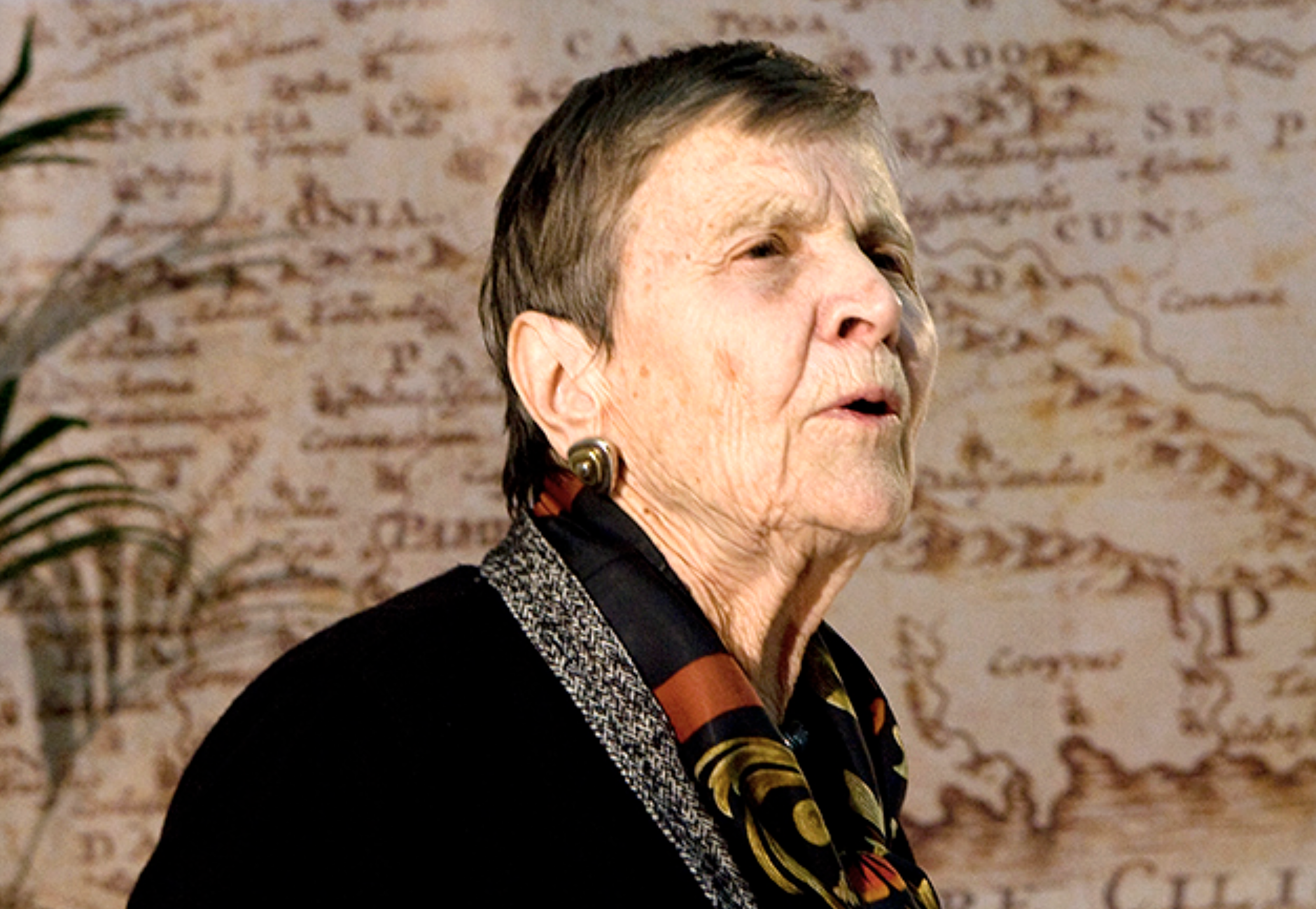
Eleni Glycatzi-Arveler, an emblematic figure of the Greek and European intelligentsia, passed away at the age of 100, leaving behind a rich intellectual legacy.
Born in Athens in 1926 of Asia Minor parents, followed the path of history early on, initially in the University of Athens and then to Paris. She met her husband in the French capital, Jacques Arveler (1918-2010), an officer in the French Navy, with whom he had a daughter, Marie-Hélène.
For her, Byzantium was not just an object of study, but a a living laboratory of political thought, social organisation and cultural continuity. With her work she sealed the study of the Byzantine world and repositioned its role in European history and cultural consciousness.
Her international academic career has been impressive. Professor at the University of Sorbonne since 1967, became the first woman, in a seven-century tradition, to hold the highest administrative office of the institution: department chairman, university president and, in 1976, dean. Its presence in the institutions of European university life was substantial, interventionist and deeply political in the broad sense of the term.
At the same time, Eleni Glycatzi-Arveler has been active in international organizations and cultural institutions. Since the Georges Pompidou Centre until UNESCO and the European Cultural Centre of Delphi, her presence sealed the dialogue between historical knowledge, culture and contemporary society.
Her literary work, extensive and widely translated, remains a reference point for Byzantine studies, but also for the relationship of Greece with Europe and the Mediterranean.
The soul, the memory, the account
In the book «From me these...» (Pataki ed.), the Eleni Glycatzi-Arveler, through conversations with Makis Provatas and Efi Vassilopoulou, unraveled her life, talking about the her childhood, them her parents, the Occupation and the Resistance, the immigration and the life in France, motherhood and her role as a grandmother.
Personal memory and history coexist in the pages of the book. Arveler spoke about «Greek continuation», for the relationship between ancient Greece and Byzantium, for the modern Greek history that «meloponizes», but also for the «today»: the «Erdoğan's »unhistorical nonsense, the pandemic, the war in Ukraine.
At the same time, she gave her thoughts on memory and oblivion, truth, love and happy marriage, betrayal and loss, self-knowledge and the riddle of the soul. She spoke of humanity as the highest virtue and of art as a living organism, revealing a lesser-known side of her, as the publication includes 10 of her unpublished poems.
As Nikos Vatopoulos wrote in «K», «this long interview, in the genre of books that reveal intimate thoughts, memories and descriptions, as a midwifery method of consensual autobiography, has in this case considerable virtues. Firstly, Eleni Glycatzi-Arveler, liberated and genuine, speaks not only about her own life, but with the virtue of her years about all the issues of life, in a realistic and philosophical way. Secondly, she reveals her poems (the “Account” is read with the mental image of a spruce branch or a laurel wreath). And thirdly, it makes us partakers of a way of seeing.“Discipline in man is very important and very difficult. But the basic question is: Discipline in what?; And let's say you've discerned what you need to discipline yourself to - what sacrifices are you willing to make for that? Discipline means a series of sacrifices, and that's why some people can take it and others can't.’.
I have come to the conclusion that as long as you live, you pass the ”baton” to someone and that baton is the soul. So, in that respect, you are never a single person.
«Eleni Glycatzi-Arveler speaks in a solid way and it is as if you can hear the familiar tone of her voice. “If I had the ability to remove one defect of the Greek, it would be the ego,” we read. Her words flow and there are times when you want to stop and re-read the Doric distillations of her thought. In response to a question about “where does the soul go after death”, Eleni Glycatzi-Arveler concludes: “I have come to the conclusion that as long as you live, you pass the “baton” to someone, and that baton is the soul. So, in that respect, you are never a single person.”.
Alexander the Great and the homeland
«I have now many arguments”, says, ”that make me convinced that Alexander the Great is buried in the great royal tomb of Vergina, and I believe that I will be vindicated, but after death.“ What she says at the end of the interview is impressive: ”As a legacy, I would like them to remember that I was convinced that Alexander the Great is buried in Vergina and not his father, Philip II“.”.
For Eleni Glycatzi-Arveler, home was not just a geographical place, but a feeling: «Home is emotion, it is the place that holds your memories and emotions. Homeland is our common interests, the “we”, which is multifaceted and of course includes not only the people with whom you are compatriots, but also those with whom we are moved by the same things».
«The history of Byzantium will be measured before Helen and after Helen»
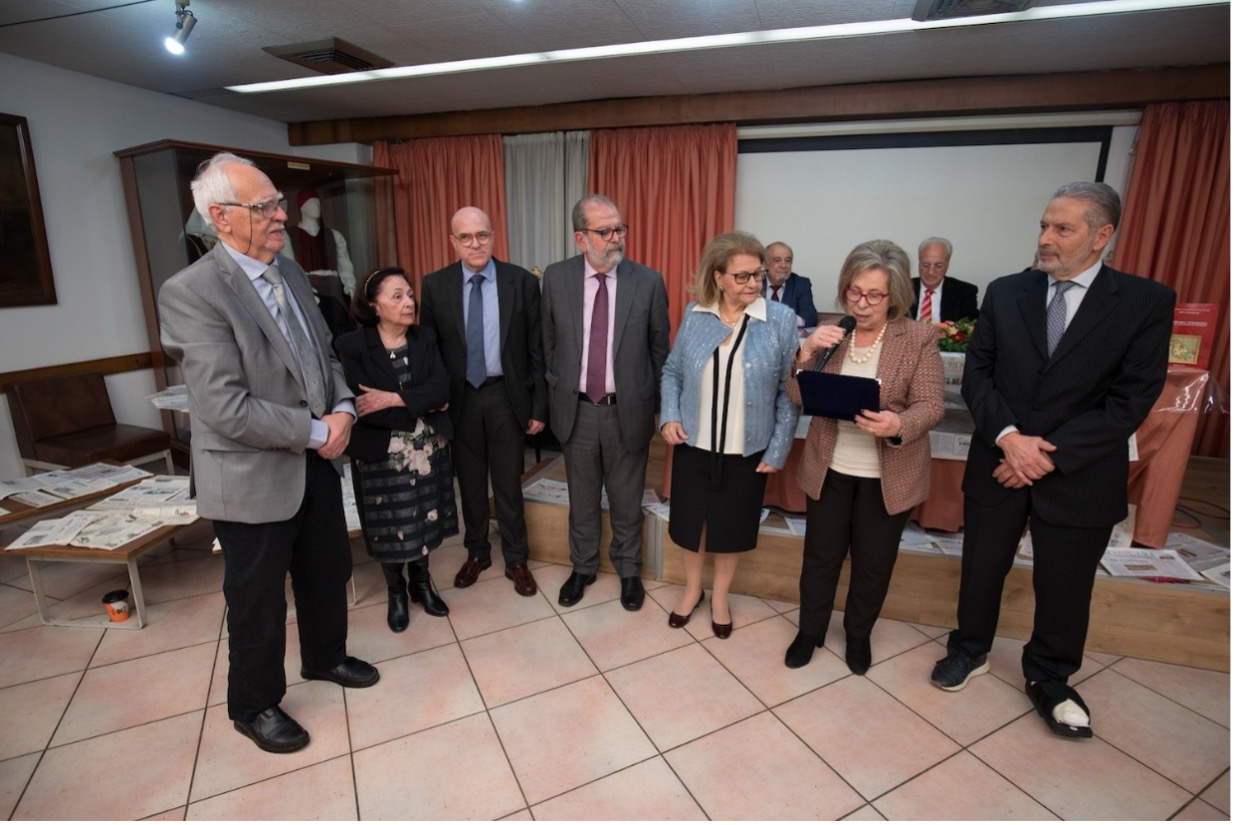
In November 2025, at the Basil and Elise Goulandris Foundation, an event was held in honour of Eleni Glycatzi-Arveler on the topic «The Byzantine culture's buttresses as “porches” of the Renaissance». It was a moment of recognition of her work and intellectual legacy, with interventions by politicians, writers and poets who spoke of her contribution to a deeper understanding of history and culture.
Former President of the Republic Prokopis Pavlopoulos described her as a pioneering researcher of international standing, stressing that she had highlighted the quintessence of Byzantine culture. As he stressed, «in the wider field of history and culture internationally, Eleni Glycatzi-Arveler will remain as the pioneering researcher who highlighted the quintessence of Byzantine culture. Byzantium owes her for revealing the great truth about it. His story will be measured before Helen and after Helen.».
«History of the Struggle»
In March 2021, Helen Arveler wrote in «K» the «History of the Struggle» on the occasion of the 200th anniversary of the Greek Revolution. Through this dedicatory poem, the Byzantinologist and historian looks back on the years of enslavement, referring to the heroes and all that sparked the Revolution.
A son of the King, my master, born in Feres
In Souli my mother saw the light, in the days of Ali Pasha.
I too am a Hydra and a Spetsesian, a sea and landlubber,
at night I'm a deburrer and in the morning I'm an auriculturist
And Thurius is to me a hymn of praise.
Thief and charioteer in Botsaris and in Gravia Androutsos
I was a sailor on Kanaris and a sailor on Miaoulis.
With Karaiskakis, guardian of the divine I was of faith
and with Ypsilanti of the Friendly I became an initiate.
I said Mado the lady, the Buboulina the lady,
I brought them gifts of ornaments from Venice.
I honour the Old Man of Moria and I love Makriyannis
His speech is glittering, gives me wings and makes me
in Lavra to raise the banner, where no enemy can reach
That which Patron blessed, and the spring had sprung.
They said it in their own way, Shelley, Hugo, Delacroix
and Salmon sings it: Hail oh! Hail freedom.
But let us not forget the sad and sad
Diakos' martyrdom, Zalogos' painful things.
"Freedom mourned Byron, glory mourned the Fish,
the women and children of Chios, the whole world cried.
The gate of the Sanctuary was built, and the vault was shaken.
The dapies fell in the Exit, but Messolonghi lives
He lived that April, Passion and Resurrection together.
For years and years this unequal struggle lasted;
despite the quarrels, divisions and civil hatreds,
that almost wiped out the race,
the cross finally won (Kalvos’ boldness and virtue);;
A victory that the French, the Russians and the English celebrated as their own,
when they defeated Ibrahim at Navarino
and the Greeks resurrection lived that year.
So since then in school the children have been learning
singing of Freedom like another Virgin Mary.
And we for the twenty-one's account,
we count Easter, Spring and Annunciation.
The saws of Elgin and the English
In November of the same year, «K» hosted interview of Eleni Glycatzi-Arveler to Pavlos Papadopoulos on the occasion of the return of the issue of the Parthenon Sculptures. He stressed that Lord Elgin had never received an official letter from Sultan Selim III and rejected the claim that he removed the sculptures to protect them. «One day the Sculptures will come to Greece and I hope to live to see it,» he said at the end of the conversation.
- Mrs Arveler, is it possible to return the Parthenon Sculptures to Greece?;
- I will say two things. First, Elgin never got a firman. Sultan Selim III never gave an official firman for Elgin to get what he got. That's not what I'm saying. Two Turkish academics, researchers of the Ottoman archives, Zeynep Egen and Orhan Shakin, proved that there was no firman. There was only one alleged translation, an Italian translation. Elgin's operation is carried out after bribing local agents. Secondly, Elgin immediately ordered saws, and when he received them, he asked for bigger ones, because the ones he received were not suitable for cutting down so many sculptures. That is, he not only takes the ones that were lying down, but he was determined to tear everything down. We are talking about 200 large boxes, transported by at least three ships, and one of them, the «Mentor», was wrecked in Kythera in 1802. Divers came from Kalymnos to collect sculptures found on the seabed. All this shows that what Elgin did was a fraud, not to say nothing more. And that alone, if the English learn this, they will have to look at things differently.
- So, didn't Elgin remove the sculptures from the Parthenon to put them under the protection of England?;
The concept of Culture and Justice will, sooner or later, bring them to the Acropolis Museum, which is better organized than the British Museum to receive them.
- No, and I'll tell you something that is not known. Mimi Denisi discovered a book, a document, written by a descendant of Elgin, published around 1920. It contains Mrs. Elgin's correspondence with her husband and her mother and describes where they will put the sculptures, in which house and in which garden. So Elgin kept it all to himself. She has the only copy, but she also made a whole documentary about this book, which is not shown anywhere. This documentary should be shown everywhere at some point, because it shows that Elgin was neither an antiquarian when he cut the Marbles nor did he want to give them to the English people. When he went bankrupt he sold them to the state and the state gave them to the museum.
- Is the return of the sculptures a realistic demand?;
- Yes, because it is a fair request. It's been a long time and there has been a shift in English society itself. We have to dwell on the fact that return is a matter related to culture and to the concept of justice. A civilised people, like the English, must stand on both Culture and Justice. Precisely because Britain is a country of international stature, it cannot but obey the concept of Culture and Justice. The concept of Culture and Justice will, sooner or later, bring the Sculptures to Athens, to the Acropolis Museum, which is better organised than the British Museum to receive them. One day the Sculptures will come to Greece and I hope I live to see it.