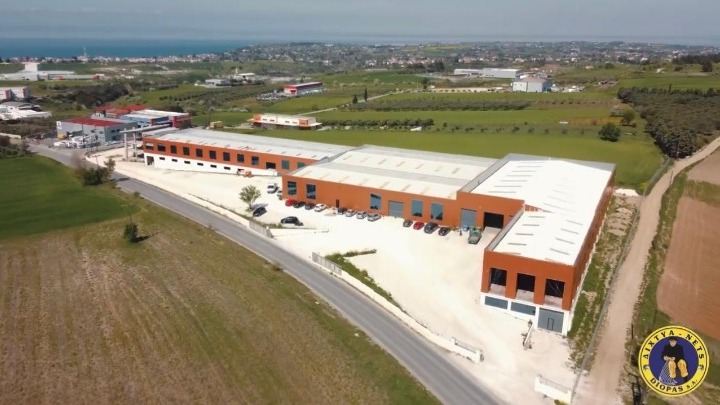
More than 2,000 fish will swim at the bottom of the first private research aquarium being constructed by the North Hellas-based company DIOPAS SA at its new facilities in Nea Michaniona, Thessaloniki, and is expected to be inaugurated in September 2023.
«This is a unique project, which will combine both traditional and modern applied fishing, in the same area, where aquaculture and aquaculture “marry” with the natural environment and recycling,» says the company's Marketing Director and responsible for the project, Magdalene Diamantidou, speaking to RES-MPA, stressing that there is nothing similar in this form within Greek borders or in the Balkan region.
According to Ms Diamantidou, the whole project is currently in its final stage of construction, with the work on 70%, and she notes that the delay in its completion compared to the initial planning is due to the international situation (war in Ukraine and coronavirus pandemic). Regarding the cost of the investment, which is being made with the company's own funds, she notes that it cannot be calculated yet, precisely because of the international situation that is constantly changing.
The marine treasure in 700.000 litres of water
From sea bream, sea bass and bass, to lionfish, sunfish, koi and goldfish -perhaps even piranhas, if they have managed to survive in northern water collections- and sea plants will line the bottom of the private research aquarium, which will occupy an area of 2000 square meters.
The approximately 2000 fish, of which about 25-30 different freshwater species and up to 50 different saltwater species, will swim, according to Diamantidou, in a water volume of 700,000 litres. In fact, the research aquarium will certainly be flanked by five large tanks, but there will also be smaller ones.
It is headed by the fish scientist with a Master's degree and experience in Aquaculture, fisherman by profession (owner of a fishing boat) Fanis Karydas, with a long-standing cooperation in research with the Aristotle University of Thessaloniki and the International Hellenic University.
Specifically, having consulted with the head ichthyologist of the private research aquarium, Diamantidou stresses that it will host (in the fish farming tank) the main aquaculture species of our country. «The endemic fish species of Northern Greece will fill the two large tanks: one with seafood (representing the conditions of Thermaikos) and one with freshwater fish, which will come from aquaculture farms in Northern Greece,» she says.
A number of smaller aquariums will accompany the collection of living beings living in our country, which, as he notes, «come either from migration of species (e.g. Lesser Antillean migrants) or from the release into wetlands of fish from aquariums (e.g. lionfish, sunfish, koi, goldfish, etc.), among which Piranhas (if they have managed to survive in our region's water bodies).
The next step is, he says, to link aquariums with plant breeding (aquaponics). Fish waste is an excellent food for many types of plants, both freshwater (edible vegetables) and seafood (microalgae and macroalgae). The plants retain the nitrogen excreted by the fish from the water and the water can be returned to the fish tanks free of the «toxic» waste.
The technical characteristics of the aquarium and what the fish will eat
For the construction of the research private aquarium, special sealing materials are used to enhance the proper functioning of the tanks and thus the smooth living of the organisms. «The basic material of the aquarium filters will consist of the company's seaweed,» Diamantidou points out, explaining that these are certain pieces of netting that are not needed in production. «We are essentially talking about the leftovers, which we will use as filters for our aquariums instead of using conventional plastic filter filling material,» she explains.
Besides, as he notes, the welfare of farmed organisms is one of the main objectives of the project, as DIOPAS SA strives to be a pioneer in the field of research and development of materials and the biology of farmed organisms, so that the combination of the aforementioned contributes to the best possible result.
The fish will be fed according to the needs of each species and the environment in which they are found. «The fish in the fish farm, for example, are fed with special dry pellet-type food, so it will be the same in the tank, where the representation of IHTHAS will take place in our space. While the “wild” fish of the other aquariums will be fed with natural food (crustaceans, molluscs, invertebrates, etc.), as is the case in the sea and in lakes,» Diamantidou says, having consulted the aquarium's head ichthyologist. The fish that will «swim» in the fish farm tanks «will be sourced from a fish hatchery (the same procedure as aquaculture farms), while the fish in the natural environment will be sourced from fishermen,» she explains.
The idea for the construction of the research aquarium was prompted by the increasing impact of climate change, which makes the protection of the environment more urgent than ever. «Every modern company must have as a key priority the creation of products that respect the environment and contribute to the circular economy,» says Diamantidou.
In this context, he adds, «the basic principle in the creation of the whole project was pioneering research and that's why it will be a research area that can be visited“, as in the five large tanks there will be a representation of IHTHAS, FISHING, the circular economy, but also tests on new nets of the company, giving it the opportunity to strengthen the research character that it has been developing all these years, by creating new and fully controlled areas for the development and testing of its products”.
Non-profit operation of the research aquarium-What is the role of the IHU
The operation of the private research aquarium, which has already attracted the interest of tourist offices of the prefecture of Thessaloniki, will be non-profit and its character will be both educational and touristic. «Profit, in the form of direct financial benefit, is not among the main priorities for the creation of the site,» Diamantidou notes, stressing that «we will be happy if we can use its income to cover the costs of its operation.».
According to her, the site will be open to visitors during the last quarter of the year, while constant upgrades will be made, so that visitors will have something new to see and «learn" on each visit. DIOPAS SA is confident that the site will attract the interest of students, teachers and professionals, as well as ordinary visitors (tourists).
Referring to the company's concession of 500 square meters of land to the IHU, in order to develop a research laboratory that will focus on the study of the marine ecosystem and the “blue” economy, Ms. Diamantidou says that «in consultation with the university, we have jointly decided to bring back to life its unused heritage, namely the aquaculture and aquaculture laboratory of the former TEI of Moudania“.
Much of the equipment of the workshop, as he explains, had remained in Moudania and with the use of the space as a school, the objects were found in «open warehouses» of the municipality. «We collected all the objects that were in usable condition and transferred them to the specially designed area of DIOPAS, and with the drafting of a memorandum of understanding, the workshop will be created, with the responsibility of the professor of DIOPAS, Georgios Minos,» explains Diamantidou.
The old tools showroom
There will also be a special corner in the DIOPAS research aquarium, the old tools showroom. Here, the history of the first people (refugees) who set foot in Nea Michaniona will be revived, with the area now considered the largest fishing village in the Balkans.
«These first inhabitants (our ancestors), who arrived in Nea Michaniona 100 years ago, brought with them fishing techniques. These techniques have evolved over the years and have come to the present day. In our effort to connect today with yesterday, we started collecting objects of daily occupation that they brought with them from their irredentist homelands, which, combined with their knowledge, became the seed for our region to flourish», notes Mrs Diamantidou.
El. Alexiadou