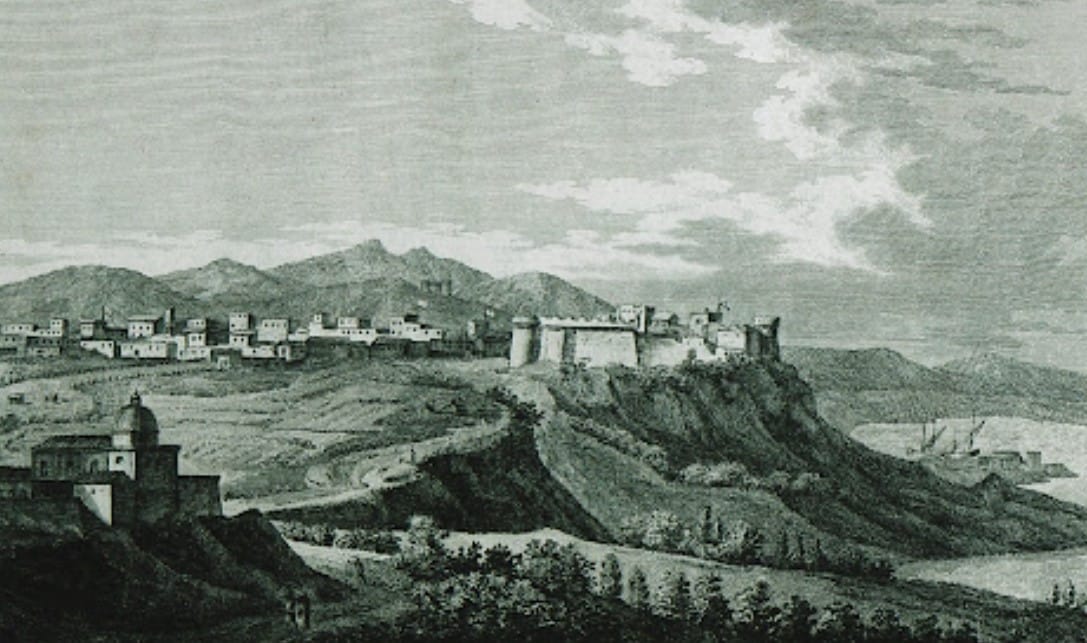
Interesting information about Kythera in the 17th century is contained in an undated and unpublished document in the State Archives of Venice (Senato, Dispacci Provveditorida Terraeda Mar, filza892, a.d.) which is an appeal of its inhabitants to the Venetian Senate. It is an original, written in Greek, but accompanied by an Italian translation prepared as soon as the appeal arrived from the Venetian-occupied island to the metropolis of Adria.
The Kythirians say that although five years before the writing of the document there has been an excise tax on the island, they have been able to pay the taxes to the Venetian fleet with whatever savings they had accumulated in the past, but now there is no money in their country.
Most importantly, however, they were left without seeds to grow, since hunger forced them to consume even those they had saved for sowing. Of course, ships come to the island with loads of grain to sell in Kythera, but the inhabitants have no money to buy.
This leaves the fields untilled and hunger spreads dangerously. Many have left their land in search of better fortune elsewhere.
It is the month of July, the season of threshing, yet they are fasting. There are people who have not eaten bread for four to six days.
The Kytherians who do not want to leave the island remain loyal subjects of Venice and beg the Doge to send them wheat by October at the latest so that they can feed themselves and sow their fields.
Such an action on the part of the Venetians will not be original, since the previous year the foreteller Giacomos Louridanos supplied Kythera with wheat, saving many poor people from starvation. The people of Kythira are therefore asking for alms, placing their hopes for the lives of their children and their own in the care of Venice.
The appeal is signed by 35 men, most of them priests, as representatives of the islanders. Most of the signatures are handwritten.
If the document is undated, we will have to look for internal evidence to date it.
One such is the name of the predictor. According to Charles Hopf (1) Jacopo Loredano q.Bernardino was the governor of Kythera from 2 November 1669 to 3 November 1671.
Another internal element is the reference to the month in which the document was written - “ta da apou was the month of Alonaris”, i.e. July.
The appeal was therefore written in July 1670 or July 1671. However, since there is also the information in the document about the grain that “was given to us by the boss prebendoros Yakomos Louridanos”, we are led from “operisi” (last year) to the dating of the appeal in July 1671.
The Kythirians also say that “there was a five-year simmer where our sowing failed”. We can therefore place the time of the beginning of the tax and the subsequent famine in 1666.
The names of the signatories are as follows: Minas Koroneos, Manuel Logothetis, Dimitris Kal(l)igeros, Michalis Mazarakis, Vassilis Klemmataras, Dimitris Klemmataras, Manolis Fardoulis, Vassilis Prineas, Georgios Megalokonomos, Hieronymos Migoulas (or Magoulas, -according to the Italian translation “Magula”-), Theodoris Psaros, Kostis Karydis, Manolis Karydis, Ioannis Strategios, Thodoris Megalokonomos, Manolis Stratikos, Thanasis Karidis, Michael Lefteris, John Samios, George Kyriakis, Theophanis Semitekolos, Manolis Semitekolos, Theodoros Kasimatis, Theodoros Massellos, Dimitris Massellos, Georgios Stathis, Manolis Kaligeros, Thanasos Kaligeros, Minas Poulakas, Markos Kontoleos, Michael Kastrisos.
Of the 22 different surnames, the following 16 survive to this day in Kythera: Koroneos (in Chora of Kythera and in the villages of Potamo and Agia Pelagia), Logothetis (in Potamos), Kalligeros (in Chora, Livadi, Manitochori, Kapsali, Strapodi and Potamos), Mazarakis (in Chora), Fardoulis (in Potamos), Prineas (in Potamos and Agia Pelagia), Megalokonomos (in Chora, Potamos, Livadi, Kapsali and Ag.(in Chora), Magoulas (in Chora), Lefteris (in Livadi), Samios (in Chora, Livadi, Potamos and Strapodi), Semitekolos (in Chora and Livadi), Kasimatis (in Chora, Livadi, Kato Livadi, Fatsadika, Karvounades, Skoulianika), Portalamianika, Potamos, Kontolianika and Travasarianika), Masselos (in Chora, Karvounades and Kapsali), Stathis (in Chora, Kapsali, Manitochori and Karvounades), Kontoleon (in Chora) and Kastrisios or Kastrissos (in Potamos).
The following 6 eponyms were not found and do not seem to survive in Kythera: Klemataras, Psaros, Karidis, Stratagio, Kyriakis and Pulakas.
In the document there are the signatures of three village representatives, who call themselves “kumessoi” or “koumessoi”, from the Italian com(m)esso: servant, agent, representative of the lower classes; P.Chiotis renders the term “kumessoi” as “sub-attorneys”.
The villages they represent are Potamos, Mylopotamos and Livadi.
Four more “cavos” or “cavos” are signed. In the Italian translation “cavos” or “kavos” is rendered as “Cauo”.
But there is no evidence of a main baptismal name Kavos, Cavos or -in Italian- Cavo. The word could be kavos (gavos): blind or all-seeing. This interpretation may or may not be supported by a handwritten signature “ego kavos Logothetis eva kepa kepa write”.
But the other three signatures of the “cavas” seem to be handwritten. The meaning of “kavos” seems more likely: capo (leader).
The latter view is strengthened by the accompanying word “σκάτρα” or “skarda” or “skarda”: squarda: group. Therefore it is capo di squadra: capo di squadra: team leader of a militia.
It is of course known that in the Venetian possessions military auxiliary corps of local militiamen (cernidori or ordinanze) formed militias (cernide).
The capi di squadra or caporali were platoon or squad leaders. The document's testimony to the existence in Kythera in 1671 of at least four platoons or groups of militia leads us to the conclusion that there was a centuria (centuria), which should have been commanded by a centurion (capo di cento), probably a Venetian captain (capitano).
The existence of militias on the island is attested about a century earlier, in a report (1563) by a Venetian official, according to which Kythera had a militia of 150 men.A short time later, Giacomo Foscarini (1577) also mentions the Kytherian militia.
The Italian translation of the appeal has some differences from the correct rendering of the Greek text. The most important difference is the rendering of the passage “kathos and the vera estatema fidelizimos”, i.e. “as in truth, we have been faithful (subjects)’. The Italian translation has ”come semo statti nella guera fidelissimi“.
The reference to the guerra, i.e. the Cretan war (1645-1669) -which ended two years before the writing of the appeal-, does not correspond to the spirit of the Cypriots. Perhaps the translator was carried away by other appeals with references to the war.
It does not seem that the famine on the island was due to the arrival of many Venetian and Cretan refugees immediately after the surrender of Chandax to the Ottomans. Indeed, it is surprising that Cretan refugees, mainly families of Sfakia, emigrated to Antikythera, an uninhabited island at that time, a refuge for pirates and a habitat for savages.
The Cretan refugees in the rest of the Ionian Islands are of course well known. But why did they avoid Kythera as a place of permanent refuge and settlement? Of course there are testimonies of Cretan refugees in Kythera, especially after the occupation of Chania by the Turks (1646), but it seems that the island served more as a station of transit to other, more prosperous and happier Venetian-occupied areas.
The same happened in 1666, when families who left the outskirts of Kissamos and arrived in Kythera were promoted from there to Zakynthos.
The island of Kythera, arid and barren, was not suitable for permanent settlement. In 1540, after the fall of Monemvasia, Archbishop Mitrofanis prevented the inhabitants from moving there (“and not to Kythera, because the place is dull and stony and stony and thirsty...”). The inherent and endemic aphorism, combined with a possible prolonged drought, created conditions for the occurrence of famine.
Immediately after the fall of Chandax (1669) there was no great influx of refugees in Kythera. Perhaps they were aware of the famine that plagued the island. Besides, the Kythirians mention in the appeal that many of their compatriots were leaving the place in search of better fortune elsewhere. Therefore, the responsibility of overpopulation in justifying the famine must be excluded.
The fact remains that the more the Ottoman rule was established in Crete, the more its inhabitants emigrated to other places. Indeed, a large number of Cretan refugees fled to Kythera in the years 1673-1731, but also later, as Chrysa Maltezou has shown.
The exceptional cases of the Cretans Andreas Hortatzis and Constantine Mousouros (1666), as well as the priest Kallistos Grigoropoulou (1671), may confirm the view that especially in the years 1666-1671 the number of Cretan refugees who settled permanently in Kythera must not have been large.
However, because it is possible that for some reasons the Kytherians in 1671 did not write the truth about the abandonment of the island and the consequent decrease in its population, we are obliged to look for population data in other sources.
So we find, starting two centuries before the appeal, that around 1470, as Giacomo Rizzardo mentions in his chronicle of the fall of Chalkida, Kythera had 500 inhabitants.
In 1544 according to the French traveller Jerome Maurand the island was uninhabited. However, one year later (1545), the population of 1,500 or 1,850 people was recorded and in 1553 3,300 In 1563, according to the report of the Venetian official, Kythera had 3,000 inhabitants In 1577, according to the report of Giacomo Foscarini, the island had 2,405 inhabitants and one year later 3,262.
In 1579 (or 1583), according to information from Giovanni Gritti, Giulio Garzoni and Peter Castrofilakas, there were 3,162 people living there and in 1589 4,173. In 1590 there were 4,000 inhabitants, in 1620 7,500, in 1724 5,864.
In 1733, according to various sources, the population was about 5,000 inhabitants (4,921 to be exact) and in 1753 it was 5,386. In 1760, according to a Venetian census, the population of Kythera was 6 180 people.
The above figures do not allow us to draw any firm conclusions, which would certainly be possible if there were sources on the population of Kythera in 1666-1671.
However, any reservations we may have about the charity of the appeal are removed by information that towards the end of the 17th century and the beginning of the 18th Kytherians emigrated to Nafplio (44), Samos (45) and Thyateira (Axari) in Asia Minor.
The Cypriots' appeal to Venice for a shipment of wheat was about to add another headache to the decision-makers of the once glorious colonial state. The southernmost Ionian possession seems to have been loss-making from an economic point of view: in 1690 the annual income of the Venetians from Kythera amounted to 2,735.10 reals, while their annual expenses for the maintenance of this colony were estimated at 3,414 reals.
That is, there was a liability of 678.90 reais. It is worth noting here that it was financially unprofitable for the Venetians in the years of the Cretan War to maintain their only Aegean colony at that time, Tinos, even if the latter later covered its deficits temporarily thanks to the tax it managed to collect from the Turkish-occupied Mykonos.
The famine that struck Kythera in 1666 and continued through July 1671 was neither the only nor the first on the island. A century or so earlier, in 1562, the Kytherian peasants had also been struck by famine, which caused many deaths. The impoverished survivors were preparing to flee with their families to the Turkish-occupied Peloponnese across the road. It seems that this famine was also a consequence of the frequent raids on Kythera by Muslim pirates.
The question remains: Did the famine end in October 1671, with the willing and prompt shipment of food - especially cereals - from Venice, or did it continue in the following years? The lack of relevant sources and subsequent information does not allow us to come to a definitive answer, either in the affirmative or in the negative.
However, the evidence that in 1671-72 there was a famine in Zakynthos, Kefalonia and Corfu helps us to draw some possible conclusions. That famine was probably not unrelated to the number of Cretan refugees who fled to these islands after the fall of Chandax.
Thus the Venetian state had to face not only the problem of grain supply, but also the problem of hunger in its Ionian possessions as a whole. It would seem, therefore, that the unfortunate Kytherians were not soon and easily relieved of their torturous problem. Thus, as a final conclusion, the end of the famine in Kythera should not be placed before 1673.
THE GREEK PROTOTYPE OF THE CHURCH
ASV, Senato, Dispacci Provveditori da Terra e da Mar, filza 892, n.d. Kythera [July 1671].
The version is paleographic
O our beloved, we the fat feet of Giriu with the tears of our eyes come with the knees of the earth with the head, calling for alms, for though it were five years' time that our seed failed and we did not sow, and though we should wash the brow of our most gracious mistress, and though we should wash the wax of our past wax, yet were they the armada of these parts, I praised the bells with the soles that they had left in the place, and only by coming from other lands, having no means to buy it, the swine stayed from year to year in the wilderness, and I have not been able to buy it, and I have not been able to find it; and I have taken great care to save the death of the hen, and the day of her death a crib was raised, to keep the city from the dreaded month of the Alonar to die in the dead of days and days; and it is better to die of the sword than to flee from the jealousy and the wanderings of a man so wicked, that we may ask the bishop to give us the best of the best until the month of October to eat and house our children to fight the new, ...which every one hath given us, and our master, the prebendary Yakomos Louridanos, hath given us, who, like our beloved hercules, after a wreath (55), governed the whole of us, who came to his rescue and lived happily from death, without God's help, and depositing on the head of our beloved master our hopes, our life, our field and our right to the end, we ask for mercy:
† I, Father Minas Coroneos Koroneos, the cousin of Potamos, ask for a liberation
† I, Father Manul Logothetis, with my parishioners, ask for eleemosynary
† I am the king of Milopotamos, the stork of the anointed
† ego priest Demetris Kaligeros document for the Michalis Mazaraki cemetery of Lebados zitatis what is merciful
† ego papa Vassilis Climataras and pneymatic with my neighbors we live in Leymosini
† ego Father Dimitris Klimataras with my parish we live in Eleuthera
† I, Father Manolis Fardoulis and my parishioners ask for mercy
†a little horned Logos I put it on with my shit and ask for liberation
† ego father Vassilis Prineas with my parish we ask for a mercy
† ego Father George Megaloconomos with my parish we ask for liberation
† ego kavos lourdes with my shit we are asking for a lemon
† ego Father Minas Koroneos with my parishioners we ask for a white man (hymn)
I, Father Geronymus Migoulas, with my parish zit(u) mr. leimosini
† ego priest Theodore Fisherman with my parish zit(u)m with albumin
I'm a good Karidian with a good heart, and I'm looking for an elephant in the room.
I, Costis Karidis Karidis, the cowboy, with what scandal we ask me for a smile.
I'm Father Manolis Karides and my parishioners are asking for a lemonade.
† I am Father John General with the parish we ask for mercy
†Holy Father Thodoris Megaloconomos with my parish we ask for a lemonade
My dear Father Manolis General, with my parish, I ask for a lemon.
† I am Father Thanasis Karides with my daughter asking for mercy
† Ego Papa Michael Leftheri St.
† I am Father John Samios, a priest who has been raised with my parish
† I priest Ioanis Samios {ar} stergus {ro} the upright
† I, Father George of Ciriacus, steward of my parish
† I, Father Theophanis Simitekolos, I stand as a godless man
† I, Father Manolis Simitekolos, I am the upright man
† ego Father Theodore Casimatis star anethos
† ego father Theodore Maselos storgos anotheos
† ego papa Dimitris [sic] Maselos sternos t’ anotheos
† ego papa George Stathis storgo the anothe
† me father Manolis Kalygeros father of the gods
† ego papa Thanatasios Galingeros star f upwards
† I? priest Minas Poulakas I am a priest of the priesthood
† Father Marcos Kontoleos solidify the tannothe
† ego Papa Michael Castresos storgos anothe
Ioannis D. Psaras, University of Thessaloniki