Zissimos X. Synodinos, Historian - Archivist
Historical Archive of the National Bank of Greece
Economy and strategies of banking capital in the Ionian Islands.
H International Panhellenic Conference, Kythera, 21-25 May 2006
Introduction
From the middle of the 19th century, the Ionian Islands were a field of intense competition between the then largest banks, the National Bank and the Ionian Bank, due to the economy of the islands, which was mainly due to the export of their commodity products, raisins, oil and wine, to the major economic centres of the East and West, and to the concentration of capital from shipping[1]. Shortly afterwards, with the concomitant flourishing of viticulture, the quantitative increase in the export trade of the Ionian Islands and the further development of their economies[2], interest would also be shown by various circles of capitalist-bankers of the expatriate community. But no one will then be able to damage the dominant position of Ionian in the region, which, equipped since the time of the British Empire with the publishing privilege, had established branches in the three largest lucrative islands, centres of export and transit trade, successfully developing commercial and agricultural credit, intervening dynamically in the developed networks of merchant-traders and setting interest rates at a reasonable limit.
Naturally, the banks' interest and ambitions were focused on the exploitation of the markets of the three or four largest islands, where their considerable agricultural production and their consequent commercial activity could justify similar investments of bank capital. Nor, however, can the small, almost insignificant markets of the smaller or barren islands, such as Ithaca, Paxos and Kythera, be mentioned. Here the well-known traditional relations of lending and subordination and dependence of the rural population on wealthy landowners and merchants continued to exist.
«After the Union... the incomes of the inhabitants of the island -writes a Cypriot scholar- were always limited, so that the inhabitants were unable to meet their expenses, and therefore most of them were forced to take out loans from local brokers with heavy interest. Bank branches are not yet operating in the island. Such a burden caused economic hardship, the State was poor and, with the public finances under pressure, it was not possible to relieve the people financially through agricultural policy and public works...’[3]
However, at the beginning of the 20th century, with the revival of the issue of bank operation in the Ionian Islands, the National Bank, after many years of persistent efforts, succeeded in establishing its presence in the region, establishing branches in the capitals of the seven islands, gradually marginalizing Ioniki.
During the interwar period other financial institutions would penetrate the Ionian market mainly to benefit from the accumulation of idle migrant capital and foreign exchange, but most of them did not allocate resources to strengthen the productive agricultural sector.
We will attempt to present the banking activity in Kythera and its impact on the local economy from the beginning of the 20th century until the Second World War, focusing mainly on the activities of the National Bank through primary data from its Historical Archive, the most important financial archive in Greece, which documents the long history of the first credit institution of the country from its foundation in 1841 until today. For the most part, the critical material focuses on the annual accounts of the Bank and the official reports of the inspectors of the local Kythera branch for the period 1905-1939[4].
The expansion of the National Bank of Greece in the Ionian Islands
At the beginning of the 20th century, at a favourable juncture for the financial sector, the National Bank emerges strengthened through the procedures of the International Financial Control, constituting a powerful institution in the country's economic and political system, which is transformed to respond effectively to the new realities of the Greek economy. With a significantly reduced burden of public debt on its assets and with increased liquidity, it is in a position to allocate more resources to finance the economy, to complete its expansion in the Greek periphery, to intervene dynamically in the foreign exchange market, to impose its banknote and to compete in all areas with other commercial banks[5].
In this context, in 1905, after forty-five years of efforts, he succeeded in establishing himself in the Ionian area[6]. However, in exchange for the acquisition, from 1920, of the exclusive privilege of circulating its banknotes throughout the Greek territory, it was obliged to set up branches on all the islands, even on the less lucrative ones. According to the law VOX/17.3.1903[7], which resulted from the contract between the Greek State and the Hellenic Bank of Greece of 28.2.1903, branches were established in 1905 on the six islands, since the Bank had already been operating a unit on Lefkada since April 1900[8].
On 1.7.1905 the branches of Corfu, Kefalonia, Zakynthos and Kythera were inaugurated, while from 22.10.1905 the branches of Ithaca and Paxos were opened[9].
The establishment of units in the capitals of all the islands is an important step in the expansion of National Bank in this rural region, in a period of generalised crisis where agricultural production, crafts and trade in the Ionian Islands are being severely affected by the sharp fall in the prices of agricultural products. The Bank will strengthen the local economy by expanding its core activities: commercial and agricultural credit, interest-bearing loans and lending to public and municipal entities. However, this expansion will vary from island to island and will be based on the adoption of specific criteria linked to local economic, commercial and agricultural specificities and the behaviour of individual customers. Its presence will inevitably be linked to an increase in the inflow of money into the region, the strengthening of rural credit and support for certain development projects currently being undertaken by the municipalities and port funds of the larger islands (paving of roads, construction of new ports or enlargement of old ones), although the evidence shows that the National Bank is looking not so much to agricultural lending and the support of traders and producers, but rather to the exploitation of the current economic environment (commercial and maritime traffic, the influx of large amounts of migrant remittances to the islands, relatively high deposits, abundant foreign currency, etc.).) in the circulation of its banknotes and the modernisation of credit relations.
On the other hand, the competitor Ioniki no longer had any desire to expand in the region, since it saw its profits diminishing and its great prospects opening up further east, in British-occupied Egypt.
Productive activity and socio-economic structure in Kythera
Until the Second World War, agriculture continued to be the main sector of the Ionian economy, with the development of which the commercial activity both within each island or between the islands, as well as with the nearest mainland Greece and with the major economic centres abroad, was linked.
Kythera, a rocky and mountainous island with many valleys, limited and fragmented arable land, lacked the production of noble exportable products, raisins and wine, whose increased external demand gave the special tone of development to the larger islands. With a low yield per hectare and low production of agricultural and livestock products (oil, wine, cereals, fruit and vegetables, fruit, sheep and goats, etc.), the islands were the main source of demand for these products.), without shipping, somewhat isolated, located on the edge of the Ionian islands, far from the established sea routes and the main trading centres of the Ionian Sea; without a significant port, they were inaccessible not only for large European merchant ships but also for domestic sailing and steamships.
Until almost the end of the 19th century, the total agricultural production with the seasonal work of the inhabitants outside the island tended towards self-sufficiency, while its small commercial activity was related to the import or disposal of essentials and clothing, as well as to the export of mainly the surplus of oil, some fruits (almonds, figs), and a few thousand small and large animals. However, it was precisely at this time that the exhaustion of the margins for the expansion of the cultivated area, the fall in the prices of agricultural products, the increase in population and the large overseas exodus led, in combination or individually, to a vertical decline in all primary production activity on the island. In the 20th century, the only product that was relatively abundant was good quality oil (around 350,000-400,000 ounces per year on average), the surplus of which (one third of production) was sold on the Piraeus market[10], since only Corfu, Kefalonia and Zakynthos, which had significant production, large ports and permanent trade, were able to secure large foreign markets. The island's artisanal-industrial infrastructure, which until World War II included two dozen mills and flour mills, a soap factory and a pottery, is also characterized as rudimentary.
As far as the survival of the inhabitants was concerned, the produced semolina (mixed wheat and barley) and the other cereals were no longer sufficient for their diet. So every year about 450,000 ounces of flour were imported. Colonial, pulses, rice, textiles and other essentials, food and clothing were also imported.
In 1930 the distinguished scholar, editor of the Kytheraic Inspectorate and Headmaster of the Kythera High School, Spyridon Stathis, pointed out in the Great Greek Encyclopedia that «the island has become self-sufficient in no agricultural product except oil and almonds, and hardly any wine...»[11].
It was also common for residents to find seasonal work on the nearest coasts of the Peloponnese, Crete or the coast of Asia Minor. The same was true of emigration and the significant overseas exodus, which marked the economic and social structure and the general development of Kythera, perhaps more than the rest of the Ionian Islands. The once thriving Kythirian colonies in Smyrna and Egypt are well known, as are those continuing the tradition in the USA and Australia, while by the end of the 19th century several Kythirians had settled permanently in Athens and Piraeus[12]. And while the other islands experienced a population recovery after 1922 until World War II, Kythera continued to experience negative rates. In fact, the population depopulation of the island has continued strongly until our days[13], while in 1940 the island's permanent residents had already decreased by 40% approximately since the beginning of the century. (Total population of Kythera based on the official censuses of the Greek state, 1896: 12.306 inhabitants, 1907: 13.112, 1920: 9.702, 1928: 9.092, 1940: 8.178 inhabitants).
In terms of its socio-economic structure, the island is characterised by the fragmentation of property (small agricultural plots) and systems of varied cultivation of the land for greater self-sufficiency. Despite the survival to a certain extent of certain elements of the past, such as the system of peasant contracts, which forms a pattern of dependency-subordination relations between farmers and rich landowners[14], the sloping, uneven and rocky terrain of the island generally did not favour large-scale ownership, while the new socio-political conditions after the Union, the population exodus, the resources of migratory foreign exchange that had been flowing in since the beginning of the 20th century, combined with the urgent needs of self-consumption and the traditional, «primitive» way of exploiting the land, contributed to the development and expansion of small property.
«The territory of these islands -writes in his report on Kythera and Antikythera, in 1923, the inspector of the National Bank N. Drepanopoulos; is rather rocky and dry except for the centre of the island of Kythera where the existing relatively extensive plateaus and valleys are cultivated. This cultivated area amounts to approximately 35,000 to 40,000 acres, all of it privately owned in sections of 3-30 acres... There are no bare land margins because, thanks to the avarice of Kytheria, all arable land has been used...»[15]
We also rely on the authoritative opinion of Spyridon Stathis, who pointed out in the early 1930s:
«...The great majority of the inhabitants is a petty bourgeois population, having some property. By the income of this property and by their personal work, consisting in the cultivation of the land or the practice of a certain craft or profession, this population is more or less self-supporting. Many families, instead of working to supplement the income from their property, receive from their emigrant members remittances from abroad, with which they are supported without working. There are only a few middle-class people who can live comfortably on the income from their property, having acquired their property abroad for the most part. There is no great bourgeois in the island. There are also few landless (proletarians), who live only by the work of two hands or by the work of their minds. Of the 2 000 families on the island, about 1 700 belong to the middle class, 200 to the middle class and 100 to the landless...»[16]
In general, the economic development of the island in the 20th century is inextricably linked to the overseas exodus, immigration to the USA and Australia. The incoming remittances, «due to the frugality of the inhabitants and their predominantly savings spirit’, brought economic relief, helped to pay off old debts, release mortgaged property, buy farms from landless villagers, upgrade the residential area, while part of the cash flow was invested in public infrastructure projects: road construction, construction of schools, municipal buildings, etc.ά. This led to a great improvement in the living standards of the inhabitants, which, combined with the new ideas brought by the returnees, contributed to a certain extent to the modernisation of the local society and the emancipation of the villagers.
The activity of the National Bank of Greece in Kythera
The unit of the National Bank of Greece in Kythera was founded at the very time of the immigration boom. It is located in Chora of the island and from the very beginning it is managed by Dionysios Kaloutsis, an important personality who for about twenty-five years sealed the work of the local branch with his presence.
Coming from «one of the oldest and most cultivated families of the island», honest, intelligent and active, a perfect connoisseur of the people and things of his region, due to his previous successful career in the medical profession, he managed with his diligence and his prestige to contribute to the economic strengthening of his place. The Bank's strict inspectors even attributed to him certain official, banking «deviations»: for overdrafts on agricultural credits, tolerance of late payment of instalments of agricultural loans (but creditworthy creditors), not charging them with expenses, etc., behaviours that were undoubtedly related to his good intentions, the business manners and the psychology of his compatriots.
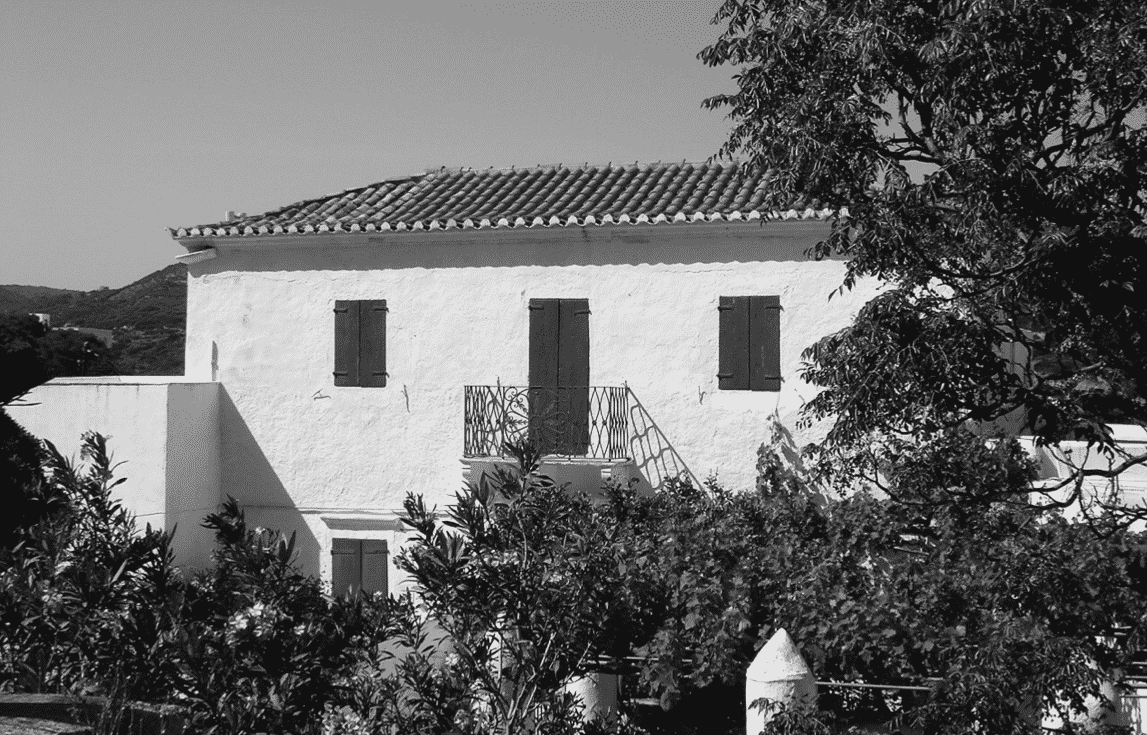
The large house of Dion. Kaloutsis' large house was rented by the National Bank of Greece to house the branch, while the Director was accompanied by a three-member Council consisting of the branch's legal adviser, the local notary and a landowner[17].
The regular administrative audits of the regional units of the Bank of Greece by experienced members of the Inspection Department have left a rich material with valuable data on the economy and society of the Greek province in the 19th and 20th centuries, since the Bank's inspectors did not limit themselves to a formal presentation of the financial results of each branch, but recorded the «composition of the economic forces of the region» and the general «plutological situation» of the area under their jurisdiction. In fact, from 1911 onwards, during the administration of Ioannis A. Valaoritis, a thorough assessment of the country's agricultural production began, with information gathered by the Inspection Department from reports of inspectors and unit managers, even before the state started official agricultural censuses[18].
Examining, through the annual Balance Sheets and the official reports of the inspectors of the H.T.E., the evolution of the operations of the local branch of Kythera in the period 1905-1939, we observe:
- The branch's asset operations remain at low levels: commercial discounts range between 0.5-3.5% of the total discounts of the ETE in the Ionian Islands, while loans to farmers range between 1-15%. In general, the Bank's placements on the island never exceeded 2,4% of the total credit allocated to the Ionian Islands during this period, in a population that represented on average 5% of the Ionian Islands. This figure actually started from much lower rates, around 0,61 TTP3T, after a period of increase from 1920 onwards. it fell even further, to around 0,51 TP3T, only to remain at a level of «unimportant locations».
- No movement is observed in the branch for loans to Municipalities, port funds, legal entities etc., an account that in the first twenty years of the 20th century shows a remarkable movement in the Ionian Islands (about 5 million drachmas) or loans to agricultural cooperatives, after 1915, since in Kythera, due to the small cultivation needs of the inhabitants, the cooperative idea did not develop[19].
- The liability operations of the branch (demand deposits, savings, foreign exchange, interest-free deposits) show an increasing movement, from 2.2% in the whole Ionian Islands in 1906, they exceed 8% in 1927, while in 1921 the Kythirians hold more than 10.3% of the National Defence promissory notes purchased in the Ionian Islands.
- Intermediary operations (capital transfers, payment of foreign exchange cheques, placement of government securities, drachmaization of foreign currencies, etc.) have been remarkably active over the years, although after the great economic crisis their intensity has been falling.
The factors associated with the specific developments in the previous figures are multiple, while any delays in commercial discounts and agricultural lending as well as the forecast for the next harvest played a minor role in the branch's positions.
Towards the end of the second decade of the 20th century, several families of the island, having secured a comfortable living from the interest-bearing investments and other income from the surplus money earned through the hard work of their members in the U.S.A. and Australia, with the desire to «create a more peaceful and artistic life», they abandoned the systematic cultivation of their land, preferring «to work it as an amateur and only for the sake of meeting family needs as far as possible’[20].
The slow capital and increased liquidity on the island is largely due to the low absorption rate of the agricultural placements of the local branch of the E.T.E., which is now facing private competitors. We mention that in 1921 the branch's approved credit list, which concerned the merchants of Kythera, included 38 creditors with a total credit margin of 618,000 dirhams, of which 167,000 dirhams had been absorbed, i.e. only 27%. In the corresponding list of farmers the situation was worse: while there were 1,136 beneficiaries with a total credit of 807,700 dirhams, the amounts granted were limited to 42,738 dirhams, i.e. only 5,31 TPR 3 000 of the credits to be allocated. In 1923, too, of the total approved amount of 714,000 dirhams for trade, 221,000 dirhams had been allocated to merchant creditors, while only 24,000 dirhams out of the 730,000 dirhams available were allocated to farmers.[21]
«It is a fact -writes in his report the N. Drepanopoulos, inspector of the National Technical Inspectorate- that the discrepancy between the authorised credits and the current allocations must be attributed to the fact that both traders and farmers, in particular, do not seek to borrow because of their financial soundness, which completely covers the limited needs of their otherwise small turnover. Therefore, when exceptional cases of cash flow difficulties arise for some of them due to the purchase of land or more intensive cultivation, which has rarely happened since 1911 and onwards, they are covered by loans from wealthy peasant borrowers in one signature and at an interest rate of 5 to 6% per annum...’.»[22]
The inspectors« reports show their anxiety as to how the Bank will respond more fully to the real needs of the local economy and the creditworthiness of the producers of the region, e.g. by renewing the credit lists, so that in this difficult phase »even the rare synchrotism of farmers towards the Ministry does not cease". They count on the upgrading of the credit role of the local unit, even if only temporarily, since they foresee that even wealthy farmers, due to the investment of their surpluses in futures, could face occasional liquidity problems[23].
The above shows that sometimes at the level of the small geographical area there is no reluctance, refusal or inability of the Bank to allocate resources, due to the large absorption of resources by the Greek state, as has been written by some scholars[24].
From 1918 the local branch of the National Bank of Greece gradually became a unit of passive operations (deposits), earning profits almost exclusively from certain intermediary operations such as payment of foreign cheques, capital transfers, purchase of foreign currency, etc.
A decline in the total agricultural production of the island, including olive oil production, due to the abandonment of crops. No cooperative movement either.
The temporary shortage of labourers was covered by the refugees who settled on the island after the Asia Minor catastrophe and tried, without success, to introduce tobacco cultivation on the island.
The taxation of interest on deposits turned residents to investing their cash in treasury bills or national loan bonds, which at the time had a higher yield. In 1923, Kytherians held treasury bills worth about 5.5 million drachmas.
The foreign exchange market shows remarkable movement. At first it is largely controlled by the local branch of the ETF, later, with the increase in inflows and the rapid rise in the price of foreign exchange, commercial agents of other banks (Commercial, Industrial, People's, Anglo-American, National Economy) and various speculators who offered better prices, but mainly the intervention of the Bank of Athens, which established an agency in Potamos in 1924, limited the profits of the National Bank in this lucrative field.
In fact, the competitors Bank of Athens and Anglo-American with agencies in Potamos (which had become the largest commercial centre of the island due to its location, its Sunday trade fair and its proximity to the bay of Ag. Pelagia, while Chora was gradually declining), attracted the most deposits in foreign currency, since they were able to send it abroad, while the branch could not issue cheques «abroad».
The Bank of Athens was also the great competitor of the E.T.E., the first modern large deposit bank, which attracted a large part of the private deposits nationwide, including immigration surpluses.
By 1931 the local branch of the National Bank of Greece managed to triple its deposits; the fall of the Anglo-American and Thessaly banks contributed to this, while the newly established agency in Potamos contributed to a further concentration of private deposits, so that in 1935 the National Bank of Greece had a share of 70.7% of the total deposits of the island, which were estimated at about 70 million drachmas.
Then we have the peak of the island's economic prosperity («the most cultivated economic period until then»), with a remarkable accumulation of resources, unfortunately inactive[25].
After 1931, due to the international crisis, the rhythm of incoming resources from migrant foreign exchange is halted.
But the speculative activity with the foreign exchange of the small banks of the interwar period did not leave the small market of Kythera unaffected. Several inhabitants of the island saw their savings disappear along with the failing banks, such as the Anglo-American (1924-1929) and the Bank of Thessaly (1921-1929). According to one information, only the collapse of the Anglo-American bank resulted in the loss of 5 million drachmas or 12,500 gold pounds[26].
The inspectors do not fail to refer sometimes to the work of feeding the population undertaken by the local branches of the National Bank of Greece between the wars, as in 1923, where they point out the renting of an additional warehouse in order to better ventilate the flour sacks and their timely distribution to the communities of the island in order to avoid deterioration of their contents[27].
Undoubtedly, the presence of the National Bank of Greece in Kythera contributed decisively to the modernization of credit structures, the expansion of trade and monetary circulation and the general economic development of the island during the first ten years of operation of the local branch, despite the relatively limited financing of the productive sector of agriculture, while from 1918 onwards it facilitated the utilization of the accumulated idle funds from emigrant foreign exchange. Thus the Bank's unit in the island's capital, together with the Agent's Office in Potamos from 1932, was gradually transformed from a productive unit into a depository «for the servicing of capital not involved in activity and of no use to society», channelling the inflows from the migrant currency to other areas outside the island.
[1] On the subject see in the more recent studies, Evangelos Prontzas, «Banking Law and Capitalists in the Ionian State (1833-1864)» in the Centre for Ionian Studies, The Ionian State, 1815-1864. Proceedings of the International Symposium (Corfu, 21-24 May 1998), ed. Philip L. Cottrell, «FoundingaMultinationalFinancial Enterprise: IonianBank, 1833-1849» in Kostas P. Kostis (ed.),The Creators and the Creation of Banking Enterprises in Europe from the 18th to the 20th Century,Alpha Bank Historical Archives, Athens 2002, pp. 57-128. Also Th. Ioannis A. Valaoritis 1855-1914. Governor of the National Bank of Greece 1911-1914, Athens 2000, pp. 47-57 and Zisimos Ch. Synodinos, «The union of the Ionian Islands with Greece and the credit system. The competition between the banks of Ethniki and Ioniki in the 19th century» in the proceedings of the Conference, forthcoming. The union of Ionian Islands with Greece, 1864-2004, organised by the Academy of Athens and the Library of the Hellenic Parliament in February 2004.
[2] The three largest islands, Corfu, Kefalonia and Zakynthos, which are the critical size, are usually counted, with Lefkada being a secondary island and the other small islands being very few.
[3] Ioannis P. Kasimatis, From the old and modern Kytheraic life. Legends, traditions and chronicles of the Kythiraean people, Athens 1957, p. 188.
[4] Historical Archive of the National Bank of Greece (I.A./E.T.E.), A1Σ4Y1, Hellenic Accounts E.T.E. and A1S29Y2, Branch inspectors' reports.
[5] See. Christos Hadjiyossif, «The Belle Époque of capital», in. History of Greece in the 20th century, vol. Α1: The beginnings 1900-1922, Athens [1999], pp. 319-320. Kostas P. Kostis, with the collaboration of George Kostelenou, History of the National Bank of Greece, 1914-1940, National Bank of Greece, Athens 2003, pp. 45-50, 72-73 etc.
[6] A first attempt to establish a branch of the E.T.E. in Corfu (1872-1881) was abandoned due to poor results, see. Ioannis A. Valaoritis 1855-1914, op. cit., pp. 50-51.
[7] See. Government Gazette A no. 45/ 17.3.1903, pp. 101-104 and National Bank of Greece, Account of the year 1903, Athens 1904, pp. e'-iv'.
[8] The establishment of a branch of the National Bank in Lefkada in 1900, on an island where the competitor Ioniki had not developed, was due to an initiative of the Lefkadian Ioannis A. Valaoritis, then deputy governor of the National Bank of Greece.
[9] I.A./E.T.E., A1S5Y1B27, E.T.E., Collection of the Circulars to the Branches of the year 1905, Athens 1906.
[10] Of course, this quantity was insignificant compared to that of the four large islands. Around 1920, the inspectors of the H.T.E. recorded an annual average production of oil in octaves, Corfu: 15,450,000 octaves, Kefalonia: 1,200,000, Zakynthos: 1,100,000, Lefkada: 1,040,000. It should be noted that olive oil production, which is one of the most vulnerable, varies greatly from year to year: an expected good harvest could soon turn out to be very poor. Oil prices were just as volatile. The reduction of the risk of falling prices was due, among other things, to the establishment of important soap factories in the Ionian Islands.
[11]See. Sp. Stathis, Kythera. Pour in the Great Greek Encyclopedia of Pavlos Drandakis, vol. IV, p. 340.
[12]«The disproportionately disproportionate to the number of Kytherians the cultivable area of the island, reports the inspector of the H.T.E. Angelos Pallis in 1921, forced them from ancient times to migrate to the nearby countries of the Peloponnese, Crete, and even Asia Minor, where they offered their labour during the seasons of cultivation and harvesting of agricultural products, returning to their own country after the end of their agricultural work with a small stock of money to cover the deficit of their unfavourable trade balance. The above mentioned periodic annual emigration of the Cypriots was transformed into a strong current of emigration to America and Australia from the year 1900, which until today has carried over 10,000 Cypriots to the vast working field of the New World and about 3,000 to Australia.
The new phase of the appropriate use of the surplus labour force of the island, consolidated by the immigration to America and Australia, changed the economic situation of the island for the better, as the balance of trade of the island became very favourable due to the considerable remittances from America and Australia in relation to the population, and the economic distress of former years has been replaced by economic comfort, manifested in the very marked improvement in the economic conditions of the inhabitants» lives, as evidenced by their good diet and the considerable sums allocated for deposits...", I.A./E.T.E., A1S29Y2F59, Branch inspectors' reports, Report of the inspector of Kythera, Angelos Pallis, 28.5.1921. See also Michael K. Petrochilos, History of the island of Kythera, Athens 1940, pp. 98-99, 114-116.
[13] See. Georgios K. Giagakis, The prominent polynosa of Kythera and Antikythera. (The place - the depopulation - the pollution), Tinos 1994, pp. 11-13.
[14] The work of Professor George Leontsinis remains a classic on the subject. The Island of Kythera: A Social History (1700-1863), Athens 1987, as well as his study «Structure and function of agricultural and other contracts in Kythera (circa 1700-1863)» in Georgios N. Leontsinis, Issues of Ionian social history, Athens 1991, pp. 183-225.
[15] I.A./E.T.E., A1S29Y2F66, Branch inspectors' reports, Report of the inspector of Kythera N. Drepanopoulos, 10.5.1923.
[16] See. Sp. Stathis, Kythera, op. cit., p. 341.
[17] Among the long-term members of the Council of the Branch we mention the legal adviser, lawyer Hieronymos S. Stai (1905-1923) and the landowner Antonios D. Kasimatis (1907-1923).
[18] Cf. Administrative Circular 96/3.12.1911 to I.A./E.T.E., A1Σ5Y1B42, Collection of Circulars of the H.T.E. to all the Branches in 1911. Also see. Zissimos X. Synodinos, «The contribution of Ioannis A. Valaoritis to the reorganization and strengthening of the National Bank of Greece» in the proceedings of the interdisciplinary conference in Lefkada in September 2000. Ioannis A. Valaoritis, Governor of the National Bank 1911-1914.
[19] We mention indicatively that in 1927 about 60% of the credits in the Ionian Islands concerned loans to cooperatives, mainly in Corfu.
[20] See. I.A./E.T.E., A1Σ29Y2Φ66, op. cit.
[21] The accumulation of money, the impasse of its investment in the narrow productive environment of the island and the abstention of the inhabitants from bank lending forced the inspectors to speak of «the necrosis of the positions of rural credit» in Kythera.
[22] I.A./E.T.E., A1Σ29Y2Φ66, op. cit.
[23] Cf. I.A./E.T.E., A1S29Y2F69, Branch inspectors' reports, Report of the inspector of Kythera N. Drepanopoulos, 5.7.1924.
[24] Cf. Kostas Kostis-Vassia Tsokopoulos, Banks in Greece 1898-1928, Athens 1988, pp. 60, 75 etc. Of course, on a more general scale, the large funds that the National Bank committed in credit to the Greek public sector in certain critical phases of the national economy often did not allow it to expand as much as it would have liked in long-term placements to the private sector.
For example, in the five-year period 1922-1926, in order to contribute to the country's return to a normal political and economic life, the National Bank of Greece had immobilized in favour of the State, in the form of temporary advances, short-term loans and payments of maturing promissory notes, an amount of 1,594,000,000 drachmas. In the 1930s, the amount invested by the Bank in national loan bonds and Treasury bills increased further to reach, in 1939, 2,879,116,000 drachmas. In the same period, the total amount of assets was increased to 87,879,116,116,000 roubles in the amount of 1,879,116,000 shares. National Bank of Greece, Report of the year 1927, Athens 1928, p. XXIIand Report of the year 1939, Athens 1940, panel A.
[25] According to another, in our opinion overestimated, testimony, the five bank branches on the island had funds on deposit of around 120 million drachmas or 300 thousand gold pounds. See. Ioannis P. Casimatis, op. cit., σ. 202.
[26] Ioannis P. Kasimatis, op. cit., σ. 201.
[27] I.A./E.T.E.,A1Σ29Y2Φ66, op. cit.
Zissimos X. Zizisimos Synodinos was born in Athens in 1958, studied law and history at the University of Athens and works as an executive at the Historical Archive of the National Bank of Greece. He has worked on economic history and archives and has published independent papers and various articles on related topics.