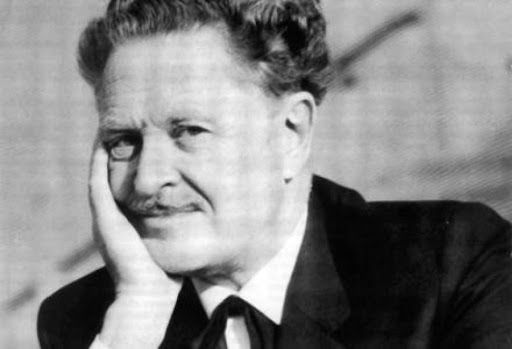
On this day, January 15th, 1902, was born Nazim Hikmet, the aristocratic son of a senior official of the Sultan, who loved the poor and humble people more than anything else and remained disobedient until his last day. He was imprisoned, tried, tortured and taught with his blood and original work.
It is significant that Hikmet, one of the most important Turkish writers of the 20th century, regained his Turkish citizenship, which had been revoked in 1951, almost half a century after his death. Many writers, such as Nobel Prize-winning author Orhan Pamuk, have argued that Hikmet's case is an example of the oppression of intellectuals in modern Turkey.
Hikmet was born in Thessaloniki and died in exile in Moscow in 1963, at the age of 61. He became famous in the West and his works were translated into 50 languages. But in his country he was considered, even after his death, a controversial figure because of his links with the Communist Party and the then Soviet Union. In total he spent 15 years in prison. During his time in various prisons in Turkey, Hikmet turned the prison into a real school for his fellow prisoners with language, literature and French lessons.
Learn to fly. Tomorrow they may even take away our roads.
| Nazim Hikmet (15 January 1902 - 3 June 1963) pic.twitter.com/P5EcfVjhN2
- Manthraspenta (@manthraspenta1) June 3, 2017
The “blue-eyed giant”, as he was called, was awarded the Peace Prize in 1955 for his overall work and his internationalist dimension.
The poet's vision for Greece and Turkey
The timelessness of Hikmet's spirit can be seen in his writings on the Greek-Turkish friendship he envisioned. At a time when Turkish nationalism and populism are taking on new, alarming dimensions, the poet's words should be taught in schools in both countries.
Hikmet's message to the Greek people that was broadcast during the trial of Nikos Belogiannis:
«Friends and brothers of my soul. You who have fallen in prisons and on the islands of hell, who are kept chained in concentration camps because you are fighting for the independence, bread and freedom of the Greek people, accept my love and admiration. The peoples of Turkey and the Greece have the same deadly hated enemies: the Anglo-American imperialism and its local lackeys. The peoples of Turkey and Greece, kissing each other, with the help of the peace-loving peoples of the whole world, will in the end crush these enemies. This I believe. Your own glorious struggle is one of the most glorious proofs that the cause of peace, bread and freedom will win. I clasp you all lovingly in my arms. NAZIM HICKMET 10/8/1951 Berlin’.
Furthermore, the Warsaw Radio Station broadcast on 19/8/1952 an open letter of the poet to the Greek people for peace and brotherhood:
«Brothers Greeks,
There are two Turks and two Greeks. The real one and the fake one. The independent and the servile one. One is the Greece of Belogianni and the thousands of Greek patriots suffering in prison. The homeland of the Greek people. This is the true Greece. This is Turkey with thousands of Turkish patriots, rotting in the dungeons. The Turkey of the Turkish people. This is the genuine Turkey.
There is also Turkey and Greece of Menders and of Plastira. They are the official ones, not the real ones. They are the ones who, with their few supporters, have sold out both countries to American imperialism. Now lately, under the American blessing, Menderes and Plastira have shaken hands in Athens.
Their bloody hands, sending Turkish and Greek soldiers to Korea. Their bloody hands preparing a new war. This friendship we all understand. To strike together with the fighters of the Turkish and Greek people, who are fighting for independence, peace and freedom. To grind in the same American meat grinder, children of the Greek and Turkish people. To force the people of Turkey and Greece to bow their heads and worship their masters and their masters' masters.
But the peoples of Turkey and Greece give a very different meaning to the Greek-Turkish friendship. For them, friendship means a common struggle for the liberation of their homeland. For national independence, for happiness, so that they can taste the bread and olives of their land side by side at the brotherly table of friendship.
My Greek friends. We must fight together, hand in hand, for the national independence of our countries, for democracy against every manifestation of fascism, against the imperialists.
My brothers and sisters Greeks...liberate Greece from the clutches of the imperialists and fascists. To build an independent, smoother, happier Greece. Then the children of the people will have the right to laughter and joy.».
Besides, Hikmet envisioned the common struggle of Greeks and Turkish Cypriots against the British. In an article in Dawn in April 1955, he said:
“There is no question about the Greekness of Cyprus. The majority of its inhabitants are Greeks and are rightly fighting for the Union of Cyprus with Greece. Addressing in particular the Turkish minority of the island, the Turkish poet stressed that he must cooperate with the Greek Cypriots for the liberation of the island from British imperialism. Only when the island is free from the English imperialists will the Turkish inhabitants of the island be able to live truly free. And this can only be done through the unity of the Cypriot people, through the cooperation of Turkish and Greek Cypriots in the struggle against the foreign oppressor. Those who try to turn the Turks against the Greeks only serve the interests of the conqueror”.
From a text by Th. Mikroutsikos in the Radical of 16 May of 2015:
“His (Hikmet's) poetry is deeply popular not only because it touches the folk sources, the folk artistic traditions but because it renews the tradition by proposing new elements. It is not copying and imitating folk art but goes along with the people's forces, expressing them dynamically rather than statically in standardised forms. And that is exactly why his art is innovative and modern. It does not follow the people - as the Ritsos - in a stopped historical moment but in its constant movement. Hikmet's poetry contains at the same time the ALL and the OTHER. Deeply social, deeply human, unadulterated and a lesson of the artist's responsibility before his time and before the world.
They invited Maria Dimitriadis and me to the Istanbul in 1978 at an evening dedicated to Nazim Hikmet on the 15th anniversary of his death. At theatre “Taxi”, 8 thousand spectators started singing “If my half of my heart” in Greek. It was the most moving moment of my life that I will never forget. And this moment, which for me has lasted 37 years, proves that there can never be a society in which the Poet will fish and the Fisherman will write poems. It is up to us.”.