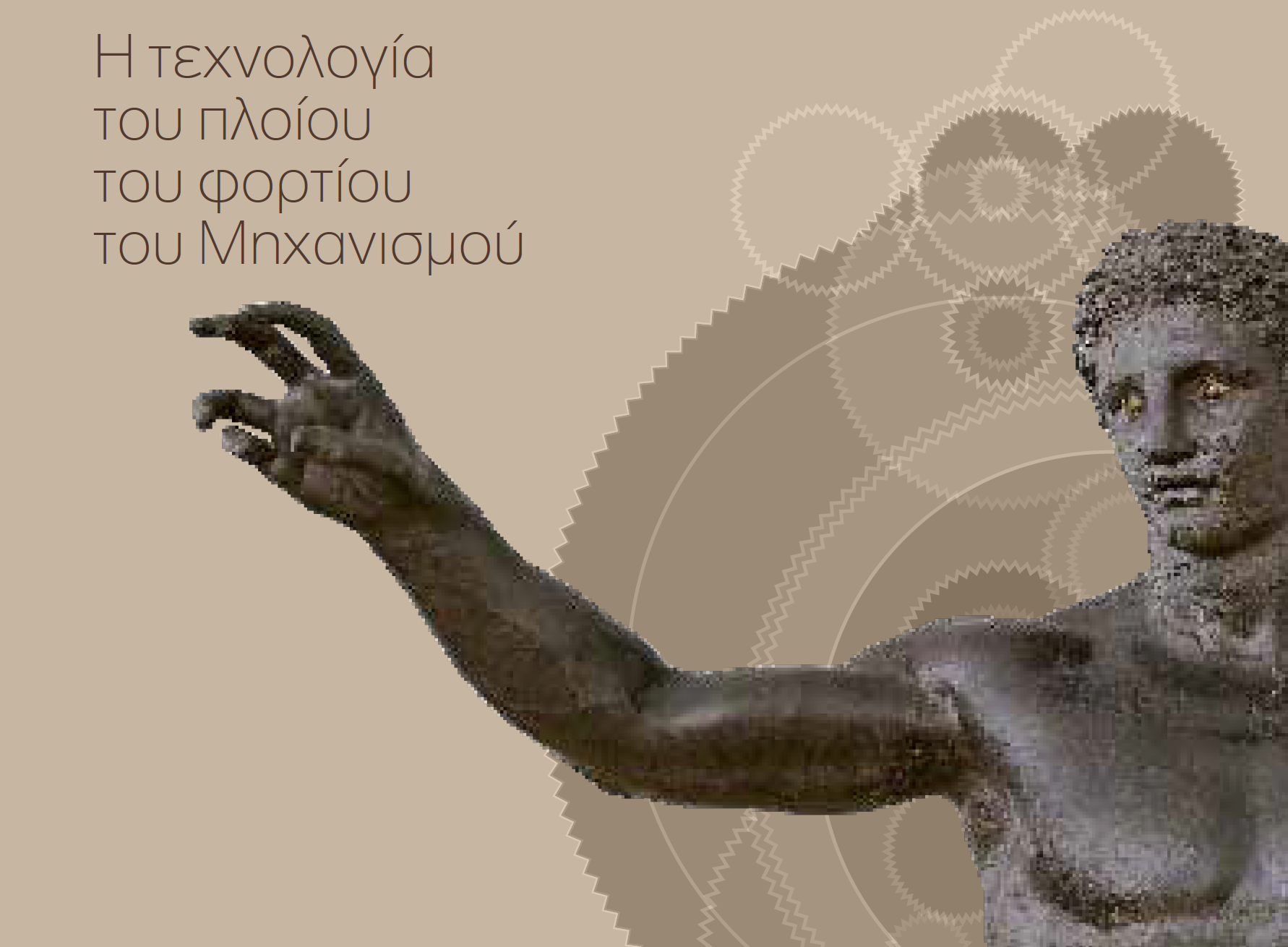
Read the technology manual published in the context of the temporary exhibition «The Antikythera shipwreck: the ship - the treasures - the mechanism at the National Archaeological Museum». The publication was edited by: Alexandra Christopoulou - Anastasia Gadolou - Polyxeni Bouya.
Technology has coexisted with man since our Palaeolithic ancestor struck one stone with another to make his first tool. Since then, all human achievements have been works of art, in the original meaning of the term art, which is a noun derived from the ancient verb teucho, i.e. to create/manufacture with skill, or the verb tikto. Sculpture and ceramics, mathematics, architecture and physics are included in the fields of art and technology. Awestruck, man realized the greatness of his achievements very early on and humbly surrounded it with divinity and myth. For the Greek antiquity they were Metis, personification of wisdom, wisdom and ingenuity for survival, Hermes, inventor of fire, Hephaestus, protector of metallurgy, Athena, protector of a multitude of craftsmen, the Muses, the Telchines, the Cyclopes, but also Prometheus and Daedalus.
Art or technology, in essence, is the process of the constant advancement of intelligent man. His achievements, each time they first appear, attract and attract their contemporaries. Then, having become the property of all, they take their place on the evolutionary scale of the field in which they have been registered. In this way, for example, the art of pottery went from the handmade Neolithic vases to the elaborate redware of the classical period.
The Antikythera Mechanism is no exception, as it incorporates all the previous knowledge of ancient technology. It is an astonishing technological achievement and has been described as mankind's first computer. It is on this occasion that this manual was created. In addition to the Mechanism, every find from the Antikythera wreck, from the ship itself and its equipment to its precious cargo - the marble and bronze statues, the glassware, the
gold jewellery, the multitude of clay vessels and the bronze beds; it presupposes the maturation, enrichment and evolution of older techniques and/or specialised know-how.
The present publication is an additional contribution to the Antikythera Shipwreck chapter and is part of the activities of both the National Archaeological Museum and the experts who collaborated to provide the public with the best possible and most up-to-date information.
We hope that through its pages the unseen side of these artefacts will be illuminated, as well as the breadth and innovation of ancient Greek technology, and that the contribution of ancient Greek intellectuals to European and world culture will be appreciated.
We would like to thank OTE and COSMOTE for funding this publication, which, together with the scientific catalogue and the small guide published in the context of the exhibition, The Antikythera Shipwreck. The Ship-Treasures-The Mechanism, we believe that it will contribute significantly to the multiple reading of the findings of the Antikythera Shipwreck and the Antikythera Mechanism.
Dr. Alexandra Christopoulou
Head of the Public Relations Department and
Educational Programmes of the National Archaeological Museum
Below is the digital version.