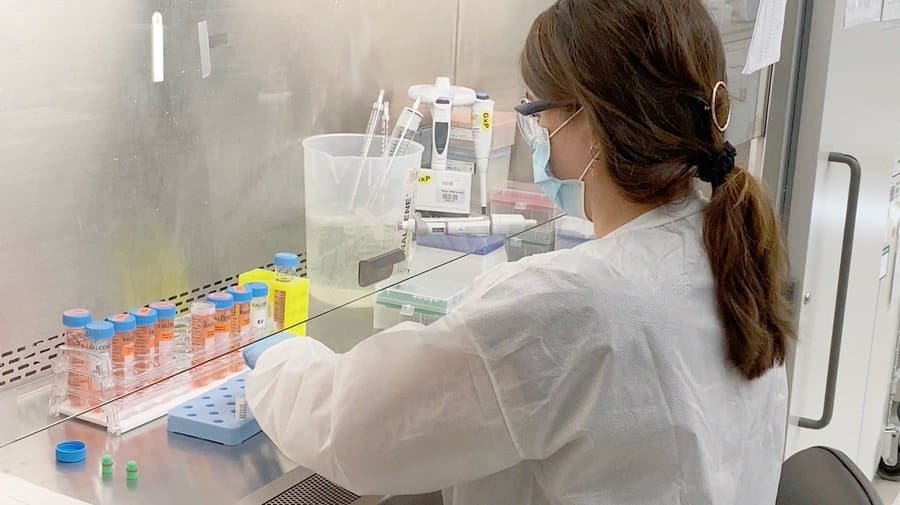
The mRNA is a biological terminology that has come well and truly into our lives in recent months and even more so since the adoption of the vaccines of Moderna and of BioNTech.
The function of this RNA transporter, a molecular structure that carries information about a disease, a virus, a bacterium, to the DNA and causes the cytoplasm to produce proteins that create memory in the cell, without in the process leaving any room for infection, is obviously not new. It was only in the 1970s that the scientific community began to work on such an option. Somewhere in the 1990s this work was discontinued.
But it is a process to produce it on a large scale that required and still requires huge costs and time. Usually, such a process before a vaccine was released and judged to be effective could take up to a decade. The cost for all the experimental phases and production was close to 70 million dollars.
Even the richest pharmaceutical tycoons were not in the mood for such a waste of time and money, so from a certain point onwards the logic of «traditional» vaccines that carry dead or inactive viruses and bacteria and activate the immune system was preferred.
In contrast to these, an mRNA vaccine works suppressively rather than preventively, but also in a personalised way. It targets each organism and each cell differently. As the information transmitter, which is the ribosomes, guide the cell in finding the antigens, the cell archives the proteins and will present itself ready the moment they appear with a virus attached to them.
The economic collapse caused by the pandemic of COVID-19, created a new situation in which the loss in relation to the cost of producing mRNA vaccines was infinitely greater. So there was an unexpected and enforced loss that freed the hands of governments and corporations to draw resources and put them into the mRNA process.
With time now condensed and in less than 9 months we have experiments, results, phase two, phase three and finally approval, circulation and administration on a global scale, a path is opening up that can give man the weapon to fight diseases that used to be an invincible opponent.
First and foremost various forms cancer. With current practices, treatment is based on chemotherapy and radiation, but this requires a lot of tissue and cell destruction before a victory is achieved. It turns out to be an instant victory, since the weakening of the organism is now such that the slightest invasion can cause the fatal. In addition, it is practically the same form of treatment for any type of cancer, while each cancer has a different source of origin.
Vaccines made to fight coronavirus abolish the usual interaction of mRNA with DNA by pumping information from the cell nucleus. Plus, mRNA directly identifies the necessary protein to be produced by each cell, then records the sequence of amino acids that produce it and ends up having exactly the information it will carry to the nucleus.
It is this rapid action of mRNA that made the release of the vaccines so fast and the their safety at the gene level, since mRNA does not return to the nucleus to insert foreign genes into our DNA.
Each form of cancer is treated as unique by the specific tactic and applies reverse engineering to the cellular information to find the culprit of their alteration.
Another problem that was encountered until the advent of coronavirus vaccines was the fragility of mRNA. Its structure is easy to break down as it gets deeper and deeper into the cell. By the time it finds the nucleus, in many cases, its molecules have broken down. The mutant form in Moderna and BioNTech's vaccines covers the mRNA with fat nanomolecules that act as a shield.
Somehow, the coronavirus seems to have provided stepping stones for the scientific community to take the data they had collected from similar efforts in the past on cancer, bring it up to a high enough and useful level and reorient it towards something that they didn't think could be achieved at the time. And now, according to the founders of BioNTech, the Ugur Sahin and the Ozlem Tureki, in 2 to 3 years we will have the first drug approvals for cancers!
She was the Hungarian scientist, Cataline Carico, who at the beginning of the millennium was one of the first in the world, together with her scientific partner, to find an effective way of using mRNA through uridine, after losing her funding and contracting cancer herself.
Her research was found to be read by the Stanford scientist, Derrick Rossi, who went on to found Moderna, and both of BioNTech's founding oncologists hired her and gave her the funding she needed to achieve her goal.
Apart from cancer, this new vaccine technology may have no limits. It can be applied to cytomegalovirus, cystic fibrosis, heart failure, HIV (BioNTech is already working with the Gates Foundation to start research in 2021), but also in cases that now seem like science fiction: bone marrow and sickle cell anaemia!
University of Pennsylvania professor, epidemiologist Drew Weissman who was involved in the creation of this mRNA for the two vaccines, claimed a few weeks ago that this weapon will allow doctors to treat genetic diseases with a simple vaccination with targeted mRNA!