Tuberous iris L
Hermodactylus tuberosus (L.) Mill.
Hormodactylus the club-footed
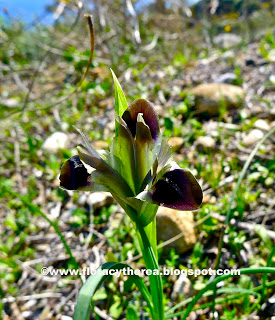
A perennial aromatic plant, endemic to the Mediterranean. The beautiful pale yellow petals turn deep purple or black and, more rarely, golden yellow. It blooms in late winter, forming fairly large clusters in uncultivated fields, rocky areas, and on roadsides.
The name "hermodactylus" was first given to this plant by the botanist Mattioli in 1565, although it had been used since the 6th century BC to refer to a type of colchicum (Alexander of Tralles) that was considered an excellent remedy for arthritis.
Linnaeus then described it as Tuberous iris in the 18th century.
At the end of the 18th century, it separated from the genus Iris and classified as a separate genus. However, following molecular analyses carried out in England (Jordell Labs, Kew) in the 20th century, it is considered more accurate to describe it with the name Tuberous iris, given by Linnaeus. Ultimately, the ancient name seems to prevail. Its etymology from Hermes + finger refers to the plant's tuberous roots, which resemble fingers. The botanists who chose this name for the plant may have been clever, since Hermes was the messenger of the gods, just like Iris.
At the end of the 18th century, it separated from the genus Iris and classified as a separate genus. However, following molecular analyses carried out in England (Jordell Labs, Kew) in the 20th century, it is considered more accurate to describe it with the name Tuberous iris, given by Linnaeus. Ultimately, the ancient name seems to prevail. Its etymology from Hermes + finger refers to the plant's tuberous roots, which resemble fingers. The botanists who chose this name for the plant may have been clever, since Hermes was the messenger of the gods, just like Iris.
The common names in English, widow iris and snake's head iris, refer to the somewhat mournful color of the widow and the similarity of the petals to a snake's head, respectively.
In Kythira, in some areas it is called mavrokrino, while in other areas of Greece it is known as “rabbit's ear.”.