Macrolepiota phaeodisca Bellu
Macrolepiota foedora
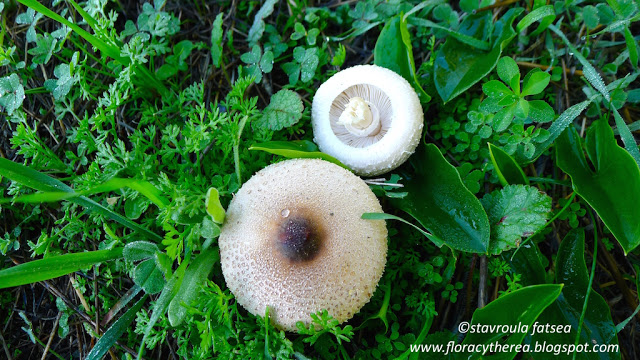
A fairly common mushroom in Southern Europe. It grows in sunny grasslands, depending on weather conditions, from late October through February. It belongs to the genus Macrolepiota, of which Macrolepiota procera is the type species. Mushrooms of this genus are generally considered edible and tasty, although caution is advised, as some resemble other species that are toxic. This particular species was described in 1984 by the Italian naturalist Francisco Bellu, who gave it the scientific name Macrolepiota phaeodisca, which is accepted today. Modern research classifies it as a color variant of the species Macrolepiota excoriata.
On Kythira, I found it mainly in the northern part of the island in fields and olive groves among grasses and, more rarely, in scrubland. The local name in the northern part of the island is “Maria,” and it is considered a safe and tasty mushroom.
WARNING! It resembles the species Chlorophyllum rhacodes, which, however, is larger and has long, raised “scales,” and causes gastrointestinal problems; in some organisms, it can even cause more severe poisoning. The flesh of Chlorophyllum rhacodes turns red when cut, while the flesh of “Maria” remains white.
WARNING! Even mushrooms considered safe and edible can become dangerous if they grow in an area with trash, scrap metal, etc. Never eat wild mushrooms unless you are absolutely certain of their origin and have complete confidence in the mushroom picker.
The genus name derives from the Ancient Greek word *lepis* – *idos* = scale, “scale,” and the adjective “makros” (long), referring to the long “scales” on the cap of the mushroom’s fruiting body. The specific epithet is derived from “phaios” and “diskos” for obvious reasons.
Place: Potamou-Karavas Regional Office, Kythira 802 00, Greece