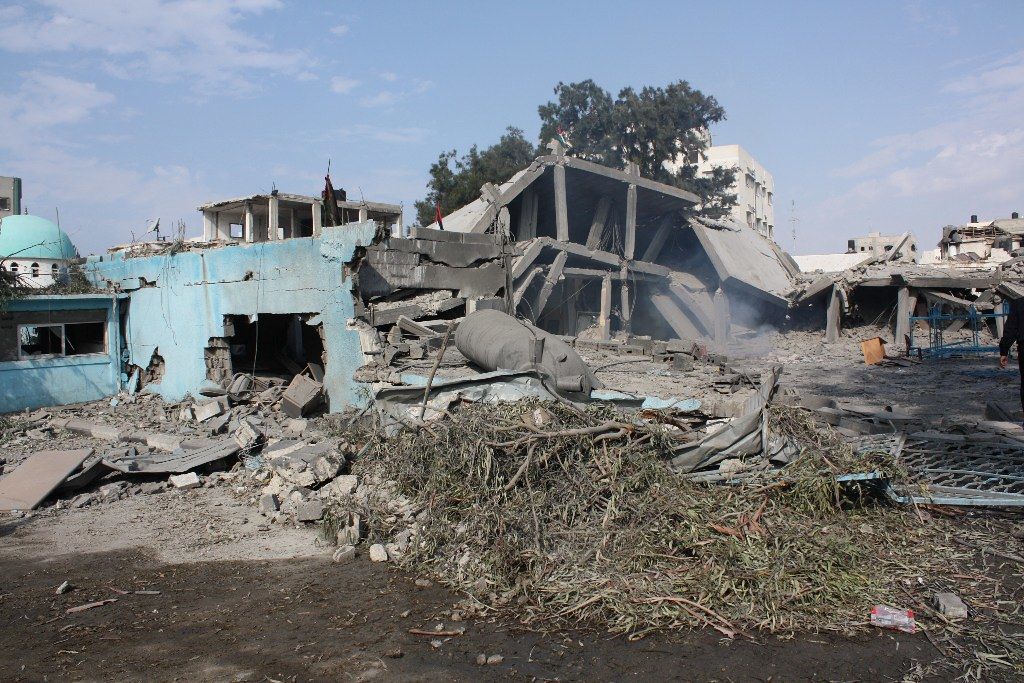
The Palestinian Islamist movement Hamas threatened last Monday night to execute Israeli hostages it is holding in retaliation for the Israeli strikes on the Gaza Strip that have multiplied in the third day of the war sparked by its massive and surprise offensive, as the death toll exceeded 1,600, according to official statements from both sides, in three days.
The threat followed Israel's announcement that it had placed the Gaza Strip, a Palestinian enclave controlled by Hamas since 2007, under «full siege». It is being hammered by the Israeli army in retaliation for Hamas' unprecedented attack on Israeli territory since Saturday, by land, sea and air, the deadliest ever by a state, comparable to the September 11, 2001 attacks on the United States.
Yesterday the Israeli army announced that it had regained «control» of communities in the south of the country where Palestinian militants had attacked and today it asserted that it had regained control of «the border» with the Gaza Strip.
Speaking to Israeli radio, Rear Admiral Daniel Hagari said that control of the border with the Palestinian enclave had been regained and that mines were being placed on parts of the «fence» (wall) on the border that were demolished by Hamas fighters. The senior officer assured that there had been no new infiltration of militants since yesterday and denied rumours that the Palestinians were using underground cross-border tunnels.
«We are already in the heart of the campaign, but this is only the beginning,» Israeli Prime Minister Benjamin Netanyahu told senior local officials in southern Israel, where the Hamas attack took place. «What Hamas will experience will be difficult and terrible (...) We will defeat them with force, with enormous force,» he promised them.
For its part, however, Hamas warned Israel: «Every time our people will be targeted unannounced, it will lead to the execution of one of the civilian hostages (...). The enemy does not understand humanitarian and moral language, so we will speak to him in the language he understands,» it said.
Nearly 150 people have been kidnapped in Israel by Hamas militants, at least according to the Israeli government.
The US, which on Sunday began sending military aid to Israel, mainly ammunition, and ordered an air strike force to sail in its direction in the Mediterranean, made it clear last night that it has «no intention» of deploying troops «in the field» through a spokesman for the president's national security council.
For his part, Saudi Arabia's Crown Prince Mohammed bin Salman spoke by phone with Palestinian Authority President Mahmoud Abbas and assured him that he is working to prevent the risk of «expansion» of the conflict, the official Saudi news agency SPA reported in the early hours of today.
«Massacre»
According to the Israeli army, more than 900 Israelis have been killed since Hamas launched its attack on Saturday. The Health Ministry, for its part, reported 2,616 wounded.
Over 250 people were killed while at a rave party in a desert-covered area near the Gaza Strip. «They slaughtered people in cold blood in a totally unthinkable way,» said Moti Bukjin, a spokesman for the NGO Zaka, which was involved in the recovery of the bodies.
On the Palestinian side, 687 people have been killed and 3,727 others injured, according to local authorities.
Tens of thousands of Israeli troops have been deployed around the Gaza Strip, the tiny enclave where 2.3 million Palestinians live in suffocating conditions.
Israel had withdrawn its troops and removed settlers from the Gaza Strip in 2005, having occupied the area since 1967. However, it maintains control of its airspace and territorial waters and has imposed a blockade since 2007, strictly controlling the movement of people and goods to and from the territory.
At the same time as the announcement of the «siege» in Gaza, Israel ordered the «immediate interruption» of the water supply to the enclave, after cutting off electricity and food deliveries.
In a televised address last night, Netanyahu called on «the opposition leaders» to agree «to immediately form a government of national unity (and) an emergency government without preconditions».
The Israeli army reckons that the unprecedented Hamas attack on Saturday, which a spokesman described as an «invasion of Israel», involved about a thousand fighters.
He also said that he had killed «suspected gunmen» who had entered Israel from Lebanon.
The Lebanese Shiite movement Hezbollah, a black sheep for Israel, announced yesterday that it had bombed two Israeli camps in retaliation for the deaths of three of its members in Israeli bombings in a border area in southern Lebanon, against the background of concerns that another front would be opened.
The Hamas attack was launched exactly 50 years and a day after the 1973 Israeli-Arab war, which had taken Israel by surprise and cost 2,600 lives on the Israeli side in three weeks of hostilities.
The Ezzedine al-Qassam Brigades, the armed arm of Hamas, announced that it launched the attack against Israel to «put an end to the crimes of the occupation forces».
While the Hamas attack was condemned by the West, UN Secretary General Antonio Guterres, acknowledging Israel's «legitimate security concerns», said he was «deeply disturbed» after the announcement of the imposition of a «full siege» on the Gaza Strip.
For their part, Germany, the US, France, Italy, France and Britain issued a joint statement last night stressing that they «support Israel's efforts to defend itself» and condemn Hamas in unequivocal terms.
However, Turkish President Recep Tayyip Erdogan warned Israel against a possible «indiscriminate» attack on civilians in Gaza, as it would only «worsen their suffering» and «exacerbate the escalation of violence in the region».
Israeli military spokesman says the border crossing between Gaza and Egypt is now closed, correcting an earlier statement
The Israeli military spokesman corrected his earlier comment by saying that the border crossing between Gaza and Egypt is now closed.
Earlier, the Israeli armed forces had suggested that Palestinians fleeing Israeli air strikes in the Gaza Strip should head to Egypt, as that country also borders the blockaded enclave.
«I am aware that the Rafah border crossing (on the Gaza-Egypt border) is still open,» Lt. Col. Richard Echt, the chief military spokesman, had earlier said during a briefing for foreign journalists, adding. «Those who can leave, I would advise them to leave.».
The military spokesman's office then issued the following statement: «Clarification: the Rafah border crossing was open yesterday but is now closed».