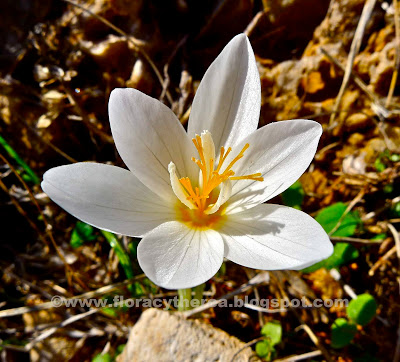
Crocus boryi J. Gay
The genus Crocus L. includes about 80 species with a distribution throughout Central and Southern Europe and much of Central Asia. Depending on the species and climatic conditions, species of the genus flower in autumn, winter or spring. Many species are cultivated as ornamentals; perhaps the best known species, Crocus sativus, (Saffron Crocus) has been cultivated in the Mediterranean from ancient times to the present day, for the production of the world's most expensive spice, saffron or saffron. In the past it was used as a dye, giving a bright yellow or red indelible color, but also for its medicinal properties.
Crocus is often confused with the colchicums and sternberries, which are predominantly autumnal, belong to different families and have six anthers rather than three like crocus. Warning: while the bulbs of yolks may be edible, the bulbs of cochineals and sternberries are toxic to poisonous.
The Latin name of the genus comes from the Greek crocus which in turn probably comes from the Hebrew karkom, Arabic kurkum, Akkadian kurkanu words meaning the bright yellow colour. ( Dictionary of Modern Greek Language, G. Babinioti). The characteristic epithet of the species was given in honour of the French traveller and naturalist, Baron J.B. M. Bory de St Vincent (1780-1846)
This species thrives at low to medium altitudes in southern Greece, the Ionian Islands and Crete, flowering from late autumn until January. In Kythera I found it in abundance at 500m in the west of the island.