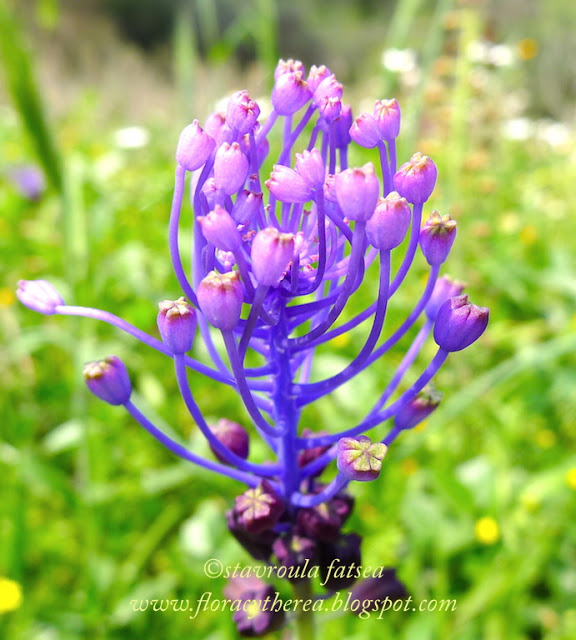
Perennial bulbous plant, native to the Mediterranean and Europe, spreading as far east as Iran and as an epiphyte in North America and Australia.
Originally the species was classified in the genus Muscari hence the synonym which is still widely used today. The genus Leopoldia, which is still considered by many to be a subgenus of muscari, includes 12 species of plants, which are considerably taller than those of the genus muscari and the stems are more sparsely distributed in the inflorescence.
At the top of the inflorescence, the characteristic intense purple-blue crest consists of sterile flowers while lower down the fertile flowers are brown with a pale yellow spout. The bulb is reddish in colour and has a life span of five to ten years; overharvesting can therefore lead to a reduction in the plant's population as it is deprived of the possibility of renewal through pollination. (see below case in Crete)
The bulbs of leopoldia are edible and are considered by many Mediterranean peoples to be an excellent delicacy. In Apulia in southern Italy they are fried with eggs and make a bitter omelette.
In Crete the bulbs are called askodoulaki. They are eaten boiled or pickled as a snack or as an accompaniment to meat dishes. In recent years locals have complained that due to overharvesting the leopoldia populations are dangerously declining and there is a need to protect the plant. (Decision of the Municipality of Phaistos 16/2/2016)
In Kythera we call them kalogerias, they are collected in spring and are one of the favourite dishes of Kathara Monday. They are engraved crosswise and boiled in two or three waters to spice them up. They are then either served freshly boiled with olive oil and garlic or preserved as pickles.
In southern Italy they are grilled with lots of oil, salt and pepper. A similar recipe was given to me by the nature lover Paul Sophios. He washes them well and removes only the outer skins, sprinkles them with oil, salt and pepper, wraps them in parchment paper and then in foil and roasts them either on the grill or in the oven. In this way they become very soft without losing the outer layers as is the case with overcooking.
Bulbs have been a popular food since ancient times. The stoic philosopher Chrysippus in his treatise “On Good” records an ancient saying where the porridge of bulbs and lentils is considered “ ambrosia in the cold of frost”
(Athenaeus, D47).
Dioscorides considers bitter bulbs excellent for facilitating digestion, with painkilling action in arthritis and rheumatism etc.
“...the edible bulb, edible and pungent, the fire-breathing bulb, of Libyan composition, and the bitter and mouldy, pungent, digestive bulb. and all things dreadful and warming, intercourse impulsive, tongue and tongue roughening, polyglot and carnal, ...inspired, and they shall be consumed with the tremors and the scabs and the scalps and the pains of the joints and the gout, plus honey and themselves, and the swellings and the swellings of the fins, likewise plus honey, and they shall sweat and perspire....” MM2.170
The genus was named by the Italian botanist Filippo Parlatore (1816-1877) in honour of Leopold II, Grand Duke of Tuscany (1797-1870). Since the genus name is already a heavy burden for this delicate plant I preferred shaggy as a distinctive adjective to easy, which is correct but adds extra weight to the name.
The characteristic adjective from the Latin comosus-a-um = the one who has a rich crown, shaggy-haired (mentioned in Pliny, dense-leaved)
They are considered an excellent tonic, diuretic and like all bitters a digestive and appetite enhancer.
The synonym muscari comes from the Greek word musk, a substance with a penetrating odour, secreted by the glands of animals such as the Siberian deer or plant species such as the Siberian elk. abelmoschus moschatus.
To provide the best experience, we use technologies such as cookies to store and/or access device information. Consent to these technologies will allow us to process personal data, such as browsing behavior or unique identifiers on this website. Not consenting or withdrawing consent may negatively affect certain features and capabilities.
Functional
Always active
Technical storage or access is strictly necessary for the legitimate purpose of enabling a specific service explicitly requested by the subscriber or user, or for the sole purpose of transmitting a communication over an electronic communications network.
Preferences
Technical storage or access is necessary for the legitimate purpose of storing preferences that are not requested by the subscriber or user.
Statistics
Technical storage or access used exclusively for statistical purposes.Technical storage or access used exclusively for anonymous statistical purposes. Without a subpoena, voluntary compliance on the part of your Internet Service Provider, or additional record keeping by a third party, information stored or retrieved for this purpose alone cannot usually be used to identify you.
Commercial Promotion
Technical storage or access is required to create user profiles, to send advertisements, or to log the user into a website or various websites for similar marketing purposes.