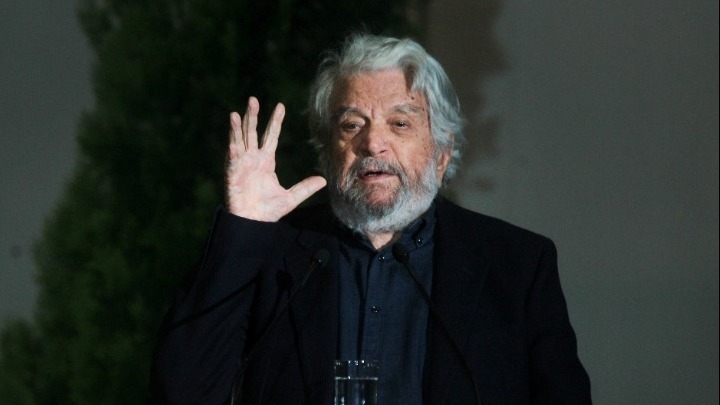
He may have entered the entertainment industry at a relatively advanced age, missed the heyday of classic Greek cinema, and been limited to supporting roles, but Angelos Antonopoulos, who died at the age of 94, managed to span the modern history of theater, earning the public’s acclaim, while, unexpectedly, his name, in the early 1970s, would take on legendary proportions when he played ‘Colonel Vartani« in the television series *The Unknown War*.
Angelos Antonopoulos would make his film debut at the relatively advanced age of 32, shortly after his first appearances at Karolos Koun’s Art Theater, he began landing major roles as a middle-aged actor, and after becoming a top-tier star as «Colonel Vartani,» his dedication to acting would establish him as one of the most reliable actors, capable of bringing to life any character he was called upon to portray.
With the spirit of Olympia and the resistance
He was born on January 16, 1932, in Tambouria, Piraeus, where his father, a railroad worker, was employed; he lost his father at a young age, during the Occupation, to pneumonia, which forced his mother, in order to survive those dark times, to move to a village near Olympia. There they would find a meal, and young Angelos would discover a place that would enchant him with its atmosphere and rich history. There, however, he will also experience the national resistance and the civil war—historical periods that will leave an indelible mark on him for the rest of his life.
Suspicious
As he himself said, he was never particularly active in politics, but he was «suspicious,» having been influenced by the struggles of the leftists of that era, aware of the decisive stance taken by the British and the outbreak of the civil war, for which Greece paid dearly—with blood and a lost generation on the barren islands, in battle, or even by poisoning a nation with discord.
From the Grocery Store to the Art Theater
He would come to Athens to stay with some of his well-to-do uncles and find his career path, starting out as a cashier at a grocery store. However, at the age of 27, while watching a performance by Karolos Koun at the National Theater, he was captivated by the theater and decided that what he wanted to do in life—to become a truly happy and fulfilled person—was to become an actor. He immediately took the entrance exams for the Theater of the Arts, where he was accepted to study acting for three years—a time that would remain unforgettable to him. To support his studies, he worked as a taxi driver until he landed his first role from Karolos Koun, whom he admired and considered a role model.
Koun, Bardot, and Myrat
His life would change completely, and he would be deeply influenced by the experience of the Art Theater’s trip to Paris to perform «The Birds,» and he would see prominent figures in the audience—such as Jeanne Moreau, Ionesco, and Brigitte Bardot—rush to embrace them at the end of that historic performance. When his paths parted ways with Koun, he joined the troupe of the prominent theater figure Dimitris Myrat, with whom he would develop a special collaboration, while also expanding his theatrical repertoire and, of course, his acting skills.
Film debut
In 1964, he made his film debut, playing a small role in Dalianidis’s romantic drama *Egoism*, and also had a small part in Dinos Dimopoulos’s comedy *Miss Director*, alongside Jenny Karezi and Alekos Alexandrakis. It was in these two films that Vasilis Georgiadis saw him and offered him his first distinctive role, that of a bandit in the plains during the uprising of the peasants against the landowners, in the dramatic adventure «The Soil Was Stained with Blood,» alongside Manos Katrakis and Nikos Kourkoulos—a remarkable film that would go on to be nominated for an Oscar for Best Foreign Language Film.
A Trip to the Movies
And while he has begun playing major roles on stage alongside great actors such as Alexis Minotis, Katerina Paxinou, Manos Katrakis, and Vera Zavitsanou, and has become a sought-after presence on the theater stage, exploring all theatrical genres, while in cinema he continued to appear in supporting roles in films such as *Society: Zero Hour* and *I Accuse People*. In 1966, he landed his first leading role in the exceptional romantic drama «Excursion,» by the distinguished Greek director Takis Kanellopoulos. The following year, he co-starred alongside Kostas Kazakos in Nikos Foskolos’s western *Bullets Don’t Come Back*, and immediately afterward, he will star in the social drama «To Our Teacher with Love» and appeared alongside the leading couple Vougiouklaki and Papamichail in the massive box-office hit «The Teacher with Blonde Hair.».
Panic
He continued to appear in films at an undiminished pace—many of which fell short of his expectations, but also in a number of fairly interesting films, most notably Stavros Tsolis’s *Panic*, alongside his close friend and best man, Kostas Kazakos, as well as the well-known adventure film *Zero Visibility*, alongside Kourkoulos. His long-standing collaboration with Aliki Vougiouklaki would lead him to co-star with her in the mediocre romantic dramas ’I Love You« and—several years later— »Cunning Female, Scheming Woman.«.
The Incredible Success of *The Unknown War* and the Criticism It Received
The early 1970s would prove decisive for his career, as the highly talented stage actor and distinguished supporting actor in film would soon become into a national icon. In 1971, he accepted Kostas Koutsomytis’s offer to play the lead role in the television series of the newly established Greek television network, ‘Unknown War.« His initial hesitations were overcome by Koutsomytis, and as »Colonel Vartani,« he enjoyed incredible success. As he used to say, after three or four episodes of the series aired, he would walk onto the stage and the audience would throw gardenias at him, as if he were an idol at a bouzouki club. The series, whose screenplay was written by Foskolos, would run with unprecedented success (during its airtime, not a soul was on the streets) for four years, while at the same time—and especially after the transition to democracy— it would come under fire from critics, a segment of the public, and some of his colleagues, because it portrayed Greek military officers with considerable sympathy at a time when the junta was on its last legs.
Filling the Theaters Again
It should be noted that the series focused on espionage cases during World War II, with Vartani as the central character, who led investigations into the activities of Axis spies. Antonopoulos will defend his participation in the series, saying that the script contained many passages condemning fascism, while noting that several of his left-wing colleagues also starred alongside him. After the fall of the junta, his career was affected for a time by *The Unknown War*, but this did not last long, as the theater where he performed would soon be filled with audiences once again.
A passion for theater, teaching, and poetry
In the years and decades that followed, he devoted himself to the theater—both at the National Theater and in «independent» productions—with plays by Ibsen, Sartre, Oscar Wilde, Chekhov, Pirandello, as well as boulevard theater, while he would enjoy enormous success with «Marx in Soho,» a monologue about Antonopoulos, which he would perform for five full years. He was fortunate enough to appear in two acclaimed television series, «Pantheos» and «Madame Sousou»; he taught at a drama school for over 30 years, passing on his love for the theater to young people, while he would take the stage for the last time in 2017, in the play «The Last Moons.» He also wrote two novels and published a collection of poetry, which he described as his «refuge.».
The child who didn't do
In his personal life, although he was very popular with women, he had a short-lived marriage to Ninetta Antonopoulou, whom he married in 1969, with Jenny Karezi and Kostas Kazakos as his best man and maid of honor. Although he lived a full life marked by moments of glory and widespread recognition, Antonopoulos expressed regret that he never had a child.
Grateful
Angelos Antonopoulos, a deeply philosophical man, felt vindicated by his career in the art of acting, but also deeply grateful for his life and his acquaintances with important figures in the arts and letters; and if he ever felt a sense of guilt, it was because he had never been politically «active,» but he was reassured by the nature of his work, which had always served as a bulwark against frivolity and social injustice.
X. Anagnostakis