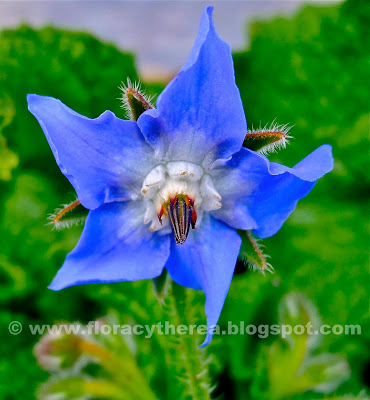
Cerinthe major L.
An annual plant that grows wild throughout the Mediterranean. Its impressive flower contains a lot of nectar and is particularly prized by bees. This, combined with the fact that its leaves have a wax-like taste, led to the name kerinthos = keros + anthos, which for the ancient Greeks referred to the yellowish substance (pollen) that bee larvae feed on. In the Cyclades, even today, they call pollen kerathi.
The adjective major= major obviously refers to the size of the flower, which is large compared to those of other species of the genus.
In ancient sources, cera is described as a different form of honey. Aristotle says that the taste of cera is similar to that of sweet figs. He describes how bees carry wax and cera on their legs, but digest only the honey and discard the rest when they reach their destination. Varro offers another version: he believes that bees use it as a finish on the cells of the honeycomb. Virgil describes how it was used to attract swarms of wild bees to hives.
This is obviously the well-known pollen, which is valuable to bees and humans alike. Bees carry it in the pouches on their legs, and it has a “waxy” appearance, as the bee processes it with substances secreted in its saliva until it acquires a smooth appearance.
During the Middle Ages, it was cultivated as an ornamental plant in European gardens. The plant remained popular during the Renaissance, but its cultivation was subsequently abandoned until the 20th century, when it returned to prominence. In Kythira, I found it in a limited area within a residential area. Perhaps it is a cultivated species that escaped and grew on its own.