he citizens of Greece, and especially the workers, are in the process of becoming poorer, as is now reflected in numerous analyses and data, although the government has tried in the past to distort the real picture by releasing data that told the half-truth. This is because it seems that our country is «competing» with Bulgaria for last place in terms of the purchasing power of workers.
Workers in Greece are becoming poorer and poorer and it is not impossible that the situation will get worse, as analysts« assessment was recorded in a Financial Times article published a few months ago. After all, our country is now being compared to Bulgaria in terms of the purchasing power of its citizens and the Greek economy has not yet managed to »catch up with pre-crisis levels'.
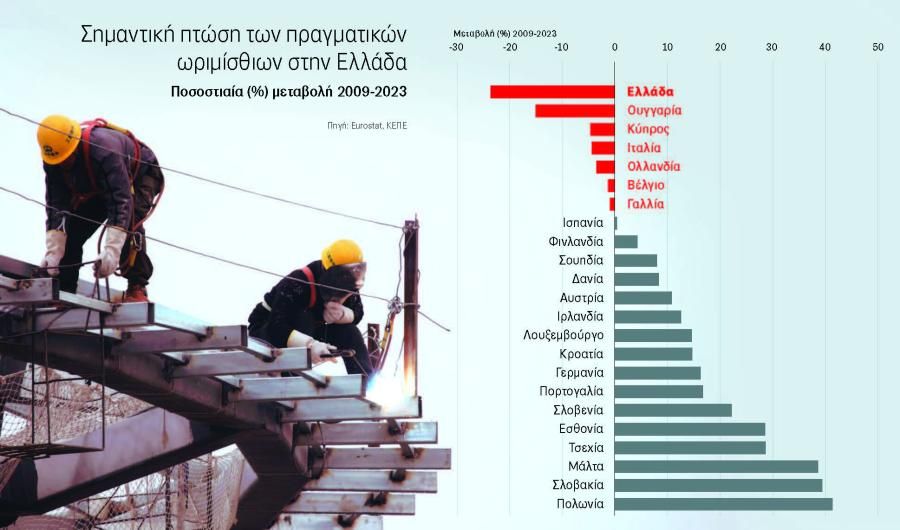
As presented in a relevant analysis by the KEPE (see table), compared to the 27 EU countries, the Greek economy now ranks last in terms of average wages per hour worked - for short, hourly wages calculated in terms of common purchasing power
It is characteristic that Greece's GDP per capita was similar to the EU average until 2009. Since then, 10 countries have seen the standard of living of their residents exceed that of Greece. Greece is now the second poorest country in the EU after Bulgaria and remains a laggard in the Eurozone. «As the gap with Bulgaria is narrowing sharply, it is not unreasonable to expect that Greece will soon become the poorest country in the EU,» as the Financial Times article pointed out at the time, sparking much debate within the Greek political scene.
Income and GDP
Since the 2010 crisis, Greece's spending has been cut and taxes increased to secure a bailout from the IMF and the EU, squeezing businesses and households and demolishing the economy, the paper said. As noted, the extent of the economic damage was rare for peacetime.
As a result, the Greek economy is now about 19% smaller than in 2007, despite the country's recovery after the pandemic, while the EU economy as a whole has grown by 17%, as Eurobank has recorded in a recent report.
As recorded by the Financial Times, real wages have been falling steadily until 2022 - the latest available OECD data -, falling by 30% from pre-crisis levels. They further report that there are also concerns about the country's long-term economic prospects against the backdrop of climate change and the demographic problem.
Shocking data on poverty
However, there is other evidence that confirms the difficult conditions experienced by citizens in Greece. In 2023 the Greek economy grew at a rate of 2%, but poverty did not decrease. According to ELSTAT, in 2023, 26.1% of Greeks were at risk of poverty or social exclusion, i.e. 2,658,400 people. In 2022 the poverty rate was 26.3%.
It should be noted that for Eurostat and ELSTAT the term «poverty» means what in our everyday life we would call absolute poverty or destitution. The poverty line is set at EUR 6 030 per person per year and EUR 12 663 for a household with two adults and two children under 14 years of age.
What applies to young people
It is extremely worrying that the percentage of young people aged 18-24 living in conditions of severe material and social deprivation is more than double the European rate. In particular, in 2023, 14.7% of young people aged 18-24 years were living in conditions of severe material and social deprivation. This is followed by women with 14.1%, people over 55 with 13%, while men have a slightly lower rate of material and social deprivation (12.9%). As a reminder, material and social deprivation is not the same as poverty, as it is not measured in terms of income, but in terms of access to necessary goods and services - from food and housing to recreation, the possibility of a week's holiday or to cover extraordinary expenses.
Greece also has a negative record in child poverty, as in 2023 almost 22% of minors were at risk of poverty (compared to 18.3% of adults) according to a recent report by the GSEE. INE GSEE pointed out that while Greek society seemed to improve after the nadir of the crisis - with a milestone in 2015, when 1 in 4 households with dependent children lived below the relative poverty line - from 2020 onwards poverty rates show a new deterioration. For example, in 2022 22.3% of households with dependent children in Greece were living below the poverty line, compared to 17.4% in the EU-27. In 2023 there was a marginal deceleration of just 0.3 percentage points.