The Necropolis of Satby (late 4th-3rd century BC) in Alexandria, Egypt, the oldest surviving archaeological site in the city, is being revived after decades thanks to the multidisciplinary Alexandrian Necropolis Project (2020-2023), carried out by the Alexandrian Archaeological Society of Alexandria. The Hellenistic Necropolis of Satby, following the successful completion of the project, will be inaugurated on Monday 8 May 2023, henceforth constituting a new visitable archaeological site of the city that was a leading metropolis of the Hellenistic world, an international centre of letters and sciences, renowned for the magnificence of its buildings, such as the Lighthouse and the Royal Quarters.
«This is the oldest site in Alexandria, based on the data of the artifacts, coins and architecture. Chronologically we are in the first generations of Greek immigrants in Alexandria, they are the people who built the city. They don't even carry the term ‘citizen of Alexandria’, they are real immigrants and it shows in their place names, maybe for sentimental reasons,» Dr Kyriakos Savvopoulos, a researcher at the Centre for the Study of Ancient Documents at the University of Oxford, tells APE-MPA, who is co-directing the excavations with Dr Mona Hagag, professor at the University of Alexandria and president of the Alexandria Archaeological Society, and Professor Hussein Abd El Aziz.
And it clarifies: «The Necropolis of Satby dates back to the beginnings of ancient Alexandria, which is why it is so close to the city walls. It is an impressive complex of burial monuments of Greek Alexandrians of Macedonian origin -also from Thessaly, Crete, Cyrenaica and Asia Minor-, reminiscent of Macedonia but having taken a long way in terms of function. That is, there are stylistic similarities with Macedonian tombs, but now we are talking about the Hellenism of Egypt. And this is distinctive from so early on’.
We asked him to explain further. «We are at the time when the Hellenistic kingdoms are being created. There are Greeks everywhere, there is a systematic exchange, ideas, population, style, trade, trade, soldiers, everything you can imagine! It's a very intense period. But the big difference is elsewhere. In Necropolis we have open courtyards. It's not the closed tombs of Macedonia that are usually about one person or a group of people. Satby is a multi-faceted space that essentially mimics the architecture and structure of a house: It has an “ androna”, i.e. a room with banquet-type burial beds that were for men only, a “ ladies” chamber« (»Frauenkeion“) like the room with the skeletons of four women - the sacristy found underneath also had bones of women only. In a way, it is reminiscent of the social life of a Hellenistic house. There are also frescoes with false windows, some even half-opened, giving the impression of the sky in the background! That is, it is implied that this is not a ”closed“ funerary monument, but an accessible ”house“, which has ”life». And all this is happening in places where the living had access. The place for the dead was a small cell, a niche, which bears no decoration inside. That is, the tomb in Alexandria is the property of the living as well. It is a new city, where new hierarchies, new societies, new conditions are created. The Alexandrians demonstrate in this way their new social status, they build on it, using the tombs", says the archaeologist.
The cemetery was discovered at the beginning of the 20th century during the systematic excavations of Evaristo Breccia, director of the Greco-Roman Museum of Alexandria, but the excavation was not completed. After being abandoned for several decades, the Alexandria Archaeological Society's expedition continued the Italian archaeologist's excavation as part of the Alexandrian Necropolis Project. «Breccia was a leading figure in Egyptian archaeology. But when he excavated the Shatby Necropolis, around 1904, he was very young, only 26 years old. He managed to do something that looked nice, to preserve the archaeological site, which is the oldest in Alexandria - we are probably at the oldest systematic excavation in the city - but he never completed the excavation, which was left an open pit. No one until now had resumed the research at the site, which over the years had been reburied by rain and soil. When we came with the pumps we removed 5 m of mattress, half of it was mud. And when we got to the natural floor, suddenly there were burial objects in place from the time of the ceremonies and the whole front of the tomb with the false windows and “doors”. We did not expect to find such findings. We were very lucky!», he stresses to APE-MPA.
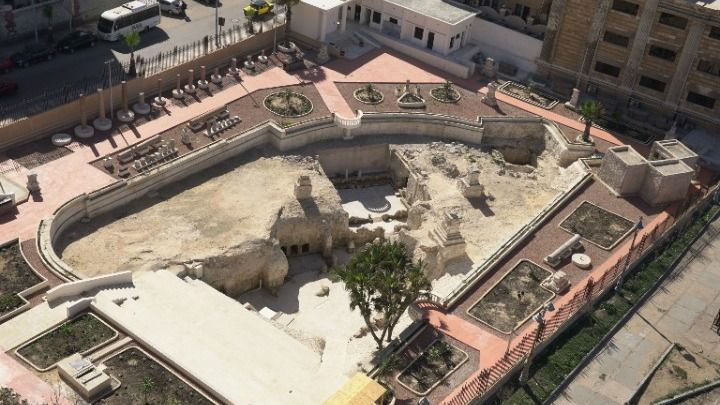
The Necropolis of Satby, which the project literally saved from destruction and oblivion (most tourist offices did not organise visits to the site), consists of a monumental underground multi-chambered complex known as Basement A, two smaller corresponding complexes (Basements B and C) and an area covered with above-ground monuments in the form of stepped towers (once the bases of funerary columns or altars over pit tombs). «It is a monument belonging to the first society of Greeks as it was gradually formed in Alexandria-a social stratum representing much more than a group of a particular origin. From the burials it does not appear to be a particularly wealthy stratum, that is, possessing personal property, of the type ‘I am a landowner in Fayum’ or something like that. The burial building which has 5 chambers with relief decoration shows that this was a project. It was not done by accident. All these people must have belonged to a system that went beyond the origin of the cities. Just behind the cemetery are the Hellenistic Royal Squares. There, there are many structures in which these people, while they were alive, could offer and reside. So right next door, outside the walls, they built their respective tombs. It's a very privileged spot - you can see it from the ‘balcony’ of the Royal Quadrangles, as the saying goes, that's how close we are,» he explains to AP-MPA.
Could - we asked him - could these people have been related to the Ptolemies? «In the surface layer where we have the individual burials, which are the oldest and somewhat scattered, we found coins from the time of the satrapy of Ptolemy, which begins in 323 BC, just after the death of Alexander the Great. Further down, in the underground area, which is more organized, we found coins with Ptolemy I-that is, there is a king and a collective structure. We could speculate with the help of imagination that one of the dead women could have been a ’lady“ of the royal court or the mounted soldier - as one of the dead is depicted in a fresco - could have belonged to the royal guard (in the broader sense). Identifications are of course purely theoretical, we could not award titles and offices without sufficient evidence. However, chronologically we are so early, that everything is still in progress. And with the new discoveries we have made we are forced to go back 10-15 years from when the monument was originally dated. We are moving, that is, the time when Ptolemy said we come here, end! And we will stay here, whatever is to be done, let it be done. That's how we speculate that things happened,” he replies.
The excavations gave a complete picture of Basement A, locating, among other things, its ancient southern façade, skeletons and objects in good condition. Also, abundant movable finds, such as sculptures, coins, glass objects and pottery, especially Hadra-type hydras, typical of the Alexandrian necropolis. «When we got to the natural floor of the site, we discovered something we had never encountered in Alexandria before, namely that they made sacristy under the dead. With these findings we go, as I said, back about 10-15 years. Also, we have found depictions of these dead, not all of them. Some make a false door in front of the niche and others make their figure. We have a lot of military men, some on horseback. They like to be depicted ‘in action’ on horseback,» he emphatically tells APA-MPA.
The Alexandrian Necropolis Project was implemented by the Archaeological Society of Alexandria, the historical archaeological association of the city founded in 1893 and which, especially in its first years of operation, had a close relationship with important Greek Alexandrians, such as Ambrosios Rallis and Georgios Gousios, its first President and first Secretary General respectively, or its members Sir John Antoniadis, Emmanuel Benakis, Michael Salvagos, Eustathios Glymenopoulos and Mikes Synadinos. «This is the first excavation that the Archaeological Society of Alexandria is doing after 85 years,» says the AP-MPA's interlocutor for the active Society, which is returning dynamically to excavation research. The programme, which was carried out with the exclusive sponsorship of the A.G. Leventis Foundation, also involves the Cyprus Institute (Andreas Pittas Digital Lab) in the field of digital mapping of the site and the University of Athens in the field of research.
SS. The photos belong to the Archaeological Society of Alexandria and were provided by the interlocutor of the AP-MPA for publication.
Eleni Markou