Biarum tenuifolium (L.) Schott
The genus Biarum comprises more than 21 species of tiny geophytes that range from Portugal to Iran and from Yugoslavia to Jordan, in dry and arid regions, open scrublands, and stony and rocky soils. The plants begin to grow in late summer or early fall; flowering continues until spring, after which the plant enters dormancy until the cycle begins again.
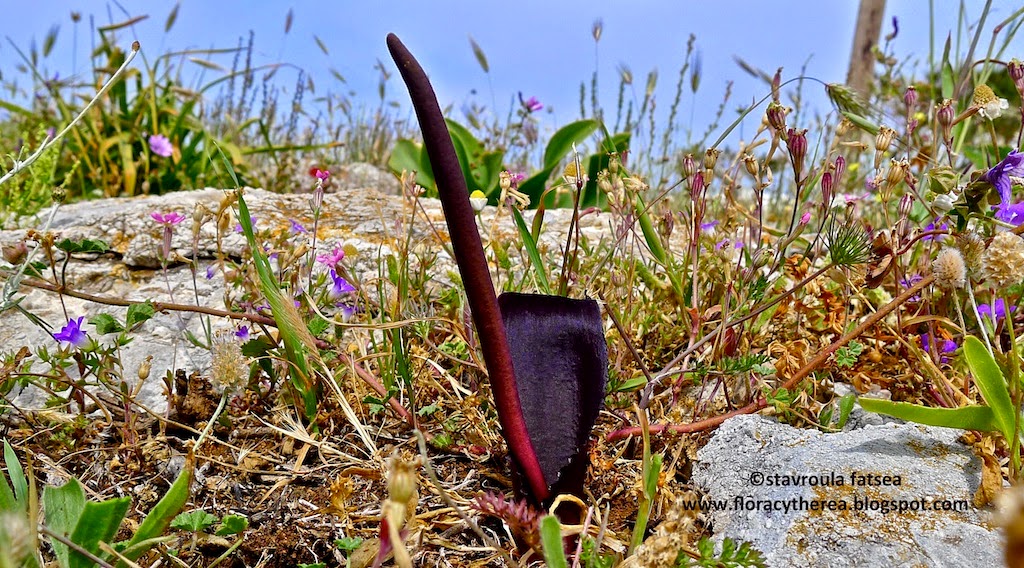
This particular species of Biarum is easily recognizable, despite its small size, due to its vivid black-purple color and the smell of animal manure it gives off. I should note here that the plant in the photograph smelled like goat manure, though not as strongly as described by experts.
The genus Biarum separated from its related genus Arum in 1832, by Schott. In my opinion, the ingenious fertilization system of the species in the genera Arum and Biarum can easily be compared to the incredible sexual ingenuity of the genus Ophrys.
Many species attract saprophagous and coprophagous pollinators—mainly flies and beetles—by mimicking the odor of the places where these insects lay their eggs. (e.g., manure and decaying organic matter). At the same time, the plant raises the temperature of the spike to intensify the odor and make the insects even more active!!!
The insects are forced to penetrate deep into the plant’s ovary, at the base of the spike, where the female flowers are protected within the sheath that wraps cylindrically around them. There they are temporarily trapped, and in their attempt to free themselves, they become coated in fertile pollen. With remarkable precision, the plant calculates the time required for the entire process and releases the insects at the right moment. On their way to freedom, the insects pass through the male flowers located higher up toward the exit and deposit the coveted pollen. The whole experience must be very frustrating for the insects, as they gain absolutely nothing from it and simply serve the needs of the highly intelligent plant.
In Crete, this and its related term Biarum davisii They are called “childless herbs” because, in the region’s folk medicine, their fresh bulbs are believed to be a powerful abortifacient. Young people of childbearing age are not even allowed to approach the plant, as it is believed to cause permanent infertility. On Kythira, the plant is quite rare. I have encountered it in the northern part of the island (four plants), while only a single plant has been found in the center of the island to date.
The genus name derives from the Latin *bi* (meaning “twice”) + *arum*, which in turn comes from the Ancient Greek *aron* (the aorist form of *airo*), meaning “to lift up,” a possible reference to the way the cob stands upright.
The name *biarum* was first used by Dioscorides to refer to a similar plant. The specific epithet of the species is derived from the Latin *tenuo* (meaning “slender,” “delicate”) and *folium* (meaning “leaf”).