Briza maxima L.
Syn. Macrobriza maxima(L.) Tzelev Poa maxima (L.) Cav.
The worst kind of swearing
The genus includes about 12 species of annual and perennial plants that are native to northern temperate climates.
Η The worst kind of swearing It is an annual herb that can grow up to 60 cm in height. Native to North Africa, the Mediterranean, and Southern Europe, the plant has spread throughout the world as an introduced species.
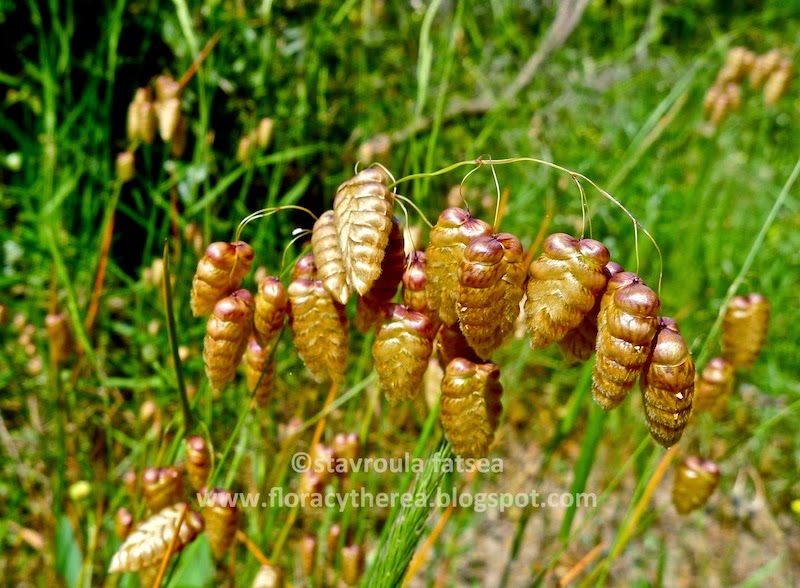
The elegant earrings resemble shimmering seashells, women’s earrings, or broken hearts, hanging from the thinnest of stems and trembling at the slightest breath of wind. They remain beautiful even when dried, and their rustling in the wind, as well as their shape, are the reason for many of the plant’s common names in European languages: rattlesnake grass, quaking grass, and shell grass in English; grande amourette in French. For the same reason, they are cultivated and used in floristry for dried arrangements.
The grain is ripe, Rye is mentioned by Pliny the Elder in the 1st century AD as a cultivated plant rather than a wild one. It appears that the name “sikali” became established for this particular grain, while the name “vriza” was Latinized and adopted by Linnaeus for wild plants that, however, had only ornamental value and are referred to in Greekliterature they are referred to as “Pseudo-Briza.” (Gennadius, Botanical Dictionary)
The genus name probably derives from the Ancient Greek verb *brizo* (aorist: *ebriksa*), which means “to fall asleep,” "to sleep peacefully," as most species and the grains that were originally given this name sway gently, as if lulled by the wind.
The specific epithet of the species comes from the Latin *maximus-a-um* = very large, greatest.