And historical experience shows that even if things get heated, in all cases of conflicts between the State and the Church, the Church has always won, with the sole exception of the case of the identity cards during the Simitis government. Just as in football it is true what fans say, that when Germany plays against another team, Germany always wins, so in the «game» of Church-State relations, the metropolitans always win.
A characteristic example of what we have mentioned above was the conflict between the Church and the government of Andreas Papandreou in 1987-1988. A conflict that ended in a state-by-state victory for the Church. At the time when the Minister of Education Antonis Tritsis, as another Iphigenia, was sacrificed on the altar of the compromise between Andreas Papandreou and the then Archbishop Seraphim (We remembered this story because 33 years ago on March 12, 1987, the Tritsis Law was submitted to Parliament, which lit the great fire in relations between the State and the Church, caused a crisis that lasted two years and ended with a clear victory for the metropolitans)..
And if we want to come closer, let's remember the removal of Nikos Filis from the government over the issue of Religious Education.
It is therefore worth remembering this 1987-1988 conflict, which is highly instructive.
A few months after PASOK's second electoral victory in the elections of 2 June, the then Minister of Education Apostolos Kaklamanis submitted to the Parliament (14.10.1985) a bill for the «regulation of monastic property». The provisions of the bill were discussed in the Hierarchy of the Church of Greece (18,19,20 November), which decided to send a memorandum to Prime Minister Andreas Papandreou, in which, protesting «against the action of the government to come to the drafting and submission of the bill in question without its knowledge, because under this unilateral act it foresees the risk of friction between the Church and the State, which it rejects and repudiates». The Hierarchy also stated that it is ready for negotiations with the Government and added that «it does not mean, however, that it is unnecessary to state here that in the context of a heterogeneous agreement the Church would accept to transfer to the State the forest and agricultural monastic property, but receiving other forms of compensation, capable of ensuring freedom and dignified life and activity».
On 13 January 1986, the Archbishop visits the Prime Minister in Kastri. They discuss the issue and on 22 February Andreas Papandreou receives a memorandum in which the Church declares that it is ready to cede 4/5 of the forest and monastery property managed by the Ecclesiastical Property Management Organization - ODEP (the so-called «liquidation property»), as well as the 4/5 of the monastery lands that belonged to them, in exchange for securing the ownership of the lands that would remain in the Church, the abolition of the 35% contribution of the churches, etc.etc. In particular, for the lands of great value in Attica (e.g. Vouliagmeni), it was proposed that they should be 'developed in cooperation between the Church and the State'.
The proposal for a 100-year pact
Nine months later, in August 1986, the new Minister of Education Antonis Tritsis responded to the Church's positions by proposing two alternatives:
-The first provided for the signing of a 100-year agreement for the development of church property and its utilization by the agricultural cooperatives, which would hand over 10% of the proceeds to the Church and 5% to the State, while for the urban land (the so-called «fillets») it proposed the creation of a special body.
Under the second solution, the Church would cede its non-civilian property to the State with certain compensations.
This was followed by repeated contacts of the four-member committee of metropolitans appointed by the Hierarchy (the current Archbishop and then Metropolitan of Thebes Ieronymos, the then Metropolitan of Demetrias and later Archbishop Christodoulos, the current Metropolitan of Thessaloniki Anthimos, then Metropolitan of Alexandroupolis and the then Metropolitan of Trikki Alexios) with the Minister of Education, which, however, ended in a deadlock.
All this time Prime Minister Andreas Papandreou and the Archbishop have been trying to keep away from daily conflicts. This way they avoid «attrition» and remain as a kind of «Supreme Court» that could provide the solution in case of an entanglement.

In February 1987, the last meeting of the committee of metropolitans takes place with Antonis Tritsis, who declares that the State is determined to proceed with the solution of the problem, even unilaterally. In the meantime, many ruling party organizations and the parties of the Left demand that the issue of the participation of the lay element in the administration of the Church be resolved at the same time. Thus the bill submitted to the parliament on March 12 includes provisions for lay participation in the metropolitan and church councils. Only those monasteries that had titles that had been transferred to the Land Registry were recognized as monastery property.
They were «burned» by popular participation
The reaction of the Hierarchy is strong. The issue of property takes a back seat and the provisions for metropolitan and ecclesiastical councils are the main targets of the metropolitans« fire. The Interim Holy Synod returns the bill »with the suggestion that substantial amendments be made, because many of the disputed provisions contradict the current Constitution and blatantly abolish the self-governance of the Church of Greece.« The reaction of the New Democracy is also strong. Its then President Konstantinos Mitsotakis states that »neither Mohammed the Conqueror nor any other Sultan during the long slavery of the nation ever thought of enslaving the Orthodox Church, financially and administratively, in the way that the PASOK government is attempting to do".
The Hierarchy calls for rallies
But Tritsis appears unmoved in his positions, while the Prime Minister does not respond to the request of the metropolitans for a meeting with him. The Hierarchy reacts on 19 March by announcing rallies throughout the country and appeals for support to all Orthodox Churches, the UN, the Vatican and the World Council of Churches. The metropolitans also abstained from the celebrations and parades for the national anniversary of 25of March.
At the same time, the metropolitans proceed in a diversionary move, proclaiming that «it distributes part of the monastic property to the demonstrably landless, the needy, farmers and large families, simply to ensure the survival of the holy monasteries».
On March 22, there are small riots in some churches during the reading of the encyclical of the Hierarchy on the issue of the Tritsis bill. Three days later, a single priest presides at the official praise service in the metropolis of Athens in the presence of the President of the Republic Christos Sarzetakis and the Prime Minister, while the Archbishop and members of the Hierarchy officiate at the church of Agios Panteleimon Acharnos.
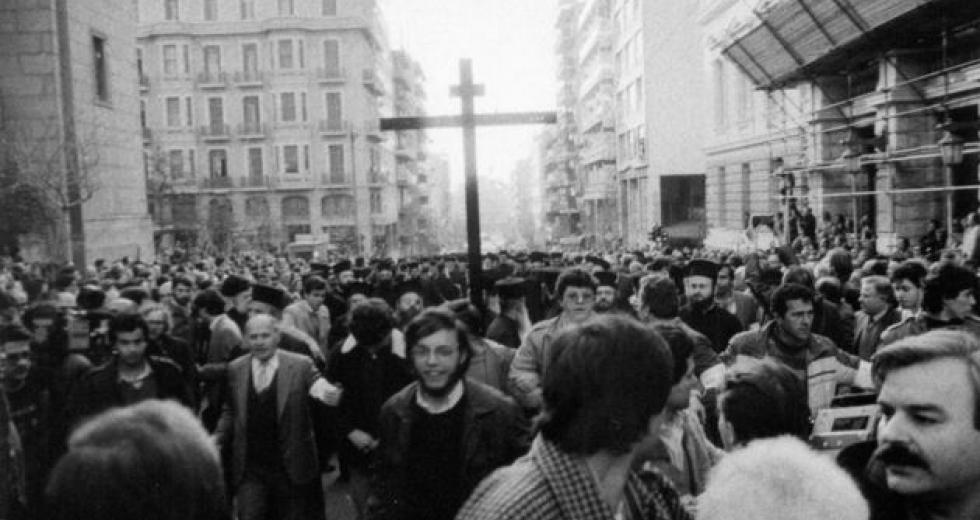
On 1η April there is a big rally in Syntagma with the slogan «Hands off the Church». There (after a short address by the Archbishop) the main speaker is Metropolitan Christodoulos of Demetrias, who used very harsh expressions about the government. It was the first ( on a nationwide level) appearance of Christodoulos who after 11 years would ascend to the archbishop's throne of Athens.
One day later, the «Tritsis Law» (1700/1987), as it went down in history, was passed in the Parliament by the PASOK, KKE and KKEeosot deputies, while the New Democracy deputies left shortly before the vote began.
The law included compromise amendments, tabled at the last minute by the Minister of Education, on the rights of metropolitans in the formation of metropolitan and ecclesiastical councils, which were characterized by the Hierarchy as a «smokescreen» and «mockery».
The metropolitans, hardening their stance, even threatened with the removal of the Autocephaly of the Church of Greece and its subordination to the Phanar again. They also stated that they will not implement the decrees that should have been issued for the implementation of the law and called on the government for new talks from «zero base».
The American intervention
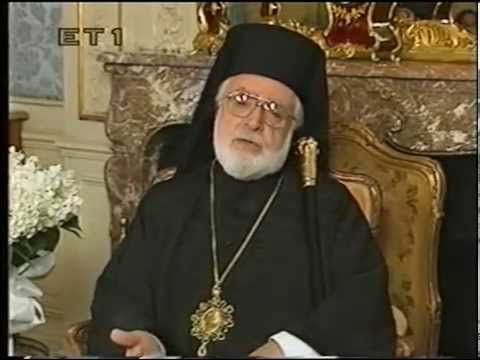
But as time went on, the tension began to subside. The first «discreet» contacts to find a compromise solution even began. Here the «American help» in the person of Archbishop James of America played a decisive role. James, after consultation also with the Phanar, arrived in Athens on 9 June and in all the discussions he had with the Prime Minister, Foreign Minister Karolos Papoulias and the President of the New Democracy, Konstantinos Mitsotakis, the issue of the crisis in relations between the State and the Church was discussed. Despite official denials , everyone knows that James had assumed the role of mediator in this matter as well.
The discussions are proceeding despite the verbal confrontations and the appeals of metropolitans to the Council of State, in which they asked for the law 1700/87 and the decision of the Minister of Education to appoint the members of the new Board of Directors of the ODEP to be declared unconstitutional. The fire of the Hierarchy is slowly beginning to focus on the Minister of Education, leaving the Prime Minister, who is called upon to provide a solution to the problem, out of the picture. Antonis Tritsis is also the reason for the failure to hold two meetings between Papandreou and Seraphim in August. The archbishop refuses to discuss the matter in the presence of the minister responsible for education.
The meeting finally takes place on 17 September. First the archbishop and the prime minister discuss it alone and then they call the minister of education. It is decided to set up an eight-member committee to «regulate issues of the broader spectrum of Church-State relations».
The march towards «conciliation» is not hindered even by the decision of the Hierarchy to impose a «fine», which prohibits the transfer of the seven members of the ODEP administration who were appointed by the Minister of Education. The «fine», which concerned President C. Anomeritis, the vice-president K. Sofoulis and the members Father George Pyrounakis, K. Georgousakos, N. Zacharopoulos, F. Panagiotopoulos and V. F. F. P. Panagiotis, F. P. Panagiotis, F. P. Pafosiou, V. P. Tsakonas and F. Tsakonas, finally came just before Easter of 1988.
«Anthony, you have made history»
The discussions lead to an agreement in principle and on 3 November the Prime Minister and the Archbishop sign the draft agreement on monastic property in Kastri, without the presence of the Minister of Education. Tritsis and other members of PASOK oppose the compromise. In fact, on 7 February 1988, a radical proposal by members of the Ministry of Education to the Committee for the regulation of Church-State relations is published in the Vima newspaper, aiming at the ’abolition of despotism« and the »establishment of a democratic regime in the Church«. The following day the Prime Minister, after consultation with the Archbishop, declares that »the government does not adopt the proposals sent to the joint Church-State Commission by a Committee of the Ministry of Education« and is quick to emphasize the change of climate, saying that «with the Archbishop, who happens to be a personal friend of mine, we had a discussion on the issues concerning the relations between the State and the Church, in which we found sympathy» (do these expressions of friendship remind you of anything in relation to what is happening nowadays on the issues of the State and the Church?).
The fate of Antonis Tritsis is now predetermined. On 13 February, he submitted his first resignation. He even collects his personal papers from his office, but the next day he withdraws it after a meeting with the Prime Minister.
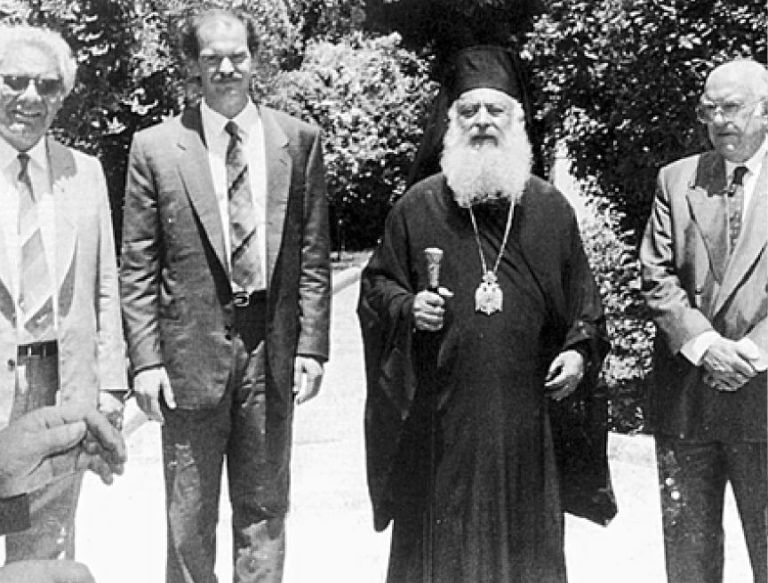
Five days later, on February 18, Papandreou met again with Seraphim at Kastri. The Prime Minister's legal advisors G. Kasimatis and Archbishop G. G. Lilaeus. Absent, once again, is the Minister of Education. And on February 29, Deputy Finance Minister G. Petsos , as a representative of the government, Archbishop Seraphim with the bishops of Alexandroupolis Anthimos and Kozani Dionysios, as representatives of the Church, sign in Kastri the notarial deed for the concession of the property.
For Tritsis, there is no longer any room to remain in the government. He is forced to resign on 9 May 1988. He is essentially expelled. And his expulsion is accompanied by the famous phrase of Andreas Papandreou: «Antonis, you have made history».
For a few days and so for the eyes of the world the ministry was taken over by Apostolos Kaklamanis (from 9 May to 22 June) and then the ministry was assigned to the Prime Minister's son, George Papandreou.
The «winners» and the «losers»
«There are neither winners nor losers», declared Metropolitan Anthimos (now Metropolitan of Thessaloniki) after the meeting between the Prime Minister and the Archbishop in which the pre-contract for the monastic property was finalized. In one respect the metropolitan , who was one of the architects of the solution given, was right. The Church retained most of what it was (for the moment) in danger of losing, while the State kept, albeit weakened, the 1700/87 law.
But a careful reading of the statements of courtesy that are usually exchanged when two opposing sides reach an agreement, and especially what happened (or didn't happen) afterwards, proves that there were both «winners» and «losers» in this battle.
The government was forced to pass provisions which essentially negated the possibility of popular participation in the metropolitan and ecclesiastical councils. Even the Church's high-value urban properties were left out of the agreement.
As for the monastic property, its fate is still pending today.
The decision of the European Court of Justice
The contract was signed by 149 monasteries. But none of them were large. Eight monasteries with huge property (such as the Petraki monastery) appealed to the Human Rights Committee of the Council of Europe, which referred the case to the European Court of Justice, which in turn ruled that the law in question violates the Protocol and Community law and that the Greek state must compensate the affected monasteries. Thus the law became inapplicable...