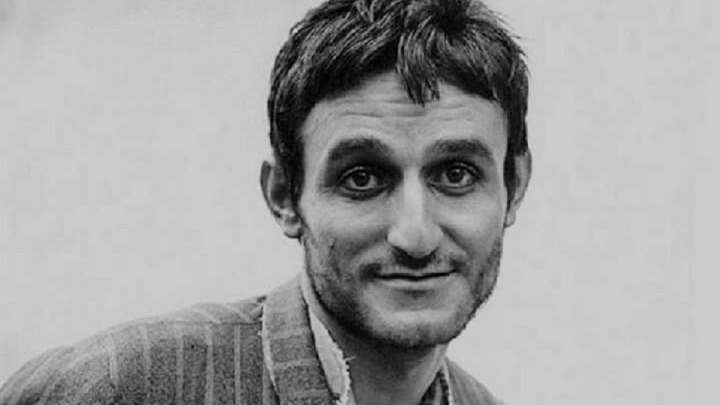
He had all the characteristics of a great comedian, who could combine them harmoniously with drama. The range of characters he could play was enormous, as was his innate gift for improvisation, and even in small roles he managed to steal the viewer's eye, the glamour of the protagonist, to be the magnet for the success of a film. Sotiris Moustakas was another huge talent, who was unjustly treated by the Greek cinema, as he was not exploited as he should have been. He started impressively, even touching the Oscar for the village madman in Cacoyannis” ”Zorba”, he entered the old commercial cinema with some typical supporting roles, he established himself as a leading actor in the decline of the old Greek cinema, became the king of the videotape, together with Stathis Psaltis and closed his circle prematurely with the decent biographical drama ”El Greco", playing Tisiano brilliantly.
Exactly 15 years ago, on June 4, 2007, Sotiris Moustakas, at the age of 66, died of a respiratory infection, after being struck by cancer. On the occasion of the death of the beloved actor, we will remember his youthful years in Cyprus, his first steps in theatre and cinema, but also his passion for gambling, which cost him his artistic career.
Fighter
Sotiris Moustakas was born in the village of Kato Platres, outside Limassol, on 17 September 1940 and was the youngest of seven brothers. Still a high school student, he actively participated in the EOKA liberation struggle from 1955 to 1959, while he was arrested by the British and imprisoned for seven months. Once released, he completed school and in 1958 left for Athens to study acting, despite his father's objections.
The meeting with Nikos Stavridis
The idea of becoming an actor came to him in 1954 when he went to see a theatrical performance by Nikos Stavridis in Limassol. After the end of the performance Moustakas approached Stavridis, imitated him and got his attention, while the popular actor advised him to go to Athens and that he would help him if needed. When he arrived in Athens, he took a job as a waiter and, at Stavridis' urging, took an exam at the Drama School of the National Theatre. Then he met his beloved Maria Bonelou, whom he married in 1973 and with whom he had a daughter, the actress and soprano Alexia Moustakas.
Sulking on the stage
While still a student, he ”crawled” for the first time on the theatrical stage in 1961 in a small role in Dimitris Bogris's play ”Haravgi” and a year later he made his first professional appearance with the company of Kostas Rigopoulos and Kakia Analitis in the play ”A door, five hundred drachmas”. The following year he would also collaborate with the companies of Maro Kontou-Giorgos Panja and Lambros Konstantaras-Maro Kontou, while in the mid-60s he played Aristophanes‘ ”Vultures”, directed by Karolos Koun, while his performance in Moliere's ”Asylum” is also considered memorable.
For two minutes outside the Oscars
But he had already started his first appearances in the cinema and in an impressive way. His brief appearance in the famous ”Zorba” as the village madman would earn him an Oscar nomination for Supporting Actor, but he would eventually be cut from the nomination because of his limited screen time, as the Academy's criteria required him to play two more minutes! Mustakas, who adored Charlie Chaplin like all great comedians, could have continued in Hollywood after his success in the Cacoyannis film, as he would have been invited by Fox to play alongside Michael Kane, but he declined to star in the stage play ”An Italian Girl in Hive”!
From the rolls catcher
His career in Greek cinema for the next five years would be limited mainly to supporting roles, some of which, although the films were mediocre, were endearing. Splendidly playing the good Armenian in ’Light, Water, Telephone... Plots with Doses”, the con man in ”Bufo”, the hungry violin student in ”Beethoven and Bouzouki”, the diplomat in ”Kolonaki Conduct Zero” and many more graphic character roles, he would provide plenty of laughs. Until 1974, when the remarkable leading role in the dramatic comedy ”The Law-abiding Citizen”, written by Kostas Mourselas and directed by Errikos Thalassinos, would come along. At the same time, he continued to do important work in the theatre, while in 1976 he formed his own company, staging the plays ”The Cage with the Madwomen”, ”Fiddler on the Roof” and ”The Good Soldier Sveik”.
King of the videotape
In the ‘80s and ‘90s he would star in dozens of video films and some cheap movie productions like ”Father Gomenius”, ”The Pink Cat” and ”The Cicciolina”. Productions bordering on the uncharacteristic, which did not match Moustakas' talent, but which provided enough income and in record time, as the shooting lasted no more than ten days. And Moustakas needed the money since he had to service his large debts from his passion for gambling.
Incurable gambler
Gambling and especially his passion for the casino is a whole chapter in the life of Sotiris Moustakas. Like other well-known colleagues, he got involved in gambling, from which he lost almost all the money he earned from cinema and theatre. His addiction took him to the extreme, and his life was even threatened when he borrowed money from loan sharks who frequented the casino outside Parnitha and when he could not pay it back, they kidnapped him, threatening to ’disappear” him. Eventually, the theatrical producer Alexandros Parisis, a friend and associate of Moustakas, as he revealed, gave the money, only to be returned in the trunk of a car!
In 2007 he was lucky enough to play the role of Tisiano in the interesting film ”El Greco” by Yannis Smarragdis, while a little earlier he had been awarded the Karolos Koun Prize for his overall contribution to the Greek revue.
And at the top... casino
Sotiris Moustakas, as those who knew him used to say, was an adorable man, sweet and noble. His death will cost everyone, but it will also be decisive for his beloved wife and actress Maria Bonelou, who will die a few months after the man of her life.
Sotiris Moustakas was wronged by the Greek cinema, but he also wronged his own talent, mainly through his participation in a multitude of films and video tapes that he played in after 1980. However, his love of acting and theatre was a given. As he had aptly stated, «Acting is like an elusive and unexplored mountain. You climb with effort, you reach the top and see that there is another peak, and then another. When you say I've reached it, you've lost the game.» Especially when the mountain has a casino...
(Photo from the brief participation of Sotiris Moustakas in “Zorba”)
Harry Anagnostakis