Phoenician juniper L.
Arkeuthos the Phoenician
Cedar, Shrub cypress
The species is characteristic of Mediterranean maquis and spreads mainly at low altitudes throughout the Mediterranean Basin from Egypt to Bulgaria and from Jordan to Morocco.
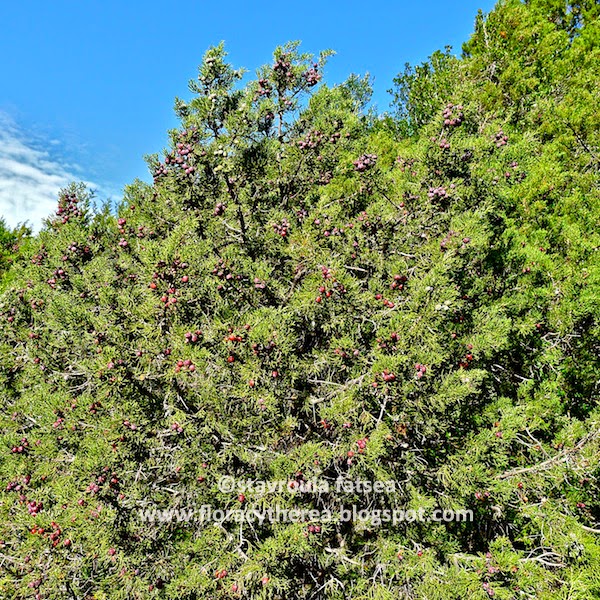
It can reach a height of 8-10 meters, but its low branches, which grow somewhat asymmetrically, give it the appearance of a shrub rather than a straight-trunked tree.If pruned properly, it can take the form of a particularly beautiful tree with a dense conical crown. It is an ancient species, one of the most drought-resistant, and can thrive at altitudes of up to 600 meters.
The cedar tree, which is native to certain areas of the Aegean Sea, used to form small forests mainly in the west and southwest of Kythira. Unfortunately, repeated fires have destroyed the beautiful cedar forests and all that remains are isolated trees and small clusters, mainly in the west and south. The species grows very slowly, regenerates with difficulty, especially after fires, and the possibility of natural reforestation seems negligible. Efforts to scatter seeds in the areas of the burned cedar forest of Mylopotamos have not yielded results so far.
I read on the very interesting blog OPHIOUSSA about the positive results achieved through individual and persistent efforts on Tinos, which gives us reason to be optimistic about our own island. [http://ophioussa.blogspot.gr/2009/10/juniperus-phoenicia.html]
Its common name in Cyprus is “Invisible” and it is found in habitats that have been designated as protected areas under the Natura 2000 network.
In Kythira, as elsewhere, its hard and extremely durable wood was used as a building material (it was used to make beams to support the roof), doors, windows, and other everyday objects. The slow growth of the tree makes its wood very hard, while the aromatic resin it contains is insect repellent and thus not attacked by woodworm.
To this day, traditional folk medicine considers that the leaves and fruits have strong antiseptic properties, while various preparations
(infusion, decoction) made from young twigs have diuretic, stomachic, and digestive properties. Tincture from the leaves is used against diabetes, diarrhea, and rheumatism, while the fruits, after being dried and ground into powder, can heal skin ulcers and abscesses.
<ἄρκευθος>· One is large and the other small. Both warm and thin; they are also urinating, and they chase animals. The fruit of the former is about the size of a hazelnut, while that of the latter is equal to a walnut, round and fragrant, sweet to the taste and subdued, called arkeuthis, moderately warming and astringent, easy to digest, used for chest ailments and coughs and flatulence and cramps and beasts when drunk. It is also diuretic, hence it is suitable for spasms, rashes, and hysterical suffocation.