Smilax aspera L.
Trachea
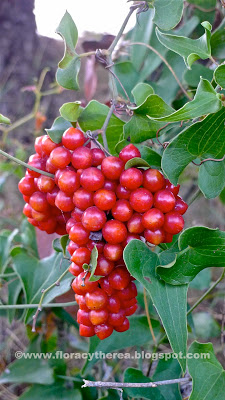
A climbing plant (bush) quite widespread throughout the Mediterranean. In Kythira, it is known as arkovatos. Its leaves are shiny like leather with small thorns at the tips. The fruit is a small spherical berry. It is described by Theophrastus and Dioscorides, who considered it an antidote for all poisons:
σmîlax tracheîa; [those with liver disease, those with calycanthemum, those with cynosvaron, those with anikiton, some the sunflower, some the east wind, some the west wind, some the elxine, the clemenon, the Egyptian lyathos, the konusson, the Roman mergina, the bouloukroum lentum, the Thuskian radia.] Its leaves are similar to those of the vine and it has many thin, thorny stems, like those of the palioros or batos, which twine around the trees above and below, its fruit is botryoid, ripe red, mild in taste, its root hard and thick; it grows in marshy and rough places. Its leaves and fruit are deadly when drunk or eaten. It is said that if someone rubs some of these on a newborn child and gives it to drink, it will not be harmed by any poison.
Dioskuridis
Other common names in Greece: arkoudotas, xylovatas, and smilagi. The genus Smilax includes 300-350 species, many of which are widely used in the pharmaceutical industry in the Western world because they contain valuable therapeutic substances. Arkoudo is considered to have similar properties to sarsaparilla or sarzaparilla, as several species in Central America and Jamaica are called. The young shoots are eaten raw and resemble asparagus, while the root of the plant is considered to cure psoriasis, bronchitis, asthma, and rheumatoid arthritis. The juice of the ripe fruit is considered to be therapeutic for skin diseases.
Other common names in Greece: arkoudotas, xylovatas, and smilagi. The genus Smilax includes 300-350 species, many of which are widely used in the pharmaceutical industry in the Western world because they contain valuable therapeutic substances. Arkoudo is considered to have similar properties to sarsaparilla or sarzaparilla, as several species in Central America and Jamaica are called. The young shoots are eaten raw and resemble asparagus, while the root of the plant is considered to cure psoriasis, bronchitis, asthma, and rheumatoid arthritis. The juice of the ripe fruit is considered to be therapeutic for skin diseases.
Ancient Greek mythology has a beautiful story about the origin of the name.
The beautiful nymph Smilax fell in love with a young Spartan named Crocus, with whom Hermes himself was in love. The unfortunate love story had a corresponding ending, with the young man being transformed by the god (or Artemis) into the crocus plant. Aphrodite then transformed the tragic nymph into a climbing plant so that she could be with her beloved for eternity.