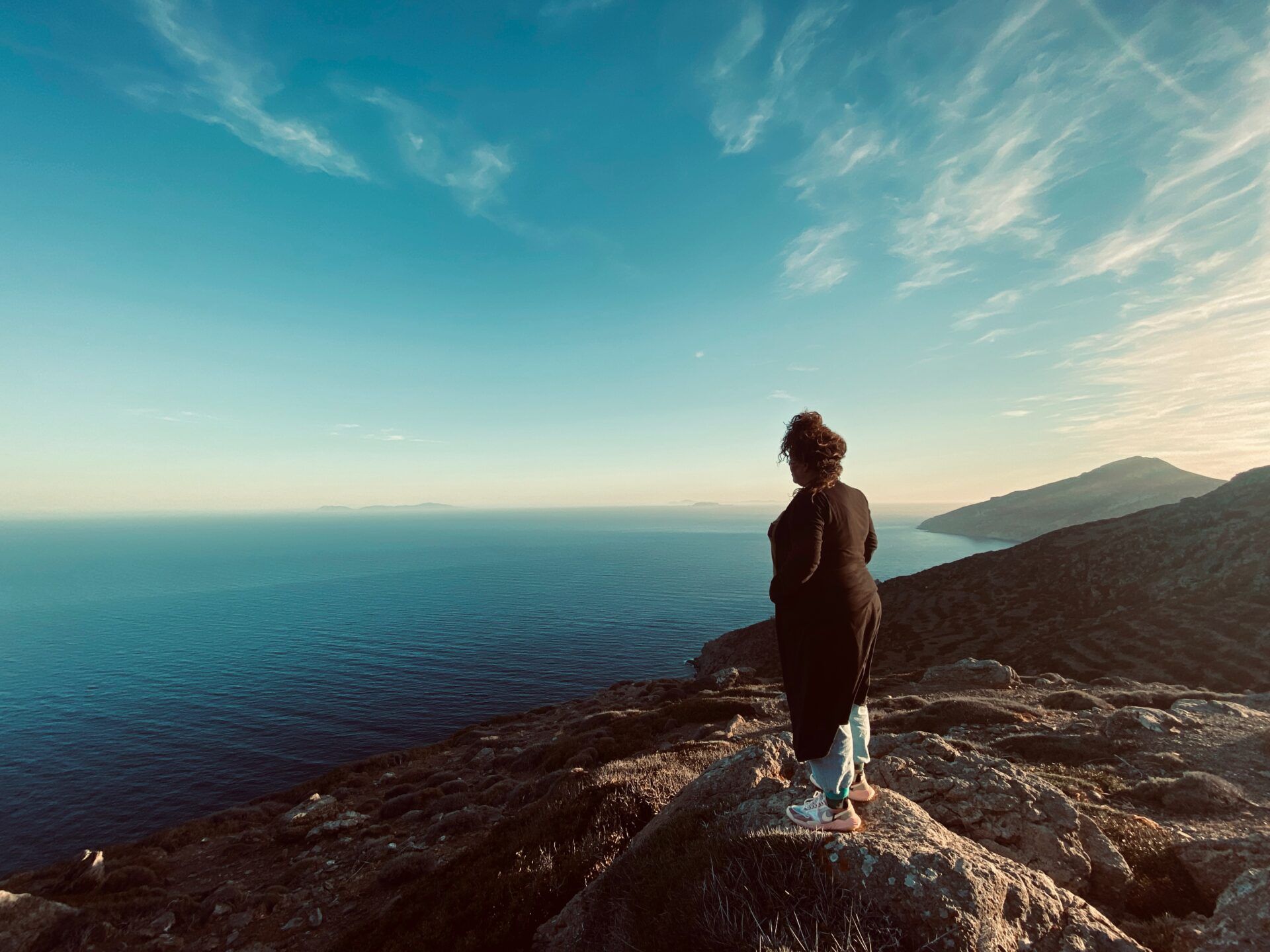
In winter she lives in Amorgos with her goats and in summer she travels around Greece from place to place, she enters our house without having the key and fills it with melodies, lyrics, messages and words that touch our souls with every possible emotion, joy, sorrow, pain, nostalgia. Matoula Zamani loves traditional music, simplicity in everyday actions, she seeks freedom and in her concerts she feels naked in front of her audience.
In a world that is getting narrower and narrower, with a unique weapon of love and sharing, Matoula will be in front of us with a new sound, songs and joy, on Monday 16 September at Labattoir in Thessaloniki and invites us to travel with her and become one in her musical journey.
Matoula believes that home is where you have the people you love around you and considers her decision to move permanently to Amorgos to be one of the best of her life.
«I went to Nikouria, I saw a little house and I said to myself: “Should I try to stay a little longer?”. That might have been one of the best decisions of my life. I live there in the winter and in the summer I travel for our tour. I've always believed that home is where you feel best yourself, with the people you have around you and love. An island is very beautiful but if you're not good with yourself and you don't have two people you really fit in with, then it doesn't say anything. Even on the island a lot of people are not well because they don't have someone to really talk to, there's a hypocrisy. There's loneliness when you don't have people to say a few extra words to. No matter how much you walk, no matter how much you travel, if you carry your trauma and your hypocrisy, the one they've put on you, you're not going to be okay anywhere. Just the beauty of waking up and being in the Aegean Sea is something incredible that cannot be compared.
For some people, life in the village may not be nice, because it is a very small society that does not suit everyone. But they find a way to escape. I believe that life gives us doors to escape and choose what is closer to us. We just have to open our eyes and see them too.».
She remembers her childhood surrounded by clarinets and dulcimers, thus recording traditional music in her subconscious. Her music blends sounds of folk, art, rock, traditional and even pop. She incorporates the traditional element she loves so much, using it as a “weapon of beauty” in her songs, connecting the old with the new.
«I started playing various traditional songs I was listening to from a young age and it all came naturally to my own songs. Some of my songs are completely unrelated, completely... wimpy. Others I incorporate the traditional element into them in a way that suits me. If I do a cover of a traditional song, I do it without violating the original. I like the arrangements of traditional songs that I hear now and the artists make them their own. So I try to incorporate the traditional song into my music as a “beauty weapon”, to connect the old with the new. To put a rock to step on to go somewhere else you don't know, but you have these gifts in your quiver.
When you snub traditional music yourself, it never goes away from you or around you, it just waits for you in the corner. These genres were terribly discredited for many years. I was at a festival the other day and it was going nuts, with great quality playing on stage, people were playing their hearts out. The people below were enjoying it, dancing, singing. These people who have never stopped playing what they love, are now being “vindicated”. The way of life has changed, fairs are a meeting place where everyone goes.
Even if you can afford it, not everyone can now go to the bar and blow 100 euros for a night out. They will drink their rakes and tsipouros at the fair, dance and have a good time. And after all, we grew up in a village!».
He considers the creation of a song a small rite of passage and loves every part of the process.
«The whole process of creating a song is like taking a thought and dressing it up to go out to sea. The lyrics that come to you, the ones that don't. The times you'll let it go and pick it up again. To get to a point and eventually it's not pretty. The hours in one song can be many, in another few. Ideas come to you, one day you can imagine it “naked” and another you can say “something is missing”. The process is like a little ritual.“.
She doesn't know if she wants to pass conscious messages to the world through her songs, but she definitely wants to make those who listen to her and see her on stage feel all the emotions of everyday folk life. She does not shy away from pain, sadness and anger. They are also processes of life.
«I don't know if I want to consciously pass something on to the world. What I want to pass on unconsciously is that you meet with some people, you all sing together, you share your thoughts and your music that can accompany each other's lives. I want to share all the emotions of everyday folk life: love, pain management, letting go, how nice it is to be yourself, to talk. For the last 7 years these have been the subjects of my pieces. Pain, grief, anger are life processes, we don't avoid them. To be as little hypocritical and self-interested as possible and as much ourselves as possible. “And wear yours” gets this very message across: however you are, smile in your own way, don't deny it.».
The sense of unity she sees and feels at her concerts is magical for her. She wants her audiences to take a dose of freedom from the concerts and join her in the struggle of their daily lives.
«You see that no matter how far we are from each other, in the end we are united by common instincts, loves and human attitudes. It's magical to see people who don't know each other in each other's arms. Music, even if you don't understand the lyrics, makes you vibrate with others together and share things. I love for the other person to feel free for a moment at the concert and I wish for them to get that freedom in their everyday life. It's a struggle in life, to make it a click more beautiful and more free. Because of course not all parts of it are beautiful and happy.“.
For Matoula there is no recipe for a successful concert.
«If you have a certain song schedule, the same jokes on stage, an office behind you telling you what to say to make it flow smoothly, it all hits a wall at some point and stops working. A successful concert is when you are so exposed and you feel naked on stage and you give yourself to a world that is also naked at that moment. I don't know if it's successful, but at least it's real.
In Xanthi we played a song on the subject of Palestine and Tempi. While I was singing the song a wind blew, a breath that we all felt. In every place you feel something different. You basically enter people's house and they enter yours, without keys. That's magic.».
She hasn't worked with many artists by choice, but she considers the encounters she had from her first contact with music to be decisive.
«I thank all the people who suggested that we work together, but at the time I felt like they were chasing or I was chasing something else. All my encounters were crucial, from my parents sending me to music high school, to my teachers there and the kids who played our first songs together in little bars. Then the years on the islands playing people the songs we liked. Then The Burger Project who we created Gypsy together and played together for a long time. Of course, Thanasis Papakonstantinou who is a whole universe in himself and our universes came together and we spent some magical years together. I never expected that “I'm talking about you”, which Melina Kana has stamped on it, would come to life again at Technopolis in 2016. Everything becomes definitive in a way you don't expect.».
The years alongside Thanasis Papakonstantinou passed quickly with ease and difficulty. At his last concert, she enjoyed him from the side of the audience, with their shared moments in their musical journey passing before her eyes.
«When you're honest with a person, it rolls off. With Thanasis without much - the relationship flowed and it was very strong for me. At the last concert because I had gone very emotional, I didn't want to go on stage at all, I just wanted to watch the concert. Martha Frindzila told me to get on stage and sing with her and I didn't realize when I got on, I sang and got off. I was in another world. I wanted to watch, as an audience, the concert of a man and a group that we had been together for 5 years. It was a powerful feeling, I felt the years we traveled together pass before me, nostalgically. His pause now marks something new, his own. Thanasis is taking his own time in things and that's the best part.».
She has found herself listening to more and more rap music, with her collaborations with Invasive and Vevilos intensifying her love for the genre. For Matoula, rap music brings out... “blood” and realism.
«I would work with rappers again with great pleasure if it was something that suited us at the time. I listen to all people's music and lately I've found myself listening to more rap. I really like Bloody Hawk, the Vevil tracks and in my own phase as I'm experiencing it right now, their tracks have brought out... “blood” and realism in me, whether it's about all the stuff we're living through or about love.
I don't believe in the labels they put on rap at all. The attitudes behind it, in all genres, are either good or they're bad. It doesn't matter what we label each and every thing to endure.».
For Matoula, art and music cannot be censored. «They can be dismantled, however, by the very people within it. Many times I feel that in our space, music doesn't happen, it becomes... shops. “Our little shop doing well.” But the music itself doesn't stop at all. It can take a beating, but in essence it's not censored. If every bitter man cries out for no reason, that's not censorship. For the message that is to reach a man's ears will reach his ears. In concerts, the messages come through very clearly and you can't stop a person from feeling what they are supposed to feel.’.
The war in Palestine and the accident in Tempe turn her stomach. Everything she hears every day affects her and, as she says, she is consumed by the question «why?».
«We are living a horror in a difficult landscape of a country that is being sold out every day with the tourism bias. And from people who had orchards of lemon and orange trees, we have become slaves to Fresno espresso. In this sold-out country we live in, where you don't know what rights you have, all the things we hear every day affect me, I'm itching to know “why?”. I try to be strong and offer where I can help with all of this, I don't hide. How everyone feels and what they say is another priest's gospel. It's all about simplicity, every moment of a person deciding to do something. He doesn't say, he does.
To me, a revolution is the woman who goes to work at five o'clock in the morning and decides to put water on a stray cat. Revolution is not a verse and a lifestyle.».
The coronavirus and the quarantines found her on the island. The social explosion brought by the pandemic confirmed the loneliness and showed the reality, according to Matula.
«All this found me in Amorgos, where we didn't understand anything. We just saw that a beach that was usually full in July was suddenly empty. When I left for the big cities, I saw fear, horror, anger. Then I saw thirst. I saw people either moving closer to what they wanted, or angrily claiming it. It was all more an expression of our true selves, embraced with fear.
That's why people broke up, some became stronger again, some got lost to find themselves again. Others said: “Is this how my life will be from now on? I don't want to,” which takes strength and that too.».
When she imagines herself in 10 years, she sees simplicity.
«In ten years I will be... 11.5 years old! In the last few years, with a short life, I have been composing the biggest part of my life. From the music I listen to, the people I see, the lyrics I write, the jobs I have to do during the day, my life is composed. In ten years I see myself in love, as I am now, writing music, being able to play, being good with people and being able to say “What a great day!” despite the difficulties. Everything else we can handle.».
After many years of abstaining in the winter by choice, this year he decided to be with a microphone in hand.
«The way I dream things are, it's a far cry from the way the stores are running now, which of course they're struggling too but... I just want music to be for everyone. So this winter will find me playing music in Athens, Thessaloniki, Cyprus and abroad in March.».