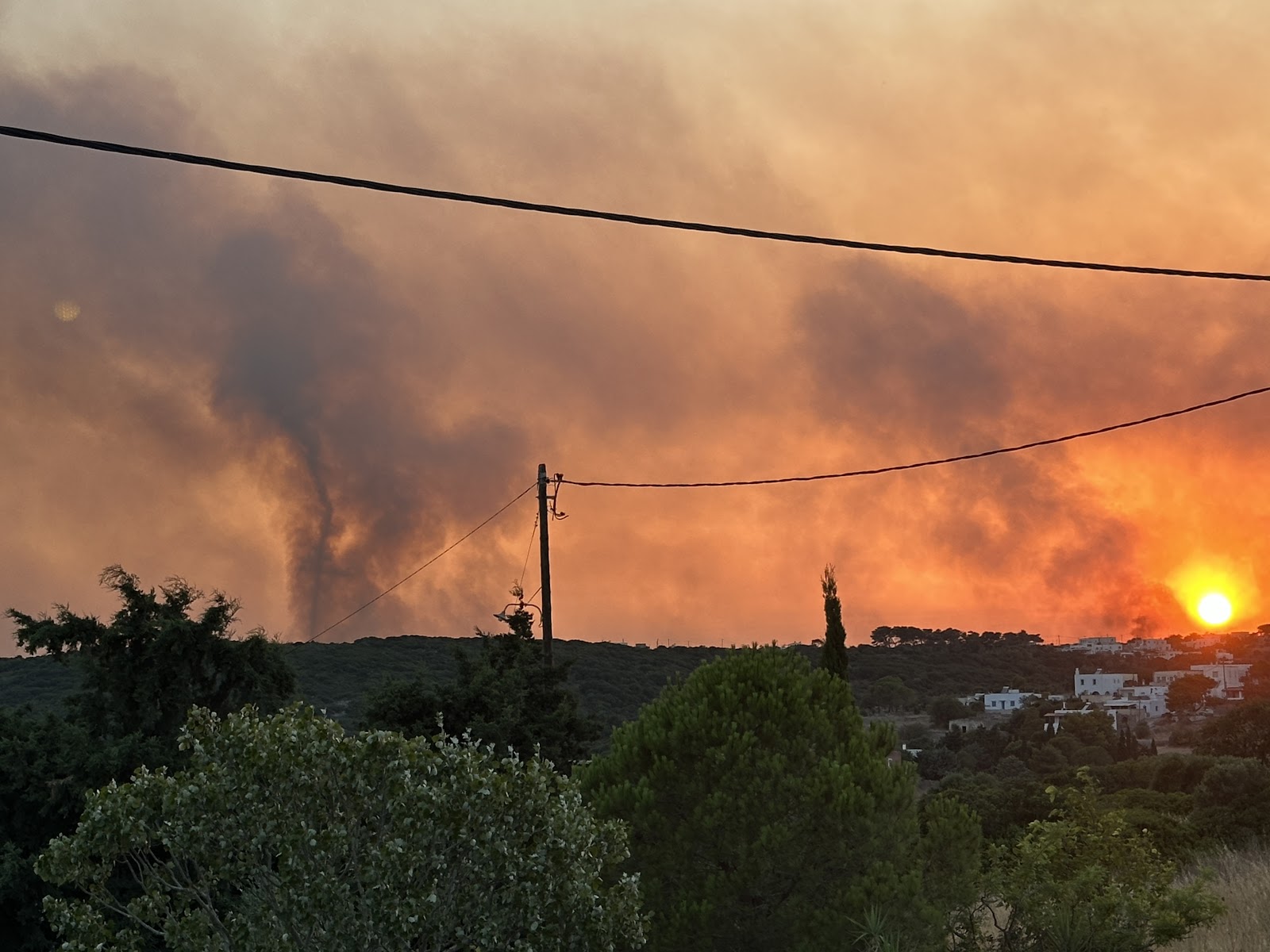
I am returning after eight years. Have we learned anything from the devastating fire of 2017? The outcome suggests not. So I return, hoping that in two, five, or ten years' time, we will not be crying again over the charred, desolate landscapes of our island.
Forest fires are a natural but also man-made phenomenon with profound ecological, social, and economic consequences. Public debate often focuses on the «aftermath»: what should be done immediately after the fire, how to «save» the forest, and how to prevent future disasters. However, human intervention is equally critical. before from a fire, as well as understanding the limits of intervention after from it. I am returning after eight years. I wonder if those responsible learned anything from the devastating fire of 2017. Judging by the results, it seems not.
Before the forest fire: prevention or institutionalized failure?;
Human activity plays a decisive role even before a forest fire breaks out. The abandonment of the countryside, the cessation of traditional grazing and gentle forest management have led to the accumulation of combustible material. At the same time, large-scale interventions presented as «preventive» are often implemented without ecological and forestry planning, resulting in disruption rather than strengthening the resilience of ecosystems.
A typical example is the program AntiNero, which was also implemented on the island of Kythira as a measure to prevent forest fires through extensive vegetation clearing. According to documented findings in the scientific literature on Mediterranean forest ecology (Keeley et al., 2012; Fernandes, 2013; Moreira et al., 2011), interventions of this type must be highly targeted and ecologically adapted.
In practice, as pointed out by Greek foresters, university forestry departments, and collective scientific bodies, in many cases, and unfortunately in our own as well:
- low and medium vegetation was removed without taking into account its ecological function,
- the structure of the forest and the microclimate of the soil were disrupted,
- the cut branches and debris were not removed but remained on the ground,

resulting in the total flammable fuel increase rather than decrease, which is in direct contrast to international fire prevention guidelines (FAO, 2018).
Furthermore, the implementation of the program was often based on contracts without prior forestry studies per region, without analysis of local vegetation, and without effective monitoring of implementation by the competent forestry services, as required by Greek forestry legislation. The absence of scientific documentation, monitoring, and evaluation makes such interventions not only ineffective but potentially dangerous for the long-term health of forest ecosystems.
Effective prevention is not a matter of mass clearing. It requires targeted fuel management, maintenance of mosaic vegetation, and respect for the natural dynamics of the forest, as extensively documented in the international literature on Mediterranean ecosystems (Pausas & Keeley, 2009). When these are replaced by hasty, contractor-driven solutions, fire is transformed from an ecological factor into a predetermined disaster.
After the fire: when and how should we intervene?;

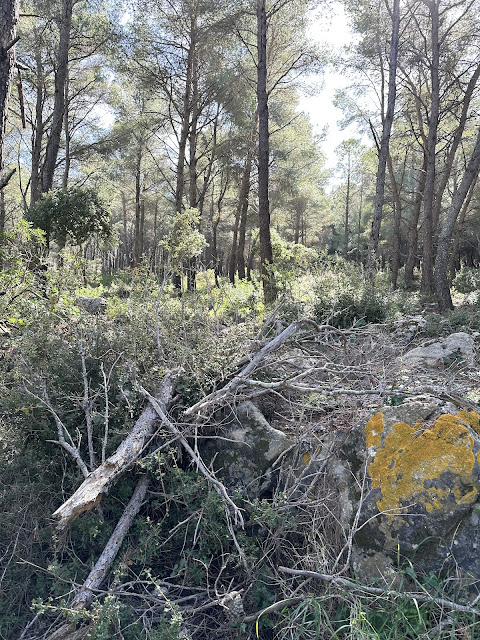

After a fire, there is considerable pressure to take immediate action. However, scientific knowledge shows that not all interventions are necessary or always beneficial.
Flood protection works: log booms and steps
Flood control projects, such as log booms and berms, are designed to retain soil and reduce surface runoff. They are indeed critical in areas with:
- steep slopes,
- heavily eroded or fine-grained soils,
- high risk of extreme rainfall,
- absence of rapid natural regeneration.
However, in areas with gentle or moderate slopes, good soil structure, and the presence of underground shoots or seed banks, extensive construction of such projects may be unnecessary or even harmful. Heavy mechanical intervention often disturbs the soil more than it protects it, destroys young plants, and alters natural restoration processes.
The implementation of flood prevention measures must be based on local assessments rather than generalized formulas.
Reforestation and tree planting: solution or problem?;

The idea of mass tree planting after a fire is deeply rooted in the collective consciousness. However, in Mediterranean ecosystems, many species are evolutionarily adapted to fire and have strong natural regeneration mechanisms, mainly through regrowth from stumps.
A critical but systematically underestimated factor in the failure of natural regeneration is grazing, especially from unattended sheep and goats. The young shoots that sprout from the stumps after a fire are extremely vulnerable, and continuous grazing can destroy them completely, as documented in studies on post-fire ecology in the Mediterranean (Keeley et al., 2012; FAO & UNEP, 2020).
In Greece, the management of unattended productive animals is regulated by the relevant legislation (Law 4056/2012, as applicable), which sets out clear responsibilities for owners and express obligation of local government bodies ensure collection, storage, and enforcement of penalties. Failure to enforce this law, especially in burned areas, effectively nullifies natural regeneration and leads to chronic degradation of ecosystems, regardless of whether reforestation takes place or not.
In this context, direct or indiscriminate reforestation often:
- destroy natural regeneration by trampling or uprooting young shoots,
- obscure the real problem of uncontrolled grazing,
- introduce species that are unsuitable or foreign to the natural flora,
- create artificial, ecologically vulnerable clusters.
Even after time has passed, tree planting only makes sense when it has been scientifically proven that natural regeneration has failed and after effective grazing control has been implemented. The role of volunteers is valuable only when it is part of a strictly scientific and institutionally controlled framework; otherwise, good intentions can turn into long-term ecological damage.
Nature knows best – humans must respect it
The biggest challenge after a forest fire is not to «rebuild» the forest, but to allow nature to do what it knows best evolutionarily. Human intervention is only necessary where natural mechanisms have been truly undermined.
The transition from impulsive action to targeted, evidence-based intervention is a key indicator. environmental maturity. In an era of climate uncertainty, the protection of forest ecosystems will not be judged by the number of trees planted, but by our ability to understand the limits of human intervention and respect the dynamics of nature.
Indicative bibliographical references
- Keeley, J.E., et al. (2012). Fire in Mediterranean Ecosystems: Ecology, Evolution, and Management.Cambridge University Press.
- Pausas, J.G. & Keeley, J.E. (2009). A burning story: The role of fire in the history of life. BioScience, 59(7), 593–601.
- Moreira, F. et al. (2011). Landscape–wildfire interactions in southern Europe: Implications for landscape management. Journal of Environmental Management, 92, 2389–2402.
- Fernandes, P.M. (2013). Fire-smart management of forest landscapes in the Mediterranean basin. Forest Ecology and Management, 294, 175–186.
- FAO (2018). Fire management – Voluntary Guidelines. Food and Agriculture Organization of the United Nations.
- FAO & UNEP (2020). The State of Mediterranean Forests.
- Forestry Service & University Forestry Schools of Greece: Public statements and technical reports on the effectiveness of vegetation clearing without forestry studies.
- Ministry of Environment and Energy (YPE): Institutional framework and implementation of the AntiNero program (public documents and announcements).
- Greek legislation on unattended farm animals (e.g. Law 4056/2012, as applicable): Obligations of owners and local authorities for collection and management.
Conclusion – When impressionism replaces science
The experience of recent years clearly shows that grandiose announcements of forest «protection» projects are often aimed more at public opinion than at the ecosystems themselves. When decisions are made based on speed, communication benefits, and budget absorption, without adequate scientific planning and careful, locally adapted studies, the result is not protection but further degradation.
Nature does not operate with horizontal measures, contracts, and general prescriptions. Each forest system has its own history, dynamics, and resilience. Ignoring this reality transforms «intervention» into arbitrary management and prevention into an excuse.
In this context, projects implemented without forestry studies, without effective control, and without scientific evaluation do not serve ecological restoration. They serve interests, timetables, and narratives of success. And as long as forest protection is treated as a communication product rather than a complex ecological process, the same failures will be repeated.
Real responsibility towards forest ecosystems does not lie in impressive announcements, but in silent, documented, and often unspectacular work based on scientific knowledge, institutional consistency, and respect for the limits of human intervention.
Stavroula Fatsa