Horsetail L
Hippuris agrostis
On the banks of streams, in wet, even shady places, grows the polycombi, the last descendant of the large family of hippurids. Its relatives, which appeared during the Paleozoic Era, were tall, tree-like plants. They reached their peak during the Carboniferous Period 360-300 million years ago. These majestic ancestors collapsed, forming the coal deposits that humanity still uses today. Their modern representative is the less impressive but very useful polycombi.
Known for its healing properties since at least the time of Dioscorides, who considered it an excellent wound healer. Pliny, who first used the name equisetum, describes it as a miraculous medicine that can stop bleeding with a single application. Even today, it is considered excellent for the regeneration of connective tissue in the skin, for healthy hair and nails, and as a remedy for acne and various skin conditions.
It is considered a powerful diuretic and is used in traditional medicine for all conditions related to fluid retention, obesity, diabetes, eye swelling, arthritis, rheumatism, kidney stones, etc.
Modern research confirms the high content of silicon and potassium, alkaloids, saponins, manganese, magnesium, and sulfur in the plant's tissues.
Due to its strong diuretic effect and its content of active ingredients, it should be used with caution and only on the advice of a specialist.
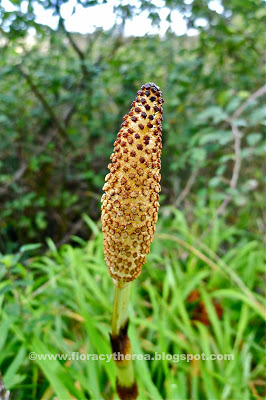
Many common names with which we encounter it in various parts of Greece and the world, as well as its scientific name, from the Latin equisetum> equus= horse + seata= hair, refer mostly to the appearance of the mature plant, which resembles a horse's tail. English horsetail, French queue-de-cheval, Spanish cola de caballo.
In the Middle Ages, blacksmiths and metalworkers, along with alchemists, valued the plant for the magical powers it could impart to swords and armor, and used the rough surface of the leaves to polish metal and precious stones. In Kythira, ripe plants were once used to wash glass bottles.
I would like to thank my good friend Dimitris for showing it to me, as it only appears in a limited area on Kythira.