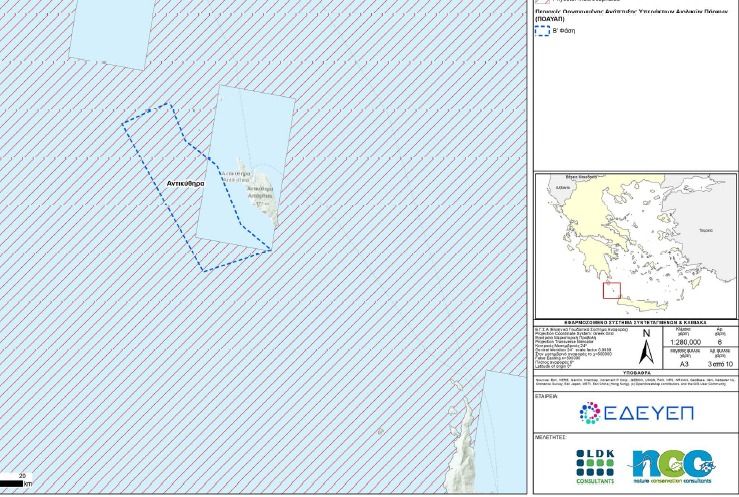
On 29 October 2024, the Regional Council of Attica will meet to give its opinion on the Strategic Environmental Impact Study (SEIS) of the National Offshore Wind Farm Development Programme (OWP), with particular interest in the case of the installation of a wind farm in Antikythera. The meeting, to be held in Agios Stefanos, will examine the potential environmental impacts and benefits of implementing these large-scale energy projects, especially in sensitive areas such as Antikythera, which is within the Natura 2000 National Network.
The issue of the installation of wind turbines in Antikythera has raised legitimate questions in the recent past, as it is an area of particular importance, known for its unique biodiversity and its strategic location on the migratory flyway of birds. Antikythera is considered one of the most important areas in the Mediterranean for birds, and any alteration of the environment could have serious consequences. The installation of wind turbines up to and including 280 metres and 15 MW of power raises concerns about their impact on the ecosystems of the area, in particular due to the close proximity of protected areas.
It should be noted that SYRIZA has criticized the government for the National Development Programme for YAP, which focuses on these issues, as the government moves to install offshore wind farms without the completion of the Maritime Spatial Plans. MP Miltiadis Zambaras testified topical question in Parliament, noting that the absence of integrated spatial planning poses serious risks to environmental balances. SYRIZA stresses that the wind turbines in Greece will be installed at distances of only 500 meters from protected Natura sites, while in other EU countries the wind turbines are placed at least 10 nautical miles from the coast.
The Chamber of Environment and Sustainability, in collaboration with other scientific bodies, has expressed serious reservations about the impact of wind turbines on marine life and biodiversity, noting that the environmental impact studies do not adequately address these issues. Also on the issue of maritime spatial planning The WWF has also intervened with a relevant complaint.
There is no opinion of the Municipality of Kythera
The Municipality of Kythera has not yet submitted an opinion, despite pleas from the Region. This fact has raised legitimate questions, as there is awareness in Kythera from the residents, who insist that they will not be able to do anything about it. a meaningful consultation on the future of their regions. At the same time the Municipality of Megareon has already submitted its views, disagreeing with the proposed siting of wind farms, citing impacts on the environment and local communities
The development of this case is expected with great interest, as the Regional Council will be asked to balance the needs for energy development with the protection of natural and environmental resources in sensitive areas such as Antikythera.

The Kythera Citizens' Movement already aware of the plan since last year
It should be noted that the Kythera Citizens' Movement has already issued since last year press release on the project the National Offshore Wind Farm Development Programme. It will be interesting to see what the movement's view will be after the latest developments.
What the Antikythera proposal says
In its opinion on the Strategic Environmental Impact Assessment, the CommissionThe subject of the submission will be only the Antikythera PDWAP and the coastal zone which belong to administratively in the Region of Attica. Read below:
WORKS AND ACTIVITIES WHICH MAY RESULT FROM THE IMPLEMENTATION OF THE PROGRAMME IN THE ANTI-POLLUTION PROGRAMME
Floating A/V action
The floating installation of wind turbines is one of the recent technological developments in offshore wind energy and allows the installation of wind turbines in water depths greater than 60m. A major advantage of floating bearings is the reduced activity on the seabed during the installation/construction phase, as no pile driving on the bottom is required. Floating-bearing SSTs consist of A/Vs mounted on floating bearing arrangements, connected by an anchorage system to the seabed, which holds them in place. Figure 3.8 shows an illustrative list of types of bearing and anchorage arrangements in relation to (a) their installed capacity and (b) announcements of CSP projects up to 2027 globally.

Phases required for the implementation of the project
With regard to the activities expected to be required for the construction, operation and decommissioning of the SIP projects, indicative activities include (https://guidetofloatingoffshorewind.com/guide/i-installation-and-commissioning/):
Α. Field survey phase for data collection within the WFD (survey permit) [indicative duration 3 years]
At the stage of the SIA Research Licences, the following indicative work and studies are summarised below:
- Measurement of oceanographic and atmospheric parameters (Metocean campaign): collection of atmospheric and oceanographic data on the basis of which the design of the SIP will be carried out (e.g. layout of the A/C, sizing of the foundation), the energy produced will be estimated and the prevailing conditions in the area of interest will be described in detail.
- Geophysical study: The study involves mapping the seabed, determining the characteristics of the seabed and its geological substrata. In addition, during these studies it is possible to identify potential seabed challenges that require special attention such as unexploded ordnance, shipwrecks and geohazards (e.g. underwater landslide, faulting).
- Geotechnical study: This study involves the collection of surface sediment and core samples from the seabed in order to investigate the physical characteristics and technical properties of the seabed.
- Environmental research: This study includes field work to record avifauna, benthic communities, marine mammals and turtles, fish fauna, as well as marine water quality measurements/analyses and underwater noise measurements, landscape mapping. Based on the data collected, the potential environmental impacts of the development of the MPA in an area are assessed.
- Study for the laying of submarine cables: this study includes bathymetric mapping and seabed composition assessment work, as well as the assessment of the potentially significant environmental impacts of the laying of submarine cables and the construction of an onshore substation.
- Impact study on the man-made environment: this study includes, inter alia, a study of archaeological and cultural interest, as well as the study of socio-economic impacts at the local level. Depending on the area of interest for SIA development, studies may be included to assess the impact on aviation and navigation.
Β. Construction phase of the floating-bearing CSP (indicative duration 3-4 years for 450 MW CSP)
- Monitoring of birds, marine mammals and turtles during construction works.
- Installation of an offshore hydroelectric power plant.
- Laying of submarine electric interconnection cables in the ESMIE.
- Construction of onshore electricity interconnection networks (underground cables, overhead GM, TSOs) - if submarine interconnection to the ESMNO is not feasible.
- Installation of anchors on the bottom at the bearing positions of the floating A/Gs.
- Transport of floating vessel sections from the service port to the berths and on-site assembly of vessels.
- Installation of floating A/Cs in the bearing positions.
Attached are the relevant documents of the recommendation to the Regional Council