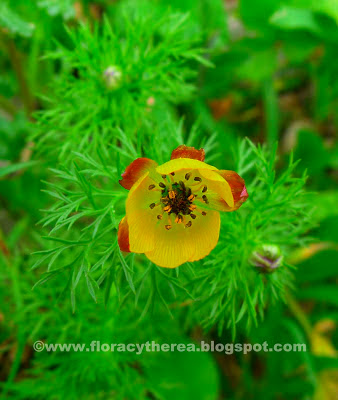
Adonis cretica (Huth, 1890) Runemark 2002
Syn. Adonis microcarpa DC var.cretica HuthSyn.
Adonis aestivalis L. ssp cretica (Huth) Steinb
A rare annual plant, endemic to Crete, hence the name of the subspecies. It blooms from February to April. The main color of the petals is often yellow, while in the microcarpa species, which is quite widespread throughout the Mediterranean, it is more often red. I found this species in very small numbers in two different locations on Kythira. (First report for the island)
The name of the plant
Adonis was the fruit of Myrrha's illicit love for her father, King Cinyras of Paphos. Myrrha was transformed into a tree as punishment for her sin, and from the trunk of the tree, Myrrha or Smyrna, the infant Adonis was born. Aphrodite secretly placed him in a wooden chest and gave him to Persephone to raise in Hades. As Adonis grew up, his beauty was so great that Persephone fell in love with him, refused to give him back to Aphrodite, and wanted to keep him forever in her dark world. Aphrodite asked Zeus to arbitrate, and he decided that Adonis would live four months with Persephone in the Underworld, four months with Aphrodite, and could spend the rest of the year as he wished. Adonis chose to spend his extra time with Aphrodite, as their love was mutual. Aphrodite devoted herself to him so passionately that Ares, blinded by jealousy, sent a wild boar and killed him before her eyes. From the tears of the inconsolable Aphrodite, roses sprouted, while the drops of blood from the unjustly slain Adonis were transformed into beautiful flowers. (Ovid Metamorphoses)
Adonis or Tammuz in Phoenician (Adon = lord and god, address of the supreme god in Semitic languages) symbolizes death and rebirth.
The ancient Greeks celebrated the Adonia in honor of Adonis and Aphrodite during the spring equinox. Wooden effigies of the god were adorned with flowers exclusively by mourning women who reverently performed all the funeral rites.
Then, the dead god was carried through the streets accompanied by mournful songs and a special flute called a gigras. Nine days before the festival, women planted fennel, wheat, lettuce, and other plants that sprout quickly but also wither quickly in ceramic pots called “Adonis gardens.” and which, after the procession, were thrown together with the wooden effigies either into the sea or into a river or spring near their home. This first day was called “Afanismos.” The next day, they celebrated with dancing and laughter at lavish tables, the “Eureka,” that is, the resurrection, the rebirth of the god. A wonderful description of the celebration can be found in Theocritus' Idylls, translated by I. Polemi:
“Miss, you kissed Golgotha and Idalion, you played the lyre, you played with gold, Aphrodite,
Like Adonis, whom Acheron carried away in the twelfth month, soft-footed Orai.
Vardistai Makaron, Orai philae, all but the desired ones come to all mortals, always carrying something.
Lady, who longs for Golgotha and Mount Idalion and the lofty Eryx to play, Aphrodite;
always light-footed, they bring you every year, through Acheron, your Adonis, the Hours;
these slowest of the immortals, who bring something good to all mortals when they arrive.
Cyprian Dionysius, you made Berenice immortal from mortal men, as a myth.,
I distilled ambrosia into a woman's breast; but what I gave her, I gave her many times over, and many times over.,
Berenice, daughter of Helen, Arsinoe, surpasses all others in beauty.
You, daughter of Dionysus, beautiful Aphrodite, have made the mortal Berenice immortal, dripping divine ambrosia onto her breasts.
And Arsinoe, her daughter, beautiful as Helen, celebrates Adonis, rich and magnificent, for your sake, O renowned and much-loved one.
For the boundaries lie where the oak trees stand, but some are kept safe in silver talismans, I will sing with golden alabaster.
All around him lie the fruits of the trees and flowers, cool in silver baskets and in golden jars from Syria.
I saw what women suffer on the plane, flowers mixed with white flour, and honey mixed with sweet olive oil, all of them with wings and crawling creatures.
All around him are delicacies artfully prepared by women, mixing flowers and white flour and other ingredients such as sweet honey and pure oil; all kinds of birds and snakes near him.
The green shadows, soft with dew, were shining; and the shepherds were singing.
Love, like birds flying freely among the trees, trying out their wings, flying away from me.
The cool anise kiosk has woven blossoms; newborn loves flutter timidly around, like little birds beginning to fly and testing their wings branch to branch.