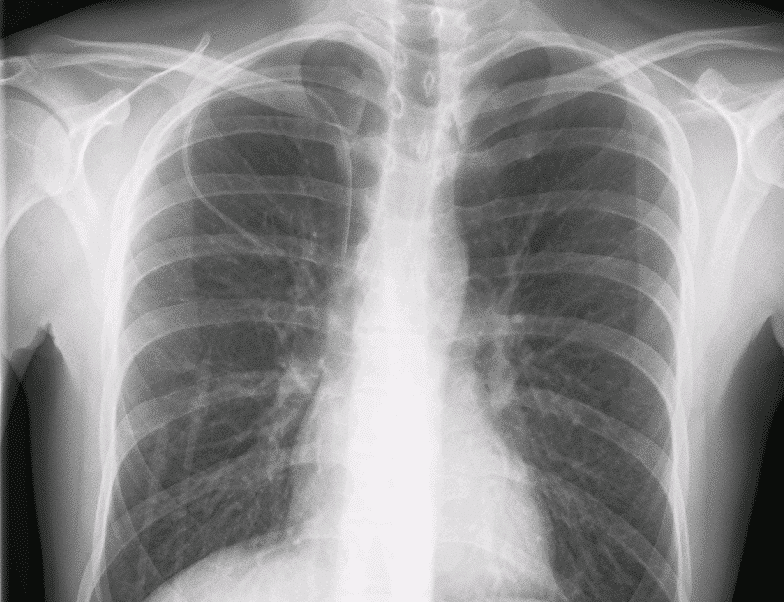
Scientists at USA, led by a Greek of the diaspora, created a new artificial intelligence platform with a machine learning algorithm capable of diagnosing Covid-19 disease by analysing X-rays of the lungs.
The «smart» system called DeepCOVID-XR, as his tests have shown, can detect coronavirus disease about ten times faster and with an accuracy 1% to 6% greater than radiologists specialised in chest X-rays.
The researchers, led by artificial intelligence expert Professor Angelos Katsaggelos, of the Department of Electrical & Computer Engineering, School of Engineering, Northwestern University of Illinois, who published the paper in the journal Radiology «Radiology.», they hope that their system will be used in the future by doctors to more effectively screen patients admitted to hospital for causes other than COVID-19, directly identifying those who are actually infected with coronavirus SARS-CoV-2.
«Our aim is not to replace coronavirus tests. X-rays-X-rays are a safe and inexpensive routine procedure. With our new system it takes seconds to check a patient and determine whether a patient needs to be isolated due to a Covid-19 infection,» Katsaggelos said.
«It takes hours or days to get the results of a Covid-19 test. AI does not confirm whether someone has the coronavirus or not. But with the new algorithm, we can single out a patient as a suspected case before the test results come out,» added Dr. Ramsey Webbe of Northwestern Medical School.
In many patients with Covid-19, chest X-rays show a similar lung picture with similar characteristic findings, as the lungs are often inflamed and have accumulated fluid. The problem is that simple pneumonia, heart failure and other lung diseases may show a similar picture on X-rays. Therefore it sometimes takes a very experienced eye to distinguish the difference between Covid-19 and some other non-infectious condition.
A. Katsaggelos« laboratory has been specializing for years in the use of artificial intelligence in imaging diagnostic examinations, especially in the field of cardiology. The researchers used their experience to develop a new algorithm, which they »trained" with 17,000 chest X-rays, including 5,445 from patients with Covid-19.
The algorithm was then tested - «against» five radiologists experienced in cardiothoracic X-rays - on the analysis of 300 random lung X-rays from a hospital. Each radiologist took two and a half to three and a half hours to analyse this number of X-rays, compared to only 18 minutes for the DeepCOVID-XR system. The diagnostic accuracy of the Covid-19 cases by the five radiologists was 76% to 81%, while the «smart» platform was 82%.
«Radiologists are expensive and not always available. X-rays-X-rays are inexpensive and are already a routine procedure in clinical practice. The new system can save money and save lives, especially now that early diagnosis is so critical when working with Covid-19,» said Katsaggelos, who is a graduate of the Department of Electrical Engineering at the Aristotle University of Thessaloniki (1979), with a PhD from the Georgia Institute of Technology, USA (1985).
The researchers pointed out that not all patients show signs of Covid-19 in their lungs, and therefore not all patients show signs of Covid-19 on their X-rays, especially in the early stages of the disease. In these cases, the «smart» system certainly cannot make a diagnosis and therefore cannot replace tests.
Katsaggelos and his colleagues decided to make their algorithm publicly available in the hope that other researchers will continue to «train» it with new data and thus improve it. At the moment, DeepCOVID-XR is in the research stage and is not yet considered ready for clinical use.