- The recitation of the Symbol of Faith without the Filioque.
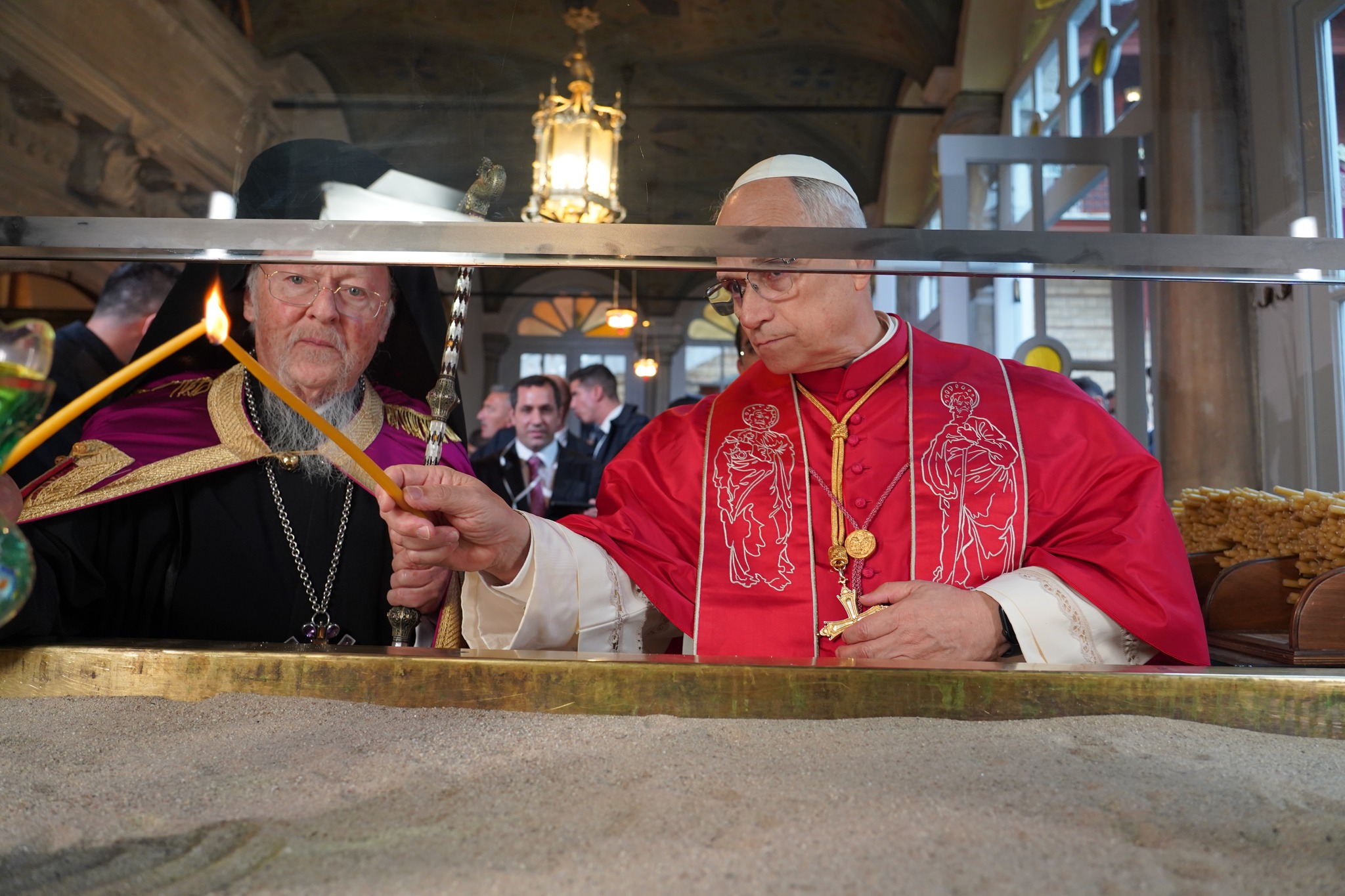
Much has been said in recent days about the recognition and recitation of the Symbol of Faith, without the Filioque, by Pope Leo 14ο. The media, either out of ignorance or recruited, project this act positively in favour of the Pope, presenting it as an example of goodwill towards unity. We must be sceptical of this statement by Pope Leo, knowing from the history of Orthodox-Pope relations the strategy that the latter follow in order to achieve their general objective, using all kinds of deceptive and illegitimate means, deceit and fraud. And to a certain extent their purpose has been achieved, since it has made it easier for them to appear to be closer to our Faith, creating favourable impressions and deceiving the simpler ones.
The recognition of the Symbol of Faith in its original form does not constitute any positive step towards the unification and retreat of the Papists in their doctrines and innovations. This can be understood from the fact that the Creed is recognized and read by the Papists without the addition of the Filioque, when there are Orthodox people present or in an orthodox place. This is also evidenced by the action of the Papists in reciting the Symbol in their worship here in Greece. We would probably say that this is an act of conversion, like Unia. Besides, the recognition and recitation of the Symbol without the Filioque does not in any way imply a condemnation of the Filioque on the part of the Franciscans, since it continues to exist in their official doctrine and is added to the Symbol.
- Recitation of a variant Symbol of Faith.
An unexpected event, of course, was the reading of a variant of the Symbol of Faith during the co-prayer of the Ecumenical Patriarch and the Pope in Nice. In a recent article, Marina Kolovopoulou, Professor of History of Doctrine and Symbolism at the Department of Theology of the University of Athens, states and points out that: «there are two points of divergence from the Greek original», which can be found in the term «likewise» and in the article on the Church [1].
The phrase of the Symbol «like unto the Father» in English official translations is rendered as follows: «consubstantial with the Father» η «of one essence with the Father» (of one substance with the Father). Traditionally the term likewise in English is translated as consubstantial. The text, which was chosen to be read at Nicea, renders the homoousiosis of Father and Son with the ambiguous translation «of one bOne with the Father» (of one substance; with the Father), which is linguistically vague and which may refer to Western-style interpretations of inter-triadic relations (not as a communion of nature [homousso], but a communion of persons on the basis of personal relations, where this periphery [West. interpretation: as a mode of existence and relationship of persons] in combination with the monarchy of the Father [Western interpretation: the Father is the principle of divinity] leads by extension to Sabellianism, but also to the support of proteanism within the Church), as well as the term being refers more to being, to substance, as opposed to the substantive. essence, which means the essence.
The second point, which drew attention, is the prefixing of the verb believe before the article concerning the Church, so that it reads as follows: «We believe in one, holy...». On the contrary, the Creed admitted by the divine Fathers does not prefix to the Church the verb «believe». Research [2] shows that the article on the Church indicates where the Holy Spirit acts and operates, i.e. in the Church. Besides, the same verb «believe» cannot be used for the Church, which is created from the beginning of the world, and for the uncreated God.
***
Unfortunately, the events taking place in the church do not allow us to see the above as innocent. The efforts of inter-Christian syncretism to mitigate the differences between Christian denominations, by emphasizing the common elements and overlooking the differences, can lead neither to liturgical nor to administrative unity, even though the latter are based on the one faith, being an expression of it. In other words, the liturgical unity which is attempted (common drinker) presupposes unity in the Faith.
The Apostle Paul advises Christians to hold fast to the unity of the faith, «In one spirit, one soul, gathering together the Faith of the Gospel», «Being mindful of the same, having this love, being of one mind, caring for the same.» (Philippians 1, 27. 2, 2-3). Because in the Church it is «One Lord, one Faith, in Baptism, one God and Father of all, who is over all, and through all, and in all things.»...resigns to being Christians.«in body and in spirit» (Eph. 4, 4-6), without being transferred from «of the caller them In the grace of Christ in another gospel» (Gal. 1, 6).
A true celebration of the First World War. A true celebration of the First Vatican Council and a real honour to it would presuppose the strict observance of what it decreed. The Fathers of the Council proceeded to condemn the Arian malpractices. A true celebration would be the condemnation of modern heresies and the avoidance of concelebration and communion with heretics. A true celebration would be the rejection of the return and spreading in the theological field of the Arian malpractices advocated by the already deceased Matriarch, who had already passed away. A true celebration would be the renunciation of the pursuit of a common Easter celebration with the heretics with the danger of splitting the Orthodox and the adherence to what the Fathers of the Synod instituted, i.e. «that they should not repent of eternal boundaries, as the Fathers did». Amen.
[1] See. «The terminology of «Homoousios» and its translational shifts», στό pemptousia.gr, 5/12/25.
[2] See further in Marina's Kolovopoulou, The Holy Spirit and the Church according to the Symbol of Faith in East and West, Enνοια, Athens 2023, p. 155 ff.
[3] Among others, Metr. Among other things, Amongst others, Metropolitan Pergamum advocated a temporal priority of God the Father over the Son and the Holy Spirit - trying unsuccessfully to support the primacy of authority, and not only honor, of the Father. Con/polis in the Church; obedience of the Son and the Holy Spirit to God the Father and different cognitive wills of the Father and the Son and the Holy Spirit, and “dialogue” within the Holy Trinity, which in the first place leads to “trinity” or the acceptance of creation for the two Persons, the Son and the Holy Spirit, etc, which will soon be presented in a separate article.
In support of specific positions of our article, but also for the knowledge of our Local Church's crew, we attach and share the above mentioned article by Professor Marina Kolovopoulou.
The terminology of «Homoousios» and its translational shifts
05.12.2025
Marina Kolovopoulou, Assistant Professor at the Theological School of Athens
«During the recent visit of Pope Leo XIV to the historic city of Nicea, on the occasion of the common Christian celebration of the 1700th anniversary of the First Ecumenical Council, the interest of the ecclesiastical community was focused - and rightly so - on the public recitation of the Symbol of Faith without the addition of the filioque, which caused a positive reaction in the Orthodox world.
However, both from his oral recitation in English, as broadcast by the media, and from the publication of the text, which was distributed to the attendees, according to the Romfea news agency, two points of divergence from the Greek original are noted, which cause concern from the point of view of theological science and ecclesiastical tradition:
- As is well known, the wording of the Symbol of Faith concerning the Son as «of the same mind as the Father» is a fundamental pillar of the Orthodox Trinitarianism and not only. The term «homoousios» was also the spearhead of the theological struggle of the Fathers for the deconstruction of Arian malodoxy. The traditional English rendering of the term as consubstantial, which functions as a technical term in the theological vocabulary or the more simplified expression of one essence render with doctrinal accuracy the patristic content of the term. In particular, the first, as a technical term, is well established in the theological tradition of the West and is not open to misinterpretation as it clearly indicates the community of the essence of the three divine substances. However, in the English text of the Symbol, which was read and distributed, neither the term consubstantial nor the simpler version was chosen for the translational rendering of «homous to the Father». of one essence but the newer rendering «of one being with the Father». However, this choice is potentially misleading, since the term being in the Anglo-Saxon philosophical tradition can denote not essence but existence. A semantic ambiguity is therefore introduced, since the divine unity in this way can be understood not as an ontological community of substance but as a relational communion between divine persons. This conceptual shift has nothing to do with the theology of the First Ecumenical Council on the homoousiosis, even if it is not always done consciously, and favours interpretations that approach the trinitarianism through specific ecclesiological readings and the mystery of the Holy Trinity through categories of anthropocentric philosophy (existentialism, persoanalism), leading to a methodological discontinuity with the patristic tradition.
- The addition of the verb «I believe» in the article of the Convention relating to the Church, as this is absent from the original Greek text. However surprising it may seem, in the Western theological tradition up to the modern Roman Catholic Catechism, the article in question is not found as «I believe in one, holy, catholic and apostolic Church» but "I believe in one holy, catholic and apostolic Church". From an Orthodox and Western point of view, this simple question has been studied and interpreted in order to avoid confusion in the content of the faith. What should be noted is that the addition of the verb believe in the relevant article on the Church, in the Orthodox world at least, is due to Barlaam Calabros and George Trapezzountius who were both secularized Orthodox. Therefore, it becomes clear that the extreme use of doctrinal terms is not a matter of literary sophistication, but an expression of theological responsibility.
The terminology of the Symbol does not belong to the discretion of each translator, because the slightest shift of a semantic centre - such as the replacement of «homoousios» by the ambiguous term «being» or the rewording of the article on the Church - may lead to a redefinition of the faith and distort the patristic understanding of the Divine Revelation. The Church, by tradition, guards not only what she believes, but also how she says it, because rightly saying is a reflection of rightly believing.