We have seen the announcements of the government of Mr. Mitsotakis regarding the accuracy of electricity, which has hit financially to a very large extent households and businesses.
The cost of state interventions according to the statements of Mr.Staikouras for electricity amount to 3.2 billion euros. The subsidy concerns money paid by the consumer from December 2021 to May 2022. Consumers have paid for the cost of the electricity they have purchased from the electricity they have paid for the electricity they have paid for the electricity they have paid for the electricity they have paid for the electricity they have paid for the electricity. has already paid €460 million, of which €280 million will be refunded.Consumers will see on their bills the 60% of the money they have paid during this period, from a minimum of €18 to a maximum of €600. And to be more specific the 60% is the amount resulting from the difference between the indexation clause and the total of the rebates of the state subsidies and providers.That is, assuming that the revaluation clause is 2500 euros and subtract the hypothetical total state discounts, let's say 500 euros , the result is 2000 euros.The 60% of 2000 is 1200 euros ,then the consumer will be refunded 600 euros.
What I object to about the government's choices is that the measures do not touch the profits of the electricity providers based on the logic of the indexation clause. In other words, the state is essentially supporting the providers, emptying the state coffers of EUR 3.2 billion from its own resources, which is taxpayers' money, and the providers are still making profits by applying the letter of the law. the update clause narrative. And until when will the state be able to subsidise consumers and not touch providers ? ;
Because it was not and is not in my logic to accuse without reason , I will prove to you that with one or at most two moves in the mathematical model of the indexation clause , a fair system could be implemented that consumers would be happy and would not need to allocate EUR 3.2 billion from the state coffers that will not work in the end.
Let's explain the mathematical model of the indexation clause
The indexation clause Y (in € / Kwh ) represents the cost of the electricity provider's supply to consumers, and constitutes the largest part of the retail price.The cost of the indexation clause is estimated to be about twice the other supply charges of the electricity provider. That is :
Retail Price in Euro = Adjustment clause + (the consumer's charges in Kwh) - (€ /Kwh of day + night) .
Now to understand the application of the indexation clause and what is the rationale behind it that affects its cost, let's look at the parameters that affect it.
The wholesale price (in € /Mwh) is supervised by the EU's Agency for the Cooperation of Energy Regulators (ACER), which aims to identify and prevent market abuses in close cooperation with national regulators, and therefore with our own Energy Regulatory Authority (RAE). The wholesale price is used by energy providers as a tool for calculating the subsequent adjustment clause.
The cost of the wholesale price directly affects the TEA , i.e. the independent variable X representing the Market Clearing Price (Market Clearing Price-MCP) of the Day Ahead Market (DAM) which its price depends on the Athens Stock Exchange.
Watch out :
The function representing the indexation clause is a line (e) of the form:
Y(x) = a•x+b (see figure)
Where x is the DAM ( I explained above what it is) ,which is affected by the closing of the market in Sofokleous .
Y(x) : It is the unit cost expressed in €/Kwh
a : This is the mark-up rate set by the provider ( in the PPC the value is 1,15 which corresponds to an angle of 49 degrees approximately ). And it is the slope of the line or the rate of change of Y(x) . The larger this coefficient is , the larger the angle of the line with the x-axis ( see figure ), indicating the increase in Y(x) . Therefore the larger the angle the larger the angle will be the price of Y(x) . So one parameter that we have to reduce to get a lower price of Y(x) is the coefficient a. And this coefficient regulated by the providers!
b: It is the coefficient that the value of to PPC and other providers is 0,0115 €/Kwh , and is the point where the line intersects the 0Y axis. And this rate is determined by the providers!
Li : is the lower limit in €/Kwh (in PPC it is 0.040).And this is determined by the providers!
Lu : It is the upper limit in €/Kwh (in PPC it is 0.050). .And this rate is determined by the providers!( see figure)
Let me give an example to illustrate its application. .
The market clearing prices (TEA) in January was 227,30 ,in February the price was 211,71,in March the price was 272,68 and in April 246,60 , all these prices are in euro/Mwh .
We saw that the TEA in March was 272.68 . i.e. x = 0.27268 .
Therefore: Υ(x)=(1.15)•(0.27268)+(0.0115) =0.325082
Now, because 0.325082 is bigger from the upper limit Lu which is 0.050 ( of PPC and other providers ) ,we get the difference
(0.325082)-(0.050) = 0.275082 €/Kwh
Multiply this by the Kwh consumed.Assuming we have consumed 3000 Kwh then : (0.275082)-(3000) =825.246 euros will be the adjustment clause that the consumer will pay.
Remark :
Because I have studied the application rationales of the indexation clause of all the country's electricity providers ,I have observed that there are differences on the parameters a , b , Lu ,Li as well as in electricity charges .However, the philosophy of the model for calculating the indexation clause remains the same.
The wholesale price is difficult to change as it is heavily dependent on the EU and the process of changing it will be time-consuming, while society is burning for accuracy. What we can change is the retail price, as is logically proposed. .
In order to change the retail price to the benefit of the consumer, in my opinion :
1/ Here reduce the cost €/ Kwh of the day and of the night.
2/ To reduce the cost of the indexation clause. This is achieved by reducing the factor a and increase the upper limit Lu .In this way we reduce the slope of the angle with respect to the axis ox . So we reduce the difference (Y-Lu) and therefore the cost €/Kwh ( see figure ).Furthermore in this way we reduce the case of TEA as much as it grows to give us large costs €/Kwh.
Interpretation of the Adjustment Clause Scheme:
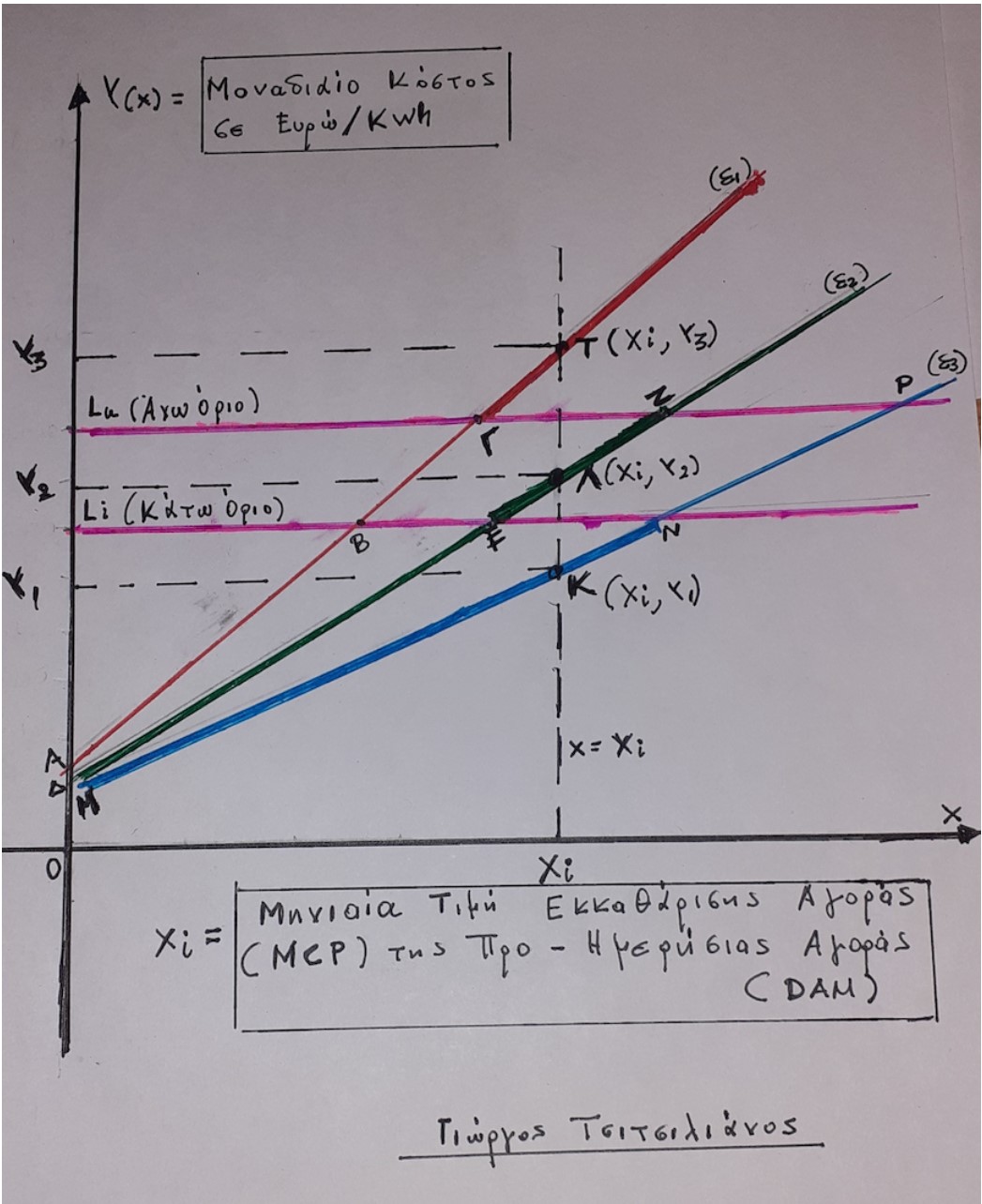
The mathematical model of providers is based on the attached figure. You can see 3 euphoria (e1) ,(e2) ,( e3) with different slope . The (e1) with about 50 degrees that they currently use the providers , the (e2) with a 42 degree slope and the (e3) with a 34 degree slope. The magnitude of the angle depends on the coefficient a .It shrinks the a the angle gets smaller, the angle gets bigger a the angle increases. Let's say Xi the Monthly Market Clearing Price (DAM) . The line x= Xi intersects (e1) at the point Τ corresponding to the point Y3 , then the consumer will pay the difference (Y3 - Lu)-( the Kwh consumed), because we have exceeded the upper limit Lu. The area of the line (e1) from point C and beyond means we pay.
The straight line x= Xi intersects ( e2) at L corresponding to the value Y2 , then the consumer pays nothing, because the L point between of lower Li and upper limit Lu . The area of the line ( e2) lying on the line segment EZ means that we pay nothing.
The straight line x= Xi intersects the straight line (e3) in point K corresponding to the value Y1, then the consumer will get money back which is the difference (Li - Y1)- ( the Kwh consumed) ,because the K point is below the lower limit Li. The area located on the linear segment MK of the line (e3) means that the consumer will get a refund.
This is the model that providers follow and this is where the excess profits come from that we don't know about, and the government tells us they're going to tax them. But is it possible to find the amount of obscenity? ;
Conclusion :
So when we reduce the coefficient a, and raise the upper limit Lu in concert, we will assess which is the happy medium, so that the consumer will pay the reasonable amount of money due or nothing or he'll have refunds. And most importantly we will avoid obscenity. So simple!
However, with what Mr. Mitsotakis with regret I say it, he makes a hole in the water, because he empties the state piggy bank to the delight of the providers of electricity at the expense of other social goods and not only, which we taxpayers will pay for in the end. And the story Unfortunately, it will continue without end if we do not take a realistic approach to the problem and solve it effectively and not with pie in the sky measures. So many geniuses our Prime Minister has at his side they can't suggest the obvious? Unless there are different objectives. .
I am frankly amazed at the logic of the government when the economy of our country is suffering from a disease and the needs of the country are very serious and urgent and the hard times are ahead.
By George Tsitsilianou, Mathematician