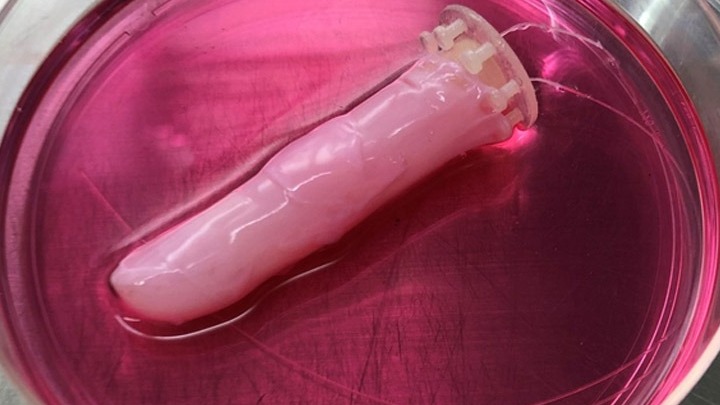
Japanese researchers have taken another step towards creating humanoid robots that look as much like humans as possible by creating living human skin for robots. They presented a robotic finger which has a soft leather texture, which also repels water and has self-repairing properties.
The researchers, led by Professor Shoji Takeuchi of the University of Tokyo, a pioneer in bio-hybrid robotics (a cross between robotics and biomechanics that combines biological and artificial materials), published the paper in the journal of new materials «Matter».
The standard silicone skin for robots can mimic human appearance, but not with details such as wrinkles, nor does it have the same functions as a human skin. The originality is that the new skin is grown on-site on the robot, rather than being created separately, cut to the robot's measurements and then fitted onto it.
In the new innovative method, the robotic finger is immersed in a cylinder with a solution of collagen and human dermal fibroblasts, the two key components that make up the connective tissues of human skin. This mixture is fitted onto the robot and forms the basis for a subsequent layer of epidermal human keratinocytes that adhere to it, making up to 90% of the outer layer and thus imparting a natural skin feel to the robotic arm.
The new skin is flexible enough to move as the robotic finger folds and stretches. It can even self-repair with a collagen patch. It is, however, weaker than a natural human skin and cannot survive for long without a constant supply of nutrients and moisture maintenance.
Takeuchi stated: «I think the living skin will be the ultimate solution in giving robots the look and feel of living beings, as it is made of exactly the same material that covers the bodies of animals.» «In the future,» he added, «we will develop more sophisticated versions of the skin, including sensory nerve cells, hair follicles and sweat glands. We will also try to cover larger areas.».
The Japanese roboticist believes that in this way humanoid robots will be able to communicate and interact with humans more naturally in various roles, as envisioned in science fiction. Some other experts doubt this, however, believing precisely that the strong external resemblance of a machine to humans will cause an instinctive aversion and negative reactions. In any case, the moment when fully humanoid robots will walk among us is still a long way off.