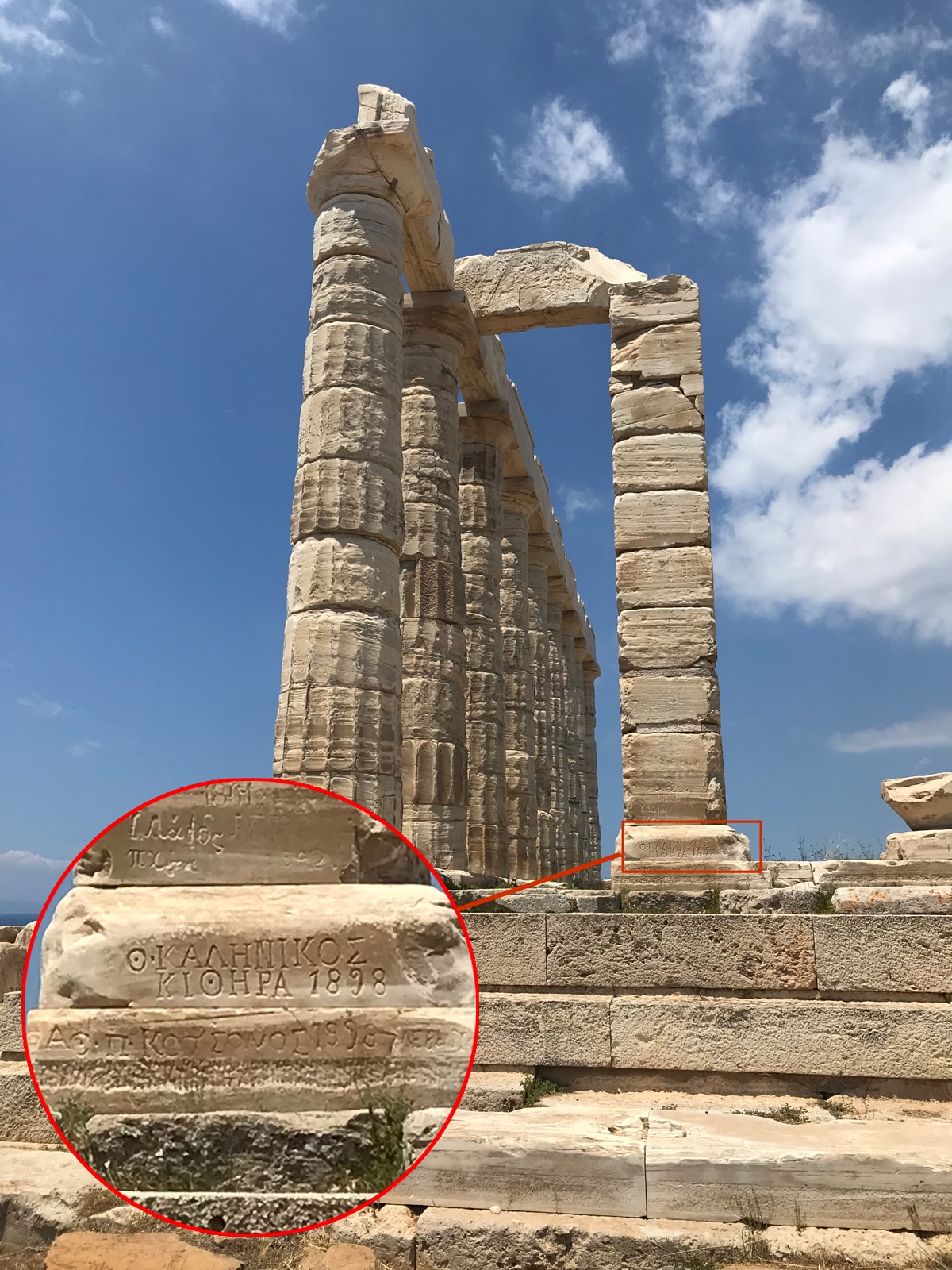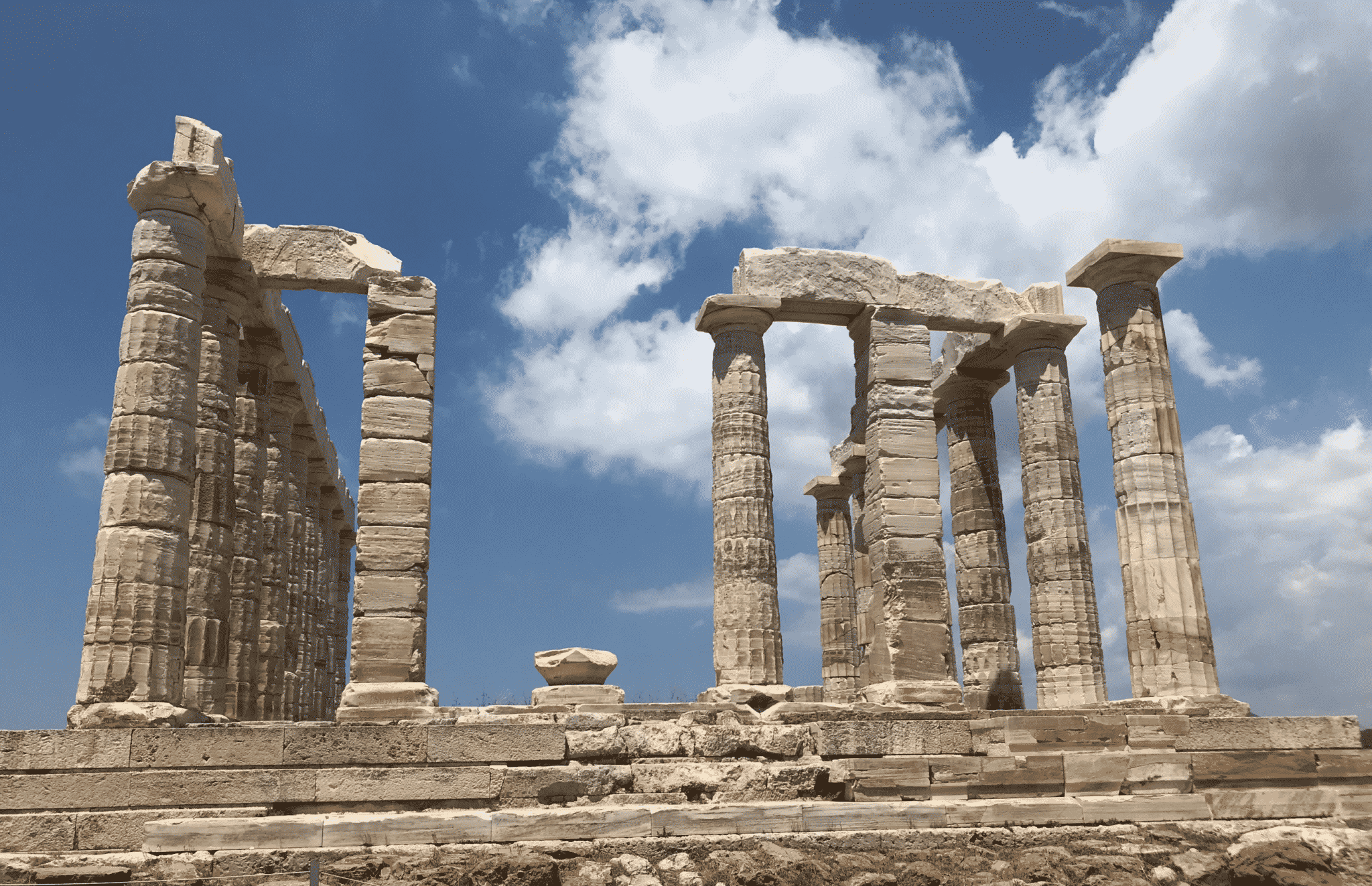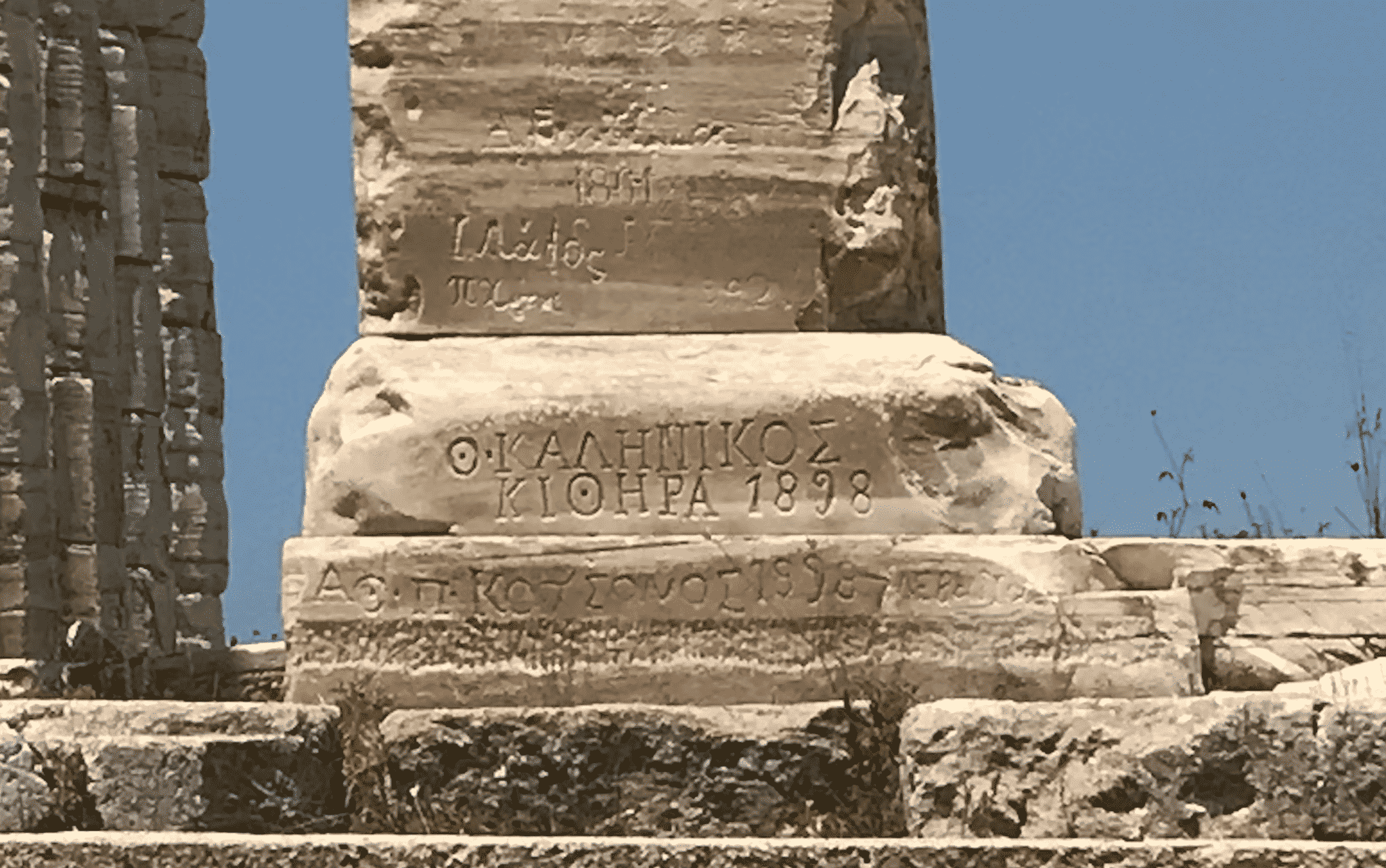
A reader of Kythera.News recently visited the Temple of Poseidon at Sounion and sent us photos showing a particularly interesting engraving on the surface of the marble. The inscription reads: «KALINIKOS KYTHIRA 1898.» Apparently, a man from Kythira who visited the temple at that time wanted to leave his mark on the sacred site, a practice that was common not only back then but continues even today—albeit in a more sophisticated form, of course—with the well-known graffiti tags!
As strange as it may sound, graffiti in public spaces has been around since ancient times and is not a modern phenomenon. People have always found—and continue to find—ways to leave their mark on walls with names, slogans, thoughts, and colorful murals.
The philologist Ms. Eleni Harou has also addressed this topic, publishing a couple of photographs of the same church, with one shot taken from a different vantage point where the inscription appears: «STRATIS KALLIGEROS KITHIRA 1898.».
Writing in public spaces is a very old human practice and is of particular academic interest as a form of visual and symbolic communication. From ancient inscriptions to today’s tags, graffiti intervenes in public spaces in various ways and very often coexists with antiquities and monuments. This coexistence sometimes seems logical and expected, and at other times aggressive and undesirable; it certainly prompts archaeologists, conservators of antiquities and works of art, architects, and other scholars to reflect on it. How difficult and laborious is the process of removing graffiti from historic buildings and monuments? Do we treat an ancient name written on a wall differently from a modern tag? Can the ancient landscape coexist with—or even interact with—contemporary graffiti?;
Read more at the link below at LIFO e-magazine the interesting discussion with: Maria Hatzidakis, Lecturer in the Department of Conservation of Antiquities and Works of Art, Technological Educational Institute of Athens, and member of st.a.co. (Street Art Conservators); Lizzie Anamaterou, Conservator of Antiquities and Works of Art, Directorate for the Conservation of Ancient and Modern Monuments (D.S.A.N.M.); Polyna Xiradaki, Conservator of Antiquities and Works of Art, member of st.a.co. (Street Art Conservators), and Dimitris Hatzigiannis, Conservator of Antiquities and Works of Art, Directorate for the Conservation of Ancient and Modern Monuments (DSAAM).
Think-Graffiti: Ancient and Modern Traces in the City, an event in search of answers