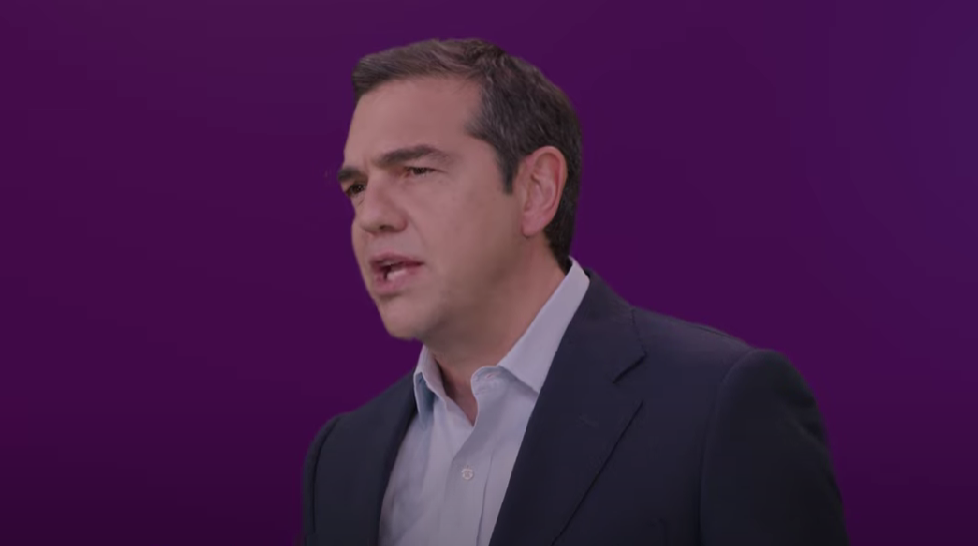
The following is launching an attack on the government and the prime minister: president of SYRIZA-PS, Alexis Tsipras, describing it as the «worst government at the worst possible time» and making it clear that «I don't think there can be any common ground».
In an interview with *To Vima*‘s Sunday edition and Aris Ravanos, he lays out his criticism of the government’s handling of the Ukraine crisis, Greek-Turkish relations, the pandemic, and inflation, and argues: «In times like these, old-school politicians who are interested only in serving the elites who support them and who try to survive solely through communication and propaganda are utterly unsuitable. Mr. Mitsotakis and his government are a prime example of this. The worst government at the worst possible time. I do not believe that any other government—not even one on the Right—would make such flawed strategic choices that leave the Greek people completely exposed to the crisis; so I don’t think there can be any room for consensus.».
Russia's invasion is unjustified
Referring to the Russia's invasion of Ukraine, emphasizes that «there is no justification for this, no matter what President Putin may claim. There is no room for neutrality when one country invades another. But it would be a mistake not to discuss how we got to this point and to succumb to fear-mongering. For example, we should not ignore the fact that President Putin is exploiting the “precedent” set by Western interventions that violated international law to justify his own invasion. Many say that this moment is Europe’s 9/11. Let’s recall how the West reacted after 9/11. Not only with regard to Afghanistan and Iraq, but also with regard to Russia. Instead of promoting an undivided security architecture, as agreed with Russia in 1999, the Bush administration took extremely provocative and short-sighted actions.».
Regarding what Greece’s stance should be, after repeating Andreas Papandreou’s phrase «Greece belongs to the Greeks,» he notes: «Russia is not an ally, but it is a powerful country with influence in our region, and we have historical ties with its people.". Today, we must stand up to it, without, however, succumbing to anti-Russian hysteria, neo-McCarthyism, or even practices that would help—rather than isolate—the Russian government and its policies among the Russian people, such as, for example, banning cultural and sporting events. After all, culture—and especially the works of great artists—is universal, and it is unthinkable that they should be subject to bans. Beethoven was not banned when Nazism was responsible for the greatest massacre in history».
Greek-Turkish Relations: «I’m afraid the hard part is still ahead»
He describes Mitsotakis’s narrative of “the West’s outpost toward the East” as dangerous, one that places us on the front lines of a military conflict with Russia,» and adds: «Mitsotakis’s hasty decision—made without any consultation with political forces—to sending military equipment to Ukraine, »It was a grave act of recklessness, bordering on national frivolity.".
Regarding Greek-Turkish relations, he states: «If the Mitsotakis-Erdoğan meeting simply leads to a lull so that the Turkish president can resume his provocations with greater international backing before his elections, it will be to our detriment.”. Greece must compel Turkey to engage in a substantive—rather than a token—dialogue aimed at de-escalation, with clear red lines regarding our territorial integrity and the right to defend our islands, and with the ultimate goal of filing a case at The Hague regarding the continental shelf/EEZ.» She believes that the prime minister delayed action, failed to capitalize on the positive momentum following Biden’s election, and «remained fixated on «the the false narrative of “isolated Turkey”», and adds: «I fear that the hardest part lies ahead of us if there is no clear and consistent national strategy.».
Common Ground with KINAL: The Needs of Citizens
Regarding relations with KINAL, he notes: «For us, the needs of society are our common ground. The minimum wage, labor relations, support for small and medium-sized businesses, the decisive strengthening of the welfare state and the rule of law, and the sound and transparent management of public funds. In this arena, we call on the entire democratic world to unite to defeat Mr. Mitsotakis’s Right. KINAL must make its choice in practice and in the substance of its political positions. The path of silence and maintaining equal distance from all sides, especially as time goes on, is not a guarantee of neutrality, but rather an alibi for a government that is leading the social majority into conditions of unprecedented insecurity.».
Measures, to be precise: «fighting fire with water guns»
Regarding the government's measures, to be precise, he states that «Mr. Mitsotakis is fighting the fire with water guns» and adds: «…It’s outrageous to consider 13 euros a month for gasoline as relief, while at the same time the blue-collar executives at HEDNO are awarding themselves a 60,000-euro bonus. Just as it is a challenge to admit that some are profiteering—such as the energy companies that have raked in nearly 1.5 billion windfall profits—but at the same time refuses to set a cap on electricity prices, as not only we have been proposing for months, but now the European Commission itself has also proposed.».
Redesigning the Energy Strategy
Regarding his own policy, he states: «First, we will proceed with a redesign of the national energy strategy. The phase-out of lignite will proceed, but not abruptly…Also We will restore the “D” in DEI—that is, its public and charitable role. And when it comes to combating high electricity prices, we will not tolerate profiteering. It is unacceptable for the cost of producing electricity to be 200 euros, while producers—including the Public Power Corporation (PPC)—negotiate its wholesale price on the energy exchange at 400 – 450 euros. This can be curbed by capping profit margins, regulating the market, promoting forward contracts, and implementing strict controls.».
As for the risk of fiscal derailment that the government is warning about, he says, «I know very well what that means because I took over a bankrupt country and left the coffers full…Nevertheless, we know how to provide whatever is needed to support society without running the risk of derailing the economy. It is, to a large extent, a matter of priorities. For example, we will cancel the privatization of supplementary social security, and 1.5 billion per year will go to those in need, not into the black hole of investment funds. The excess profits of electricity producers will also be returned to consumers. This does not require a fiscal cost but rather the political will to take on vested interests. We have that will; we have proven it.’.
Elections are the only way forward to form a progressive government
Mr. Tsipras argues that Greek society is sinking deeper into insecurity, poverty, and despair with each passing day, and adds: «I don’t want to be a prophet of doom, but what worries me is that During the New Democracy party’s nearly three years in power, there has been a rapid and dangerous breakdown of the social fabric. »Elections and the formation of a progressive government are the only way to steer the widespread social protest toward positive change.".
When asked about internal divisions within his party, he responds, «The differing views within our ranks prove that SYRIZA has something to say; it is seeking ways, ideas, new practices, and examples to advance a political plan aimed at improving the lives of the many. My proposal to give greater power to party members is precisely part of this ongoing quest to become better, more effective, and more useful to Greek society.».
Regarding the possibility of changing the electoral law, he notes: «No matter how many times Mr. Mitsotakis changes the electoral law, it will not prevent his defeat in the elections. All he’ll achieve is yet another blow to the institutions and to whatever credibility he has left.» He states that he is ready for elections and adds: «Our candidate lists will reflect the most vibrant, youthful, honest, well-educated, and socially conscious forces within Greek society. And this new generation, which is entering politics to give rather than to take, will also form the backbone of the progressive government.».