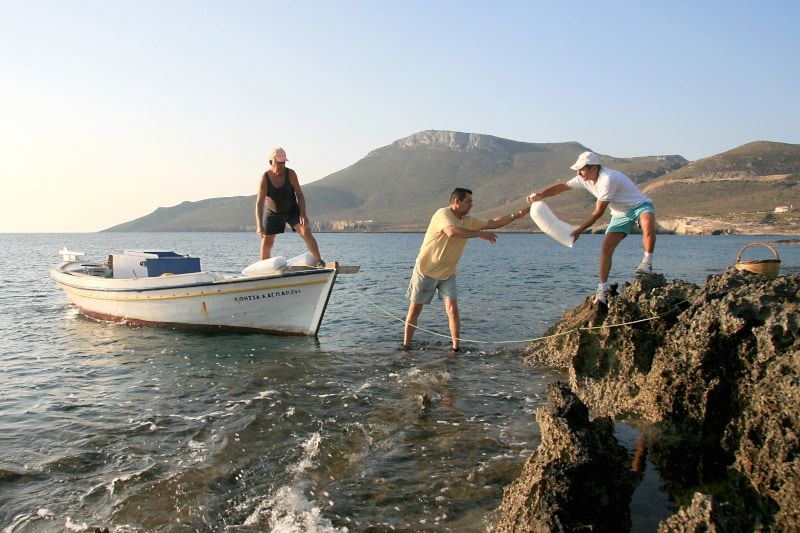
The sun has just risen on the Kythera, illuminating the figure of a man in his 80s, who, standing on the rock, on this asymmetrical balcony of the Ionian Sea, gazes briefly at the July sunrise over the calm sea, before going to work. He will spend the next few hours crouched on the same rock, fighting with it and at the same time coaxing it to deliver its salt of sea water, which for 15-20 days has been caving in this stone «basin».
The man collects in his baskets - traditionally made from reeds and rods of chaff - the famous «rock salt», sought after by cooks, chefs and landlords all over the world, from the USA and Canada, to Australia, exotic Singapore, the Scandinavian countries, icy Russia and vast China.
Salt as a product pays off, but the work of the dozens of Kythera's salt workers, who have to extract it from the rock with their hands or a large spoon, is anything but easy. By 11 o'clock in the morning, long before the sun is at midday, the man will have to collect his baskets and leave the hot rock. No matter how much stamina one has, one cannot work in such heat, especially since the rock, which on a day with a temperature of 38 degrees Celsius can reach 47 degrees, requires respect and alertness, so as not to slip.
«The rock is a difficult thing. It cuts and burns. The skin on the hands and feet of the people who work on it is permanently cracked. The rock slips, you fall and you get killed. But at the same time, the rock offers»: with these words, the Kytherian businessman Tasos Venardos opens the discussion with AP-MPA about the famous salt, which offer the approximately 30 «salt marshes» (saltpans) of the island. Alatarees, which do not have a stable owner, but are auctioned every spring, as there is a special regime on the island.
A 14-year-old boy wanders off, with a bushel of salt in his suitcase
The 1970s have just dawned and 14-year-old Tasos Venardos, old enough to sit at the rail of a ship, says goodbye to his beloved Kythera to work on a merchant ship as a cook's assistant. Stashed in his suitcase, among his clothes, is a small pot of salt, two or three kilos of the white-white «gold» of the rocks that flavors his mother's food.
His suitcase is heavy, but the 14-year-old doesn't think of leaving the island without taking his special salt with him, which, thanks to the potassium it contains, doesn't make your lips sting when it meets them, but sweetens them.
Seven or eight years later, Tassos Venardos' path, now over 20 years old, takes him to America. The salt of Kythera follows the Kytherian immigrant to Baltimore, Texas and Louisiana, alongside the riverboats that slowly cross the Mississippi.
He works as a cook in Greek taverns, but also in a popular Italian restaurant, where customers book up to 40 days in advance, even though the cost is (at that time!) 50-70 dollars per person. The tsouvalakia with the «rock salt» travel thousands of miles across the ocean, arriving continuously from Kythera to America, and the food that comes out of Kytherios' kitchen stands out for its deliciousness, so that customers ask the secret.
«The secret of the success of the dishes I cooked was the rock salt from Kythera, something that convinced the Italian owner of the restaurant, who initially insisted on cooking his famous sauce with Italian salt, until he found that the salt I suggested doubled its deliciousness», he says with a smile.
He adds that the Kostas Spiliadis, owner of «Milos Restaurants» in Montreal, New York and Athens (who was featured extensively in the New York Times in 2019), he has always advertised that his restaurant chefs use this special salt. «Customers at his restaurants are big names in the arts, entertainment and politics, who supply Rock salt and Kythera olive oil from the mini “grocery stores” that he maintains in his restaurants,» he says.
Tasos Venardos himself has not worked as an alykarios. However, for some years he helped his father on the rock that he rented. «The difficulty in getting salt to be collected and the uncertainty of whether the weather would help my father to collect enough salt to make a living has made me emotionally attached to the salt pans,» he confesses.
The 80 year old alpaca
A good living, usually a good one, was and still is an incentive for many Kytherians to deal with rock salt. Ο Andreas Friligos (Vedouras) is now approaching 80. He has been working as a saltman for almost 50 years, since he married at 30, and when we ask him how the salting has «kept him going» for so many years, he answers that the work is very hard, but salt provides a good living.
«Lately I don't go as often, when you get older it's not as easy to work crouched on the rock with a ladle or a basket,» he tells APE-MPA, adding that you go to the rock at 5 or 6 in the morning, as soon as the first light fades, because after 10-11 in the morning you can't stand the heat.
The economic crisis and the pandemic have brought more people closer to salt
The number of people involved in salt on the island was until recently around 80. However, due to the economic crisis, the pandemic and the high demand, their number has - according to Mr Venardo - increased in recent years. Nowadays, about 120 - 130 people in Kythera are involved with salt in all its phases (collection, processing and trade etc.).
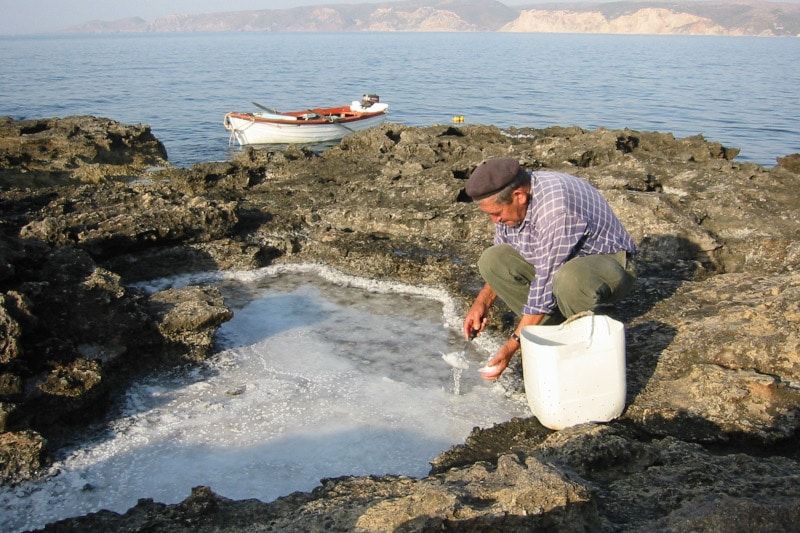
The alykarians are usually men, because the collection of salt also requires muscle strength. Women are responsible for cleaning the salt from foreign bodies such as seaweed, sticks and stones, «because women usually have more patience and cleaning the salt takes a lot of patience», explains Tasos Venardos.
As he says, there are no longer any families on the island that live exclusively from salt. This is because the ownership of salt producers is not stable. «The coastline and the rocks (alatares) are auctioned every year by the Property Committee of Kythera and Antikythera and the alatares may change hands every year.. Usually the people involved are fishermen, whose main occupation is fishing and, in addition, they harvest the salt to boost their finances,» he notes.
A five-year-old boy enters the salt marshes for the first time
For the 49-year-old barber Themis Summer by Avelona, the occupation with salt was not brought about by the pandemic, nor by the economic crisis, but by the long family history. «Salt works are a family affair for me, my father, my uncles and my grandparents worked there. and that's where I feel like I was born. Salt is a way of life for me,» he tells APE-MPA, explaining that he first entered the salt industry at the age of five, in 1977, taking on the role of ... transporter.
«At that time we were collecting salt 20 minutes away from Avlemonas and someone had to take it to the village on a donkey. That was my job as a five-year-old boy, I would bring the salt to the village and I felt joy and pride because I could offer something to the family», notes Themis Kalokairinos.
He adds that salt provides a good additional income, complementary to that from the main job, but to get it from the rock, you have to work very hard: «There is a saying in Kythera: “if you want to curse someone, send him to work as a saltman or a chimney sweeper (in the lime kilns)”. You make salt by working hard in the heat, you don't just go and pick it up,» he says.
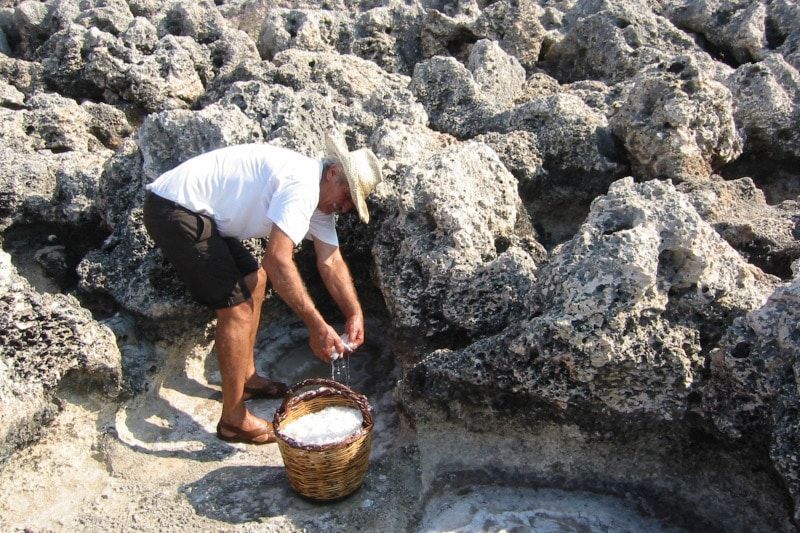
«First we clean the cavities of the rocks of any algae or sticks that may have been collected during the winter. Then we water them with seawater with the pump, as we would water an orchard. The first time we need to water two and three times to get salt. When the salt is ready, which can take a month or even 40 days the first time, we carry it out and lay it out in the sun to dry and clean it. For it to dry, it may take another 15-20 days. But that's all the processing it undergoes: picking, drying and cleaning, is a completely pure salt, made so special by the very content of the sea water of Kythera in various elements, such as potassium and iodine.», he explains.
With the ally of the North Sea and «enemy» the southern winds
For centuries now, the Alaskans have been looking at the sky, half-closed their eyes against the sun, listening to the winds and gazing at the sea, trying to guess their intentions. Today, with more modern means at their disposal, they still try to predict the weather. Why the tide can wash away the salt already built up on the rock and why the South is not their ally.
«When the weather turns south, the salt does not coagulate. In order for the salt to thicken, you need a north wind (not too much wind), because that is how the water evaporates from the salt.. The sun warms the rocks during the midday hours and the north wind evaporates the water,» says Tasos Venardos, founder of the company. «KALIMERA PRODUCTS», which markets the salt in large supermarkets in our country and in many small shops in Greece and Europe, but also worldwide, both directly from the company and through the website www.greeksalt.com.
How did they learn about Kythera salt in Russia, China or Singapore?;
Every year about 20 to 30 tons of rock salt are produced. To produce a respectable quantity (4 - 5 kg for example) from a trough (salt trough) takes on average 15 days. Salt harvesting starts at the beginning of June and lasts until mid-September.
Thanks to the convenience of e-commerce, the companies involved in the Salt of the Rocks business send annually about 4-5 tons of product to every corner of the world: USA, Canada, Australia, Singapore, Bulgaria, Bulgaria, Romania, the Netherlands, Germany, France, England, Denmark, Sweden, Russia and China.
But how did foreign markets learn about this special product, produced on a distant island in the Ionian Sea? «Internationally, Kythera salt became known by Jolmar Dam and Theodora Petanidou, who published the ALAS (All About Salt) publication. Kostas Spiliadis, the owner of “Milos Restaurants”. And finally, from the Swedish gentleman, Gioran Svanburg and me, who through the company “Kalamitsi Products”, we started exporting it 20 years ago, to Scandinavia, Northern Europe, Russia and America (through Mr. Spiliadis» restaurants)", Tasos Venardos replies.
When the public preacher -delalis- set the tone: «The auction is coming»
During the period of Anglo-Saxonism, the salt marshes in Kythera, as well as the rocky islets, were managed by the Ephorion Council. Today, based on the current provisions and Presidential Decrees, the salt marshes are exclusively managed by the Commission for the Management of the Inherent Assets of Kythera and Antikythera, which continues to lease them by annual auction.
A process that «counts» many decades of life. Every year, in May, the Eparchial Council rented the salt marshes by auction to the interested parties and the proceeds went to the Eparchial Fund. They belonged to the public (not private) property of Kythera. This status was maintained even after the union with Greece.
The coast of Kythera, along with the rocky islets and Antikythera, was divided into 25 districts with natural troughs of «self-salting salts». When the proclamation was published in May, the auction followed, with the public herald (delalos) setting the tone. «The auction is coming...»
The exploitation of the salt flats and the distribution and marketing of salt in Kythera, but also outside the island, never stopped - only during the period when the monopoly was in force in Greece, the export of this «white gold» from the island of Kythera was prohibited.
By Alexandra Guta