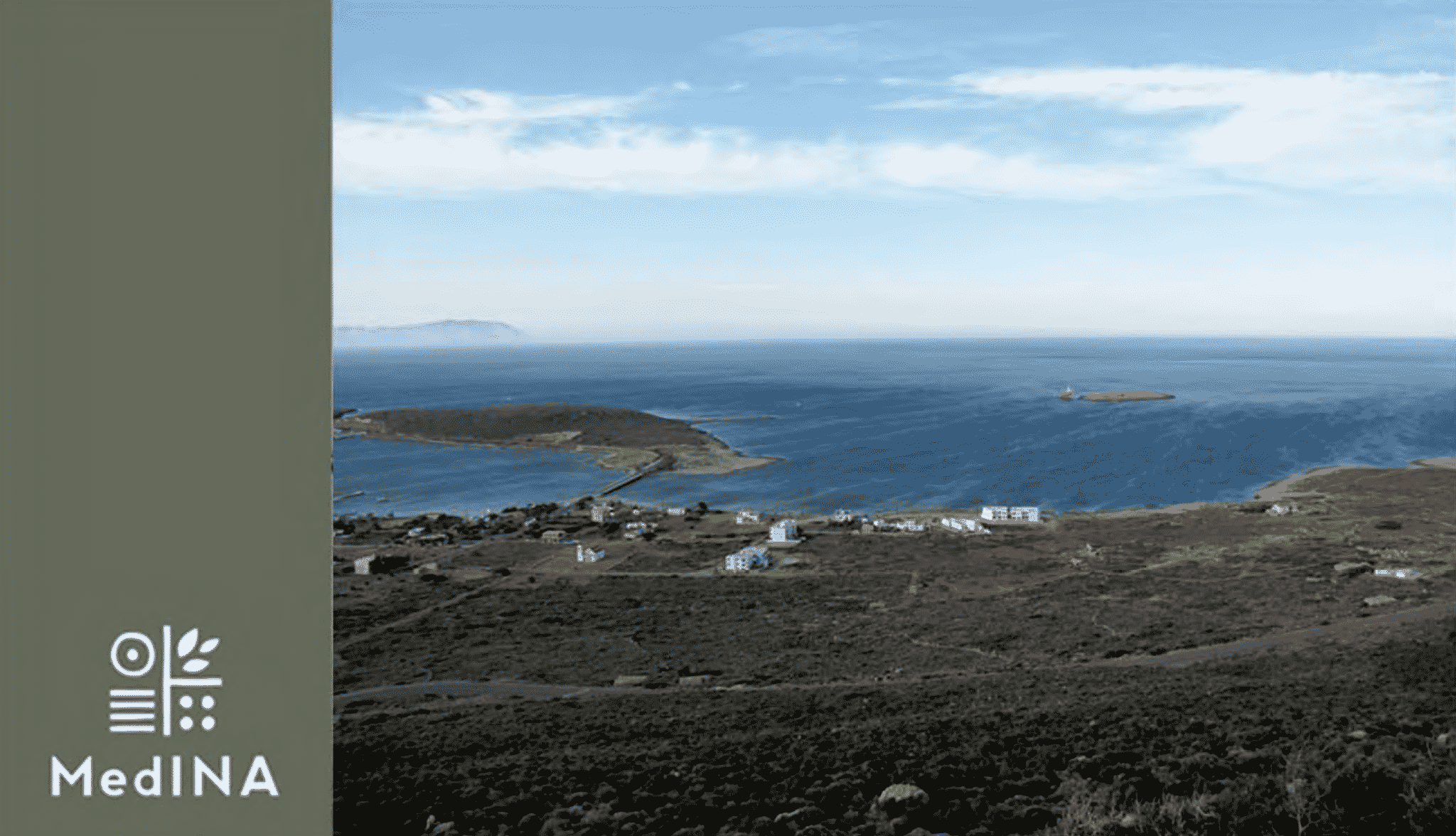
The Kythira Island Group – Antikythira forms the southwestern part of the outer Aegean island arc, while from a physiographic perspective, it constitutes the highest-elevation part of the shallow undersea channel that connects the Peloponnese with Crete. Geologically, the two islands belong to the active seismotectonic zone corresponding to the subduction zone where the African plate is subducting beneath the Eurasian plate. As a result, they exhibit active tectonics, intense seismicity, and a complex geological structure consisting of the metamorphic basement, the Alpine zones of Tripoli and Pindus, and the Neogene and Quaternary formations, as well as a dense network of normal faults.
Kythira has an extensive network of small streams, mostly seasonal, that run across nearly the entire island on either side of the low plateau formed in its center. Most of these streams converge just before they reach the sea, forming single stream channels. The island also features wetland areas, both permanent and seasonal. In contrast, the hydrographic network on Antikythira is much more limited.
In general, the region is characterized by a dry, hot season during the summer months, with relatively high temperatures, while moderately low temperatures occur during the winter months. A characteristic feature of the region is the high-intensity (mainly northeasterly) winds that blow throughout the year. Due to the long dry and hot season and the strong winds, Kythira and Antikythira have been severely affected by wildfires over the years. However, a review of the available data suggests that extensive fires have not recurred in the same areas, at least from 2000 to the present. Nevertheless, the boundaries of earlier fires should be investigated, with the assistance of the relevant agencies (Forest Service and Fire Department), in order to identify areas that have been repeatedly burned and, consequently, determine whether they require restoration measures.
In the study area, there are 5 sites that are part of the Natura 2000 Network (GR3000008, GR3000010, GR3000012, GR3000013, GR3000019). In addition, there is one area designated as a Wildlife Refuge (KAZ) with the code: K924.
In addition, the study area includes two terrestrial Important Bird Areas (IBAs) and one marine Important Bird Area (mIBA). The two terrestrial sites are GR129—Kythira Island—and GR130—Antikythira Island and islets. The marine site is GR129—Kythira Island.
The 2012 CORINE data classify most of the land area of Kythira as «forests and semi-natural areas» (64.92%), with 33.34% of the land area classified as «agricultural areas» and 1.75% as «artificial surfaces.» For Antikythira, «agricultural areas» cover 15.01% and «forests and semi-natural areas» cover 84.99%.
The habitat types listed in Annex I of Directive 92/43/EEC that occur in the study area are: 1240 – Steep rocky coasts with vegetation in the Mediterranean, with endemic Limonium spp., 5330 – Thermomediterranean and pre-desert scrublands, 5420 – Phrygana with Sarcopoterium spinosum, 5210 – Woody scrub with Juniperus spp., and 5340 – Eastern Mediterranean garrigues. In addition to natural habitats, the area also hosts semi-natural habitats of high environmental value. The most significant of these are the terraced agricultural fields and the Gerakari Forest.
The Kythira-Antikythira island group is an area of particular floristic importance due to its location. The area under consideration is the meeting point of two phytogeographic zones: the Peloponnese (Pe) and the Crete–Karpathos (KK) region.
A result of these islands’ geographical location is their high level of endemism, with an exceptionally large number of local endemic species even on the small islets (e.g., Avgo, Megali Dragonera) and, more generally, a large number of plant species, even though the islands are small and consist of low-lying terrain. To illustrate the high level of endemism in the region under study, Kythira has 55 endemic species out of a total of 820 flora taxa, Antikythira has 25 endemic species out of a total of 333 plant taxa, while Ikaria—an island of similar size to Kythira—has 13 endemic species out of a total of 829 plant taxa. Among the Greek endemic taxa in the study area, there are also 6 plant species and subspecies that have a local and rare distribution and are endemic to the Kythira-Antikythira island complex. The area also supports a wide variety of fauna, significant at the national and European levels. Special mention should be made of the endemic invertebrate species (Dendarus antikythirensis, Kithironiscus paragamiani) and the endemic lizard species (Podarcis levendis). Furthermore, special mention must be made of the area’s importance for avifauna, as a major migratory corridor, a nesting site for priority species such as the Eleonora’s Falcon (Falco eleonorae) and the Audouin’s gull (Larus audouinii), and as a marine migration corridor for large numbers of seabirds such as the Cory’s shearwater (Calonectris diomedea) and the Yelkouan shearwater (Puffinus yelkouan).
The area of Kythira and Antikythira has also been designated as important for three types of marine habitats: the seagrass beds of the endemic Mediterranean marine angiosperm *Posidonia oceanica* (Habitat Type 1120), submerged and semi-submerged marine caves (Habitat Type 8330), and reefs (Habitat Type 1170). These habitats support the region’s rich marine fauna, which includes the Mediterranean monk seal (Monachus monachus), and many cetaceans such as the bottlenose dolphin (Tursiops truncatus), the Common Dolphin (Delphinus delphis), the Striped Dolphin (Stenella coeruleoalba), the Cuvier’s Beaked Whale (Ziphius cavirostris), the fin whale (Balaenoptera physalus), the sperm whale (Physeter macrocephalus), and the gray dolphin (Grampus griseus).
INCREAte Program
Survey and Assessment of the Natural Environment of Kythira and Antikythira
3rd REVISED EDITION
October 2018