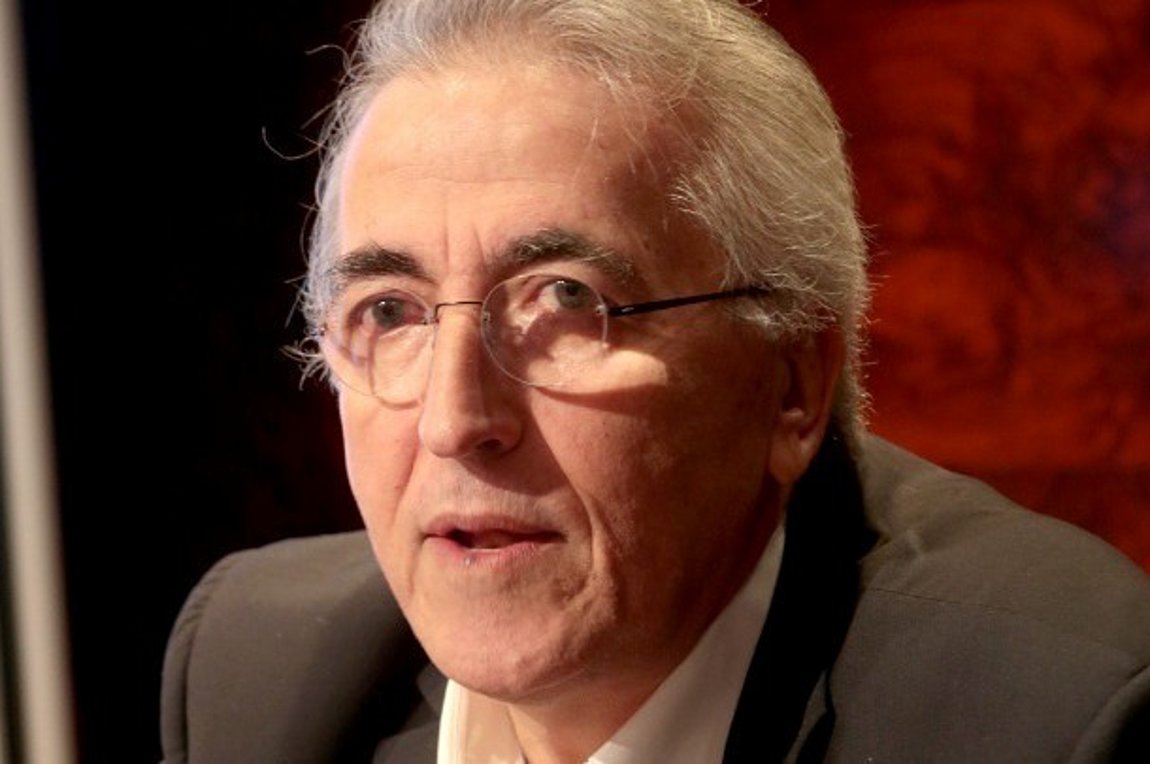
If Vassilis Rafailidis were alive today, he would tell the truth without combing his hair. And the truth, as we know, is like an unemployed man. It circulates unshaven. He wouldn't blame Panagopoulos. He would have admired him. Because in Greece it's not easy to make a career without working. It takes talent.
Panagopoulos is not just the president of the GSEE. He is a monument. And monuments, as we know, cannot be moved. They are only moved by the workers when they get angry. But because the Greek people are kind, they leave the monuments in place and move themselves to unemployment.
The nice thing about Panagopoulos is that he managed the impossible. To be a trade unionist without bothering anyone. Not the employers, not the governments, not even reality. And that's no small thing.
Because trade unionism in Greece started out to scare the authorities and ended up reassuring them. Like the dog that instead of biting the burglar, holds his lantern.
In Greece there are two kinds of workers. Those who are afraid of losing their jobs. And those who have never left their jobs. Yannis Panagopoulos belongs to the second category, without a doubt.
For the ordinary worker, work is a daily agony. An alarm clock that goes off early, a paycheck that ends early, and a life that always expects something better. For the president of the GSEE, however, work has become something else, it has become a career. And a career without an end date.
Forty years a trade unionist. Almost twenty years president. A lifetime in offices, in the corridors of power, in the smiles of ministries.
Because that's where the secret is.
His unionism did not have the smell of the street. It had no tear gas, no rain-soaked banners, no voices hoarse from strikes. It had air conditioning. He had meetings. It had «partnerships.».
It is not only his enemies who say this. It is confessed, almost with complaint, by the trade unionists of the DAKE themselves. Those who belong politically to New Democracy and who once silently went along with it now speak of a close relationship. For a president who, while formally belonging to PASOK, was actually working in harmony with the government.
And somehow, the big conflict that the workers were waiting for never came.
Instead of that, the memoranda came.
Wages have fallen. Rights were reduced. Lives narrowed.
And yet, the confederacy did not become a fire. It became a pillow.
A cushion that absorbed the vibrations, so as not to disturb the power.
He, meanwhile, continued.
With the comfort of someone who knows the system inside and out.
With the confidence of one who is not afraid of time.
Because time, instead of wearing him down, has dried him up.
It has reached an age where most workers have already retired. He, however, remained. Representing people who had left the workforce while he was not leaving representation.
As if unionism became not a role, but property.
And then came the revelations.
Villas. Swimming pools. Training centres.
Money trails that didn't seem clean.
He replied with simplicity. Almost with innocence.
He said the pool was a «cistern.» He said his life was simple.
Perhaps, in his own way, he was telling the truth.
Because in Greece, power never looks like what it is. It always looks like something more humble. Like a cistern. But deep enough to hold a lot.
His relations with ministers such as Kostis Hatzidakis, Yannis Vroutsis and Niki Kerameos were described as close. Not necessarily illegal.
But certainly warmer than a worker expecting conflict would expect.
Because the employee wants someone to pound the table. Not someone to sit at the same table.
And yet, that was the secret of the time. There were no enemies. There were partners.
SYRIZA, PAME, New Democracy, PASOK - all, in their own way, passed through the same room.
And he was always there.
Steady. Immovable.
Like furniture.
As an institution.
As a system.
And that may be his biggest story.
Not whether he is guilty or innocent. That's for justice to determine.
But how one man became the image of an entire era.
A time when trade unionism was not a cry. It was a balance.
Where conflict became negotiation. And negotiation became a habit.
Today, as his name is in the crosshairs, the question is not only what he did. It's what everyone else allowed to happen.
Because no one stays at the top for so many years on their own.
There are always hands holding him. And eyes looking away.
And perhaps, somewhere in there, lies the greatest responsibility.
Not to the man. But to the time he needed him.
And as is always the case in Greece, Kyriakos Mitsotakis is now governing a country that seems to recognize itself in this history.
Because, after all, Panagopoulos is not just a person. He is a habit.
And habits, in this place, die hard.
It's proof that in Greece you can stay in a position forever, as long as you don't do anything that forces others to kick you out.
And that's the biggest talent.
Because, as Rafailidis would say, in Greece they don't keep you because you are useful. They keep you because you are harmless.