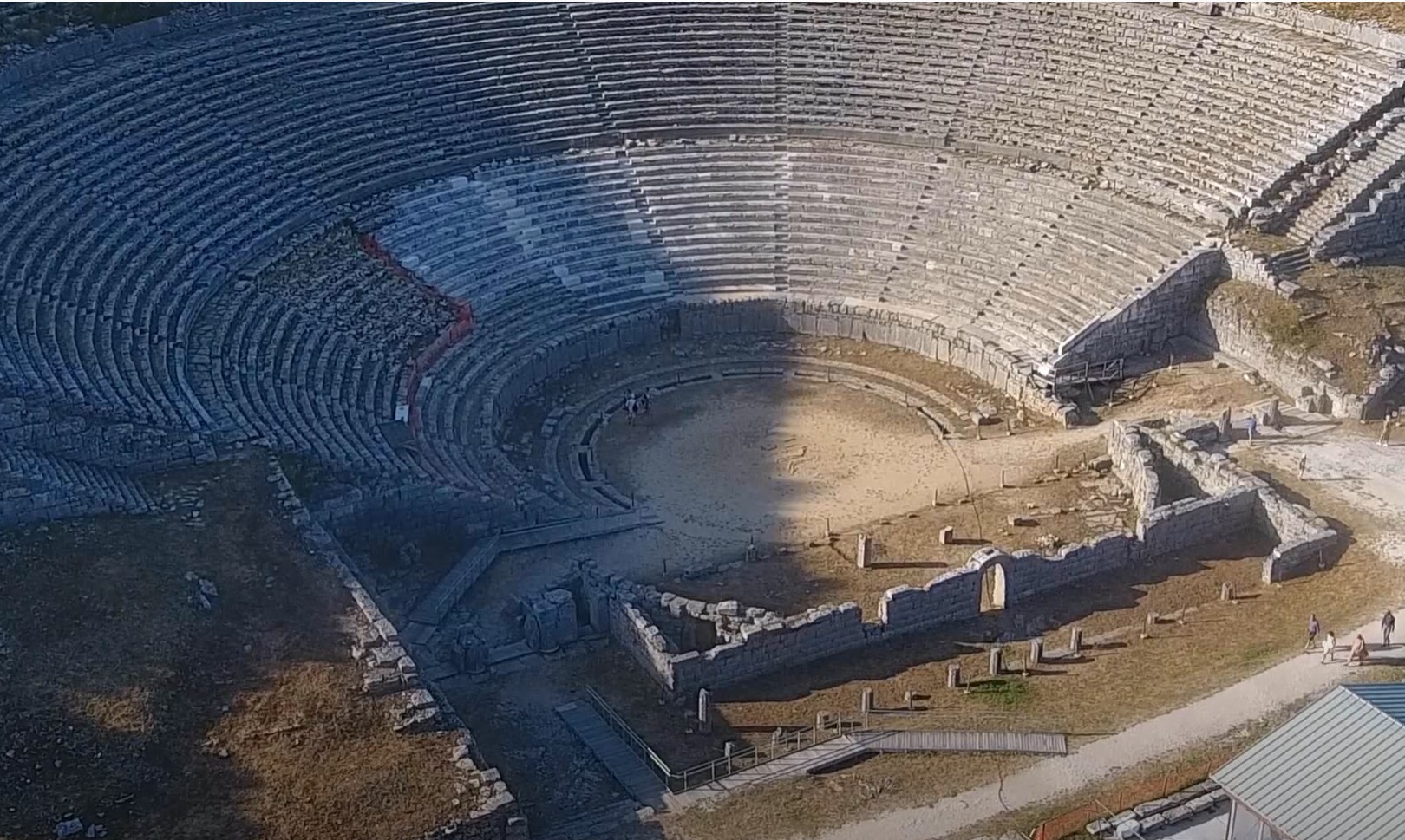

On June 21, the Boston Youth Philharmonic Orchestra will celebrate at the ancient theatre of Dodona the World Music Day. In the sacred place of the Epirus and all the Greeks, where the priests used to lie on the ground of the oracle to listen to the messages sent by Zeus with the voice of Nature, the Dodona, as foreign tourists call the ancient theatre, will celebrate with the exquisite music of the Philharmonic the completion of the restoration work in the lower hollow.
Sixty-two years after the first performance, 22 years after the opening of the plays in the largest surviving theatre of antiquity (18.000 seats) and 12 years since the start of work on the lower zone of the theatre with a total of nine stands with 2000 seats, archaeologists, architects, civil engineers, conservators and workmen have «won the bet» with the crushing, humidity and bad weather conditions and completed the largest «project of restoration and promotion of an ancient theatre» in Greece, renewing for the next centuries its «contract of life» in the valley of Tomaros.
According to information provided to APE-MPA by the archaeologist of the Ioannina Antiquities Ephorate Hara Kappa, «more than 1000 seats (seats), weighing up to 500 kilograms, of off-white and gray limestone, were removed from their position in the stands 1- 9, lifted, moved and driven to the adjacent construction site, through a special crane bridge, which has been set up in the area. One by one (in a process that takes 28 days for each seat, about a year for each stand) they were cleaned, material was added to the worn points, welded and re-installed in place, after excavation down to the rocky bedrock and shaping of the point.».
«In this way and on the basis of photographic documentation and study», as noted by archaeologist Eleni Moysiadis, who last week toured the archaeological site Greek and foreign journalists, «corrected and errors in the original placement that had been made in the ‘60s, when plates of the diazoma and pediments from the upper zone were placed lower in other locations».
The first phase of the restoration project, included in the Operational Programme ’Epirus 2014-2020«, with a budget of 5 million Euros, addressed with an innovative methodology the most important problem of the theatre of Dodoni, which concerned the ancient building material. Wherever necessary, new seats and special mortar were also installed, but with the same ancient building material, which comes from the current quarries of Clematia Zitsa, operating on the same limestone vein, on which the 3rd century quarries operated.
As pointed out to APE-MPA the deputy head of the Efa Ioannina Varvara Papadopoulou, «the restoration of the emblematic theatre of Dodoni, which is considered the crown of the work being carried out in the archaeological site is an innovative process, the distillation of many years and specialized studies». The interventions are carried out using the most modern methods and therefore, experts point out that the work at the theatre of Dodoni can serve as a pilot for the restoration of other ancient theatres in Epirus and elsewhere.
At the end of June, however, the gantry crane mechanism is to be moved to the middle span, from where the second phase of rehabilitation in the second zone will begin. Already, she said, the studies have been approved by the CAC and the removal of bearings from the middle span has begun.
As was known from the Ministry of Culture, the event for the completion of the restoration of the lower zone of the cave and its delivery to the public, next Tuesday, will be attended by the Minister of Culture Lina Mendoni.
Five ancient theatres one Epirus, i-thea, restoration and tourism development
The ancient theatre of Dodoni, built (in the 3rd century) by the king of Epirus Pyrrhus and its famous oracle is one of the five «Theatres of Epirus» of the Cultural Route coordinated by the Development Agency «Epirus SA» and addressed to cultural tourism.
The presentation of the Cultural Route in a fam trip for Greek and foreign journalists, was implemented by Anπτυξιακή Epiros S.A., in the framework of the project «Integrated Approaches for Cultural Heritage Promotion: the Ancient Theatres & Sites Route as Branded Destination»: Ancient Theatres & Sites Route as Branded Destination«) with the acronym i-Thea (INTERREG Greece-Albania 2014-2020).
The guided tours were, among other things, a first-class opportunity to record the restoration - maintenance and shaping works that have been carried out by the Ministry of Culture in recent years with national and European funds in the ancient theatres of Dodoni, Yitanes, Amvrakia, Kassopi, Nikopolis and their archaeological sites. With the exception of Nicopolis (built in the 1st century BC), the ancient theatres were built in the heyday of the Epirus public (3rd century), three of them by King Pyrrhus. They have a history of 2500 years and are connected to the cultural route, a total length of 344 km, which runs through all 4 Regional Units of Epirus (Ioannina, Thesprotia, Arta, Preveza), aiming to become the driving force of tourism and regional development.
Ancient theatre of Yitana, Thesprotia
In the ancient theatre of Yitanes (built in the mid 3rd century, 4000 seats) the restoration and renovation work on the lower stands has been completed in two phases, but work continues on the rest of the theatre and on the site of the ancient city of Yitanes on the hill above the theatre. «A large number of seats», as reported by the archaeologist of NFA Thesprotia, Vasiliki Lambrou, «have been collected in a deposition area to be used in a new phase of restoration». Many of the seats of the theatre bear on their sides engraved inscriptions, with names of people. Road access to the theatre and archaeological site requires improvements, but the Yitanes Theatre can and does currently host performances and events.
The most important of the protection works that have been carried out in front of the ancient theatre and at a distance of a few tens of metres from the orchestra is the construction of a «green dike», which prevents the theatre from being flooded by the waters of the river Kalamas. It is estimated that the theatre was the first structure of the Yitanes that visitors approached when they arrived in the city by boat, as the Kalama was navigable in ancient times.
Ancient Theatres of Amvrakia, Arta
The third stop of the Cultural Route is located in the city of Arta. Pyrrhus, historians say, built (3rd century BC) in Amvrakia two theatres: a large one that is almost all buried under buildings of modern Arta (in 1981 part of the orchestra, the hollow and the stage were found) and a small theatre (150 seats), in which excavation and promotion work is underway today. The small theatre of Arta was discovered in 1976 and is the second theatre, after that of Larissa, in a city, and is considered the smallest of the ancient theatres that have been discovered to date in Greece. Archaeologists, however, are of the opinion that it was a parliament building, where assemblies or debates on administrative and religious matters were held and perhaps it hosted some performances. Excavations have shown, however, that it was not built on a natural mound like other theatres, but on the foundations and mosaic floors of a bathhouse and on the foundations of houses in the Classical and Archaic city.
Ancient Theatre of Kassopi, Preveza, Preveza
The great ancient theatre of Kassopi (3rd century, 5000-6000 spectators) is the least known of the ancient theatres of Epirus. It is built at an altitude of 550m below the northwestern citadel of ancient Kassopi in a hidden, strategic position of Zalongo. The impressive ancient city, still impressive today, with its stunning view of the Preveza peninsula, the Ionian Sea and the Amvrakikos, built according to the Hippodamian system, had a prytaneum, a dormitory, walls, altars of the gods and a second smaller theatre known as the Odeon. It was carved on a natural rock, used for music and other events and is visible to today's visitors.
The works of the first phase for the restoration and enhancement of the lower hollow of the great theatre have been completed, although the waters of recent rains... eroded the arrangement of central seats. The actions involved work, restoration and protection of the monument as well as infrastructure and landscaping work. Recently, on the hillside above the theatre, rock protection works were carried out.
Ancient Theatre of Nikopolis, Preveza
This summer is expected to be the last with scaffolding and volumes of building materials for the ancient theatre of Nikopolis. As archaeologist Vangelis Pavlidis, the archaeologist of the Preveza Archaeological Institute of Preveza, made known to the journalists who participated in the fam trip for the five theatres of Epirus, «the ancient theatre of Nikopolis will be open to visitors at the end of the year». Thus, the largest surviving ancient city of Greece, founded by the Roman Emperor Octavian Augustus in 31 BC in honor of his victory against Antony and Cleopatra at the naval battle of Actium, can once again showcase among its imposing monuments, its impressive theater.
The first interventions to save the theatre took place in 1960. In the last decade, the work of protection, conservation, restoration and promotion of the theatre has accelerated. By the time the first phase of the project was completed in 2015, exploratory cuts had been made, revealing the entire extent of the theatre and removing volumes of materials that were dangerous to collapse. During the works, the beam supports that held the velum(tent) shade for the 5000 spectators were also uncovered.
The second phase of the project began in 2017 and its interior was fully revealed, while three rows of seats were found in a backfilled spot, which were saved from the seizure of materials, when three lime kilns were operating in the theatre and supplied - during the Ottoman Empire - with materials for the construction of the castles of Preveza. The whole restoration - promotion project, included in the Operational Programme ’Epirus 2014- 2020« had a budget of 3.4 million euros and the main objective of the project was to »increase the impact of natural cultural heritage on the regional economy«.
Thanasis Tsinganas