Contemporary intellectual reality is witnessing a marked resurgence and systematic reconfiguration of the atheisticphenomenon, which is no longer viewed as a mere private denial of the divine existence, but rather as a structured ideological and philosophical system. Atheism seeks to ground the rejection of the divine in the absolutization of rational thought andempirical verifiability, trapping the truth of existence within the narrow confines of material reality. In the face of this challenge, the Orthodox Christian perspective, fully expressed in the teachings of St. John Chrysostom, highlights the limitations of human cognitive faculties and reveals the ontological chasm between the created and the uncreated.
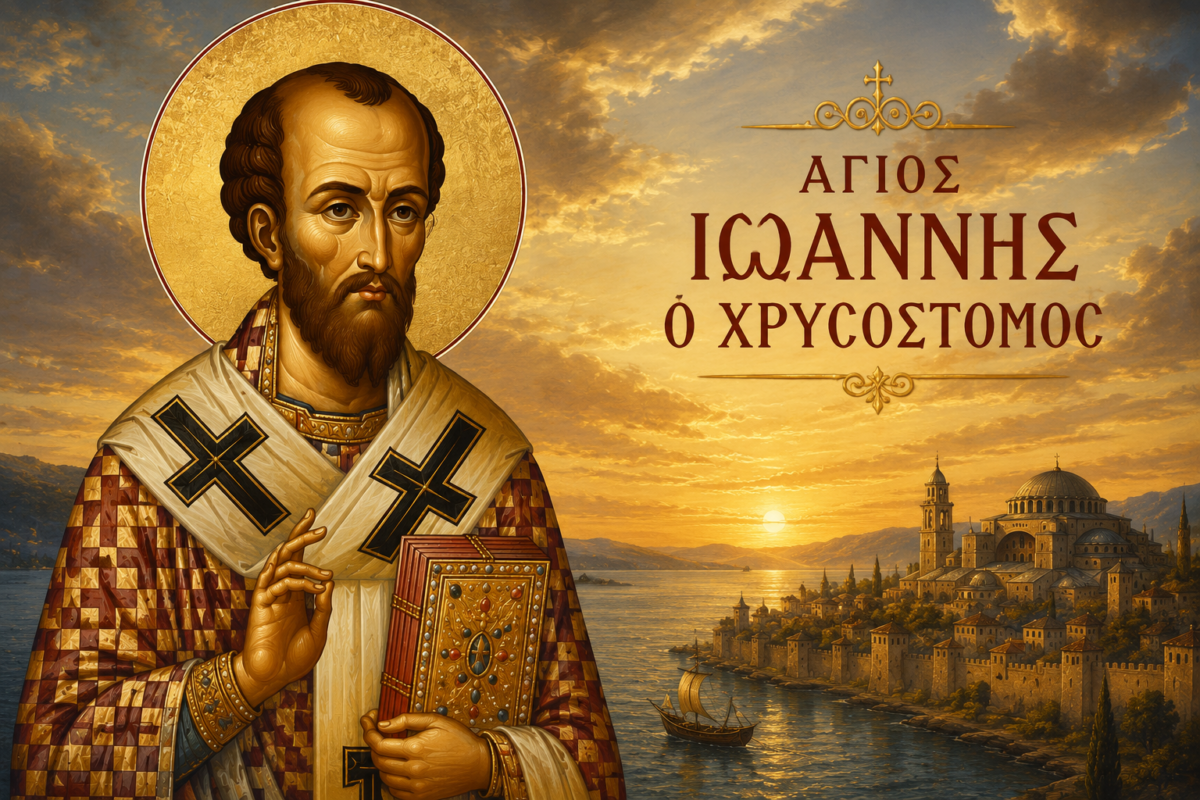
St. John employs the sharpest of language to demonstrate the absurdity of atheism. —And here it should be noted that the subject is examined solely in terms of atheism, as understood in the hagiographic «"There is no God," said the fool in his heart.» (Psalm. 52.2)—. When a person is confronted with the clear testimony of the Holy Scriptures, «In the beginning, God created the heavens and the earth», and yet if he refuses to believe her words, then he falls outside the realm of reason. «So turn away from him, for he is raging and out of control.» (In Genesis 2,3, PG 53,30). He who disbelieves in the Creator of all things and accuses the truth of being a lie is deprived ofany excuse, since his opposition to the obvious constitutes a clear example of deliberate madness. The denial of God is perceived as «a striking example of madness», since the mind of the atheist, blinded by delusion, is unable to grasp the basics (In Genesis 1,2, PG 54, 583). Turning the argument of the unbelievers of his time on its head, who accused Christians of their Faith, the holy father demonstrates that unbelief itself is a product of spiritual emaciation: «Therefore, it is a sign of a feeble mind not to believe, and of a small and wretched one». When unbelievers accuse believers of their faith, Christians must in turn accuse them of unbelief, characterizing them as wretched, small-minded, foolish, and weak. While Faith characterizes a noble and magnanimous soul, unbelief stems from a «utterly senseless and trivial»the intellect, which has fallen«toward the mindlessness of animals» (To the Romans 8.6, PG 60, 462). Spiritual health is entirely synonymous with piety, whereas atheism is defined as the worst form of pathology; «Piety is the health of the soul, but not knowing God is the worst disease and infirmity of all.» (On «Lord, is not a man’s way his own?», 2, PG 56, 157). It is, therefore, an extremely serious affliction, one that brings about the complete darkening of human reason. Consequently, ignorance and denial of the Lord constitute the «the beginning of folly» (To RomeAeous 21, 5, PG 60, 600). The atheist, believing that through his self-reliance he becomes wise, ends up being the most foolish of all, since «For there is nothing that is not a trial, except for turning to God» (2 Corinthians. 1,4, PG 61, 388). To find oneself face to face with God is the only thing that is truly sorrowful, for it deprives the soul of its foundation and delivers it into the vortex of its own corrupt thoughts.
The absurdity of atheism, always based on Chrysostom’s theory, does not stand up to the scrutiny of logical criticism, since it is refuted by a multitude of irrefutable proofs that the Creator has sown in creation and in human nature. Atheism’s insistence on ignoring this evidence demonstrates its complete intellectual folly. According to basic logical axioms and the laws of nature, no being or phenomenon can arise from non-existence without a cause, since spontaneous life and generation do not exist. The infinite universe was not created on its own or by chance, but necessarily presupposes a Wise and Almighty Creator. The sight of the surrounding world lifts man up to Him, as the psalmist notes: «The heavens declare the glory of God»…« and the Apostle Paul ‘”For his invisible attributes, which have been understood through his works since the creation of the world, are clearly seen» (Praise 9:2–3, PG 49, 105–106). The world is governed by unchanging laws, harmony, order, and purpose. St. John asks, how is it possible for elements that are opposed to one another and such a vast creation to be coordinated and directed without a ruler?«For how could I possibly account for, tell me, all these elements and such splendor could exist without someone governing and controlling everything??;»A ship cannot sail the waves of the sea without its captain. A soldier cannot accomplish anything heroic unless a general leads him. A house cannot exist or be built without its builder and architect (In Genesis 3, 4, PG 53, 36). Consequently, it is absurd to claim that this infinite world and the astonishing harmony of the elements are governedby chance and as it happened, without the presence of the divine charioteer, who holds all that is seen together according to His own wisdom, constitutes the ultimate form of absurdity. All of creation proclaims God, because «The Creator is regarded as corresponding to the size and beauty of His creations» (Heb. 11,6).
The anatomy of the phenomenon of atheism and unbelief must first be examined in terms of the ontological and metaphysicalalterations of human nature. The primary and root cause of this spiritual blindness is the Fall of our first parents, the original sin. St. John, following the established biblical and patristic tradition, directly links the loss of the knowledge of God with post-fall tragedy, according to which man falls from true knowledge and becomes trapped within the finite limits of anautonomous intellect. The primordial upheaval brought about a darkening of man’s cognitive and spiritual powers. Mankind, carried away by the hope of greater knowledge, fell into the harsh tyranny of death. That fallen state entails the loss of the knowledge of God, which man had previously possessed in Paradise, plunging him into shame and nakedness, whereas before the deception he was above all shame (To John 7.1, PG 59.63). The darkening of the mind manifests itself clearly as spiritual blindness and «madness,» which distorts the subject’s relationship to creation and the Creator. The holy father characteristically notes that unbelief is evidence of spiritual darkness; when a person, instead of being healed by contemplating creation and being elevated through it to the Creator, remains simply dazzled by the beauty of creation, then the light is transformed into darkness for him. An obsession with the autonomous examination of the visible world, without spiritual reference to the original, constitutes voluntary irrationality and blindness, since such a person ’He used light to drive away darkness» (In Genesis 1,1, PG 54, 581–582).
St. John Chrysostom emphasizes that those «outside,» those who are far from the Church and from divine Grace, are subject to the passions of the flesh and the mind, serving them. At the same time, they become trapped in the blind pursuit of their own thoughts and human reasoning. Their submission to the passions on the one hand, and their rationalistic-intellectualistic delusion on the on the other hand, renders them utterly incapable of accepting or comprehending any transcendenttruth about God, since the divine mystery lies incomparably beyond human reason (To the Ephesians 23.1, PG 62, 164–165). The defilement of the image of God is completed through the domination of the passions, and man, having turned away from God, is delivered into the power of the devil, suffering countless torments (To John 68.2, PG 59,376–377), with the result that he is no longer master of himself, since the devil binds him to evil, causing him to do whatever he wants «the sin that dwells within him» (Rome. 7,17).
The primary methodological flaw in atheistic thought lies in its inability to comprehend the clearly finite nature ofcapacity. The atheist thinker, by absolutizing his innate rational and sensory faculties, demands an approach to the divine through methods that apply exclusively to the investigation of the material world. Here, however, a major categorical error occurs, namely, that an attempt is made to subject the uncreated to the standards and categories of the created. The rationalist’s demand that Faith be made dependent on the rational process of proof deprives reason of its spiritual stability, since the divine is, by its very nature, an inexplicable mystery. St. John, analyzing this spiritual reality, characteristically states: ’It is not right to be so rigid as to demand such reasoning. For behold, how all our virtues are held up by nothing but reason and faith alone.». What kind of reasoning would accept that God is without beginning, indescribable, and infinite? (To Col. 5.3, PG 62, 333). According to the Golden-Tongued Father, the divine nature «He does not submit to questioning, nor does he follow the dictates of reason». The glory of the God who is worshiped far surpasses any human intellectual conception, transcending «every state of unity and angelic nature, every transcendent understanding, and every supercelestial power» («By what authority do you do these things?», 4, PG 56,418). Rational thought, confined within the frameworks of created logic, is unable to grasp the attributes of the Godhead, which appear paradoxical and incomprehensible. Only the attributes of God are comprehensible and His action is communicable; through these, God is known, but the corresponding conditions are required. Autonomous rationalism, driven by an egotistical desire for complete control over everything, slips into a path that is destructive to the knowledge of God. When a person attempts to approach the divine mysteries stripped of the garment of Faith, and presumptuously probes the inaccessible truths, he becomes spiritually blinded. St. John condemns this methodological deviation, pointing out that this restlessness produces the opposite results: «As for God, who wants to know everything and dares to do anything, he does not know, of all things, what God is» (2 Timothy. 8.4, PG 62, 647). The rationalist’s arrogant claim to understand, through logic, «what God is» God—not only does it fail to lead to true knowledge, but it leaves man completely ignorant of God. The divine essence remains inexpressible and inaccessible, and the insistence on its rational exploration cuts man off fromthe only path, which is participation in the incomprehensible mystery through Faith.
Alongside the methodological shortcomings of rationalism, Chrysostom’s writings highlight the sinful and corrupt life as one of the primary causescauses of atheism and unbelief. The loss of faith is the result of a gradual moral erosion, which clouds the mind and cuts a person off from the source of divine light. There is an organic and reciprocal relationship between moral decline and doctrinal alienation. Man is led into unbelief when they seek to justify their passions or when their mind is overcome by the love of earthly glory: «Indeed, this was the very cause of their unbelief: their corrupt way of life and their love of glory». (In Genesis 2, PG 53,30). Persistence in evil gives rise to unbelief, and conversely, unbelief emboldens a person to commit sin, trapping the soul in a vicious cycle. The rejection of Faith then serves as a cover for complacency, that is, so that the one who sins may be freed from the scrutiny of conscience and the fear offuture judgment, consciously chooses to deny the existence of God (To Matthew 72, PG 58,667). When a person persists in a corrupt way of life, his conscience becomes distorted. Those who turn a blind eye to divine evidence do not do so because of intellectual weakness, but because of a wicked will and a perversion of the criterion of truth (To the Hebrews, 10, PG 63,87). This inner decay, wrought by sin, the wicked conscience and corrupt deeds, deprives the soul of any spiritual antidote, inevitably leading it to complete spiritual destruction, into the abyss of unbelief («Having the same spirit of faith»…”, 1, PG 51, 280).
Another essential aspect of the cause of atheism, as analyzed in Chrysostom’s writings, lies in man’s all-consuming attachment to the transitory and ephemeral things of this present age. This worldly absorption of people, who are «devoted solely to the world, and set their minds on the things of the world», it blinds the spiritual senses, and the human mind is clouded by this passionate attachment tomatter more than anything else, since «For nothing clouds the mind as much as paying attention to the things at hand». Attachment to the present, in other words, acts as a spiritual quagmire, which settles upon the soul’s discernment, rendering it utterly incapable of perceiving transcendent truths. The harm that a person suffers from attachment to worldly things is not limited to minor matters,, but ’in the chapter on the good things», deriving this from the Gospel saying «You cannot serve both God and Mammon.» (To John 8.2, PG 59, 68).
Accordingly, the systematic analysis of the phenomenon of atheism, as it is shaped on the basis of Chrysostom’s writings, demonstrates that the denial of God constitutes, we might say, an existential and spiritual pathology. St. John Chrysostom, with his keen pastoral insight, goes beyond the superficial frameworks of the philosophical objections of the time and penetrates to the inner core of the human being, where the true spiritual transformations take place.
To summarize, then, the causes of atheism can be seen to revolve around three interrelated axes: flawed methodology, moral decay, and being trapped in the present age. As for the first, selfish and autonomous rationalism, which arrogantly attempts to subject the uncreated to the finite measures of created logic, leads to the darkening of the mind. As for the second point, a sinful and corrupt life compels a person to deny God, in order to justify his passions, but it also wrongly leads him to spiritual confusion and the darkening of the mind, that is, to spiritual blindness and the loss of reason. As for the latter, an obsessive attachment to the present and ephemeral aspects of the material world which afflicts the intellect and enslaves the soul to material things, rendering the latter utterly incapable of aspiring toward the heavens. Consequently, confronting atheism and curing this disease requires a universal renewal of human existence—or, in other words, the free participation of the ailing human being in the redemptive work of Christ, through which human nature has found in Christ its harmony and its proper functioning, which, however, is a separate issue from the one under discussion.
Deacon Hierotheos Kritikos, Preacher of the Holy Metropolis of Kythira and Antikythira
HOLY DIOCESE OF KYTHERA AND ANTI-CYTHERA
OFFICE FOR HERESIES AND PARARELIGIOUS MOVEMENTS