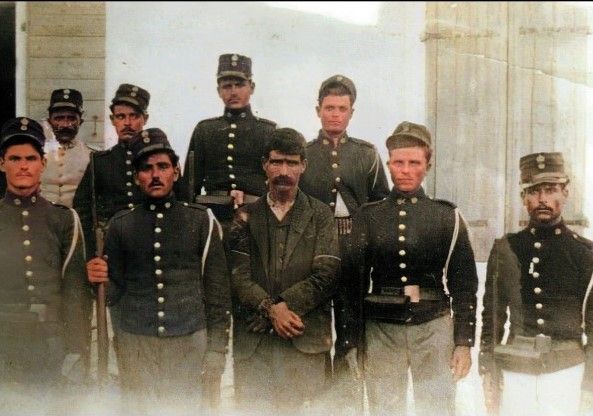
On August 23, 1909, one of the most heinous crimes in Greek history took place. The murder of 15 residents in the village of Kalokairines Kythera by A.L. The murderer and resident of the island is said to have been forced to flee the island, after an ambush was set up against him, with the aim of slandering him. He moved to Athens, where his problems continued.
Enraged by the unfair treatment of society, as he was convinced, he decided to take revenge. He returned to Kythera and armed with a knife, he murdered 15 inhabitants of the island. Witnesses report that he was in a state of amok and under the influence of drugs. A few hours after the killing, he was arrested. In Nafplio prison he committed another murder, acquiring the nickname «Captain Sixteen» because of the number of his victims. In his cell he breathed his last breath.
The wild crime of Kythera is one of the first cases of mass murder in Greece.
The ambush in Kythera
A cobbler, craftsman and instrumentalist, the perpetrator was one of the most beloved and friendly residents of Kythera. He lived in Gerakitianika in Aroniadika and made handmade stews. Apart from the good relationship he had developed with his customers and neighbours, he was one of the first guests at every festival and celebration...
Until the day when a woman from a neighbouring village arrived at his chagaradiko, received the stews he had ordered, but refused to pay for them. A stanza ensued in which he demanded his money and she invited him to her house to pay him back. And so she did. However, an unpleasant surprise awaited him. As soon as he arrived home, and while the wife was preparing the, necessary for the time, «mousafiri treat», the husband returned. Enraged by the presence of another man in his house, she beat him and forced him to flee. Malicious rumors about the cobbler quickly circulated, and later suspicions were expressed that the episode was staged. Gradually he lost all his clientele and, hurt by the deceitful behaviour of his fellow countrymen, decided to seek his fortune in Athens.
In Athens
He arrived in Piraeus and started working in a cobbler's shop, where the boss was a Kytherian. Being excellent at his work, he quickly gained a reputation as a good craftsman. This, it is said, caused the envy of his colleagues, who decided to get rid of him.
They placed some shop tools in his backpack, which were found by the boss. Due to his previous honest behaviour he was treated with leniency. However, the boss's wife reportedly insisted that charges be brought against him for embezzlement, recalling the incident on the island. Indeed, A.L. was charged with theft, convicted and sent to prison. When he served his short sentence, he found a new job, but shortly afterwards, for unknown reasons, he was fired....
The murder
Faced for the third consecutive time with unemployment, he decided to take revenge and sailed to Kythera. On 23 August 1909 he arrived in his hometown and armed with a knife he set off for Pitsinianika. Under the influence of drugs, it is said that he got confused, lost his destination and found himself in the village of Kalokairines.
On the same day, a baptism of a girl was scheduled at the village church of Agios Spyridon. The would-be murderer arrived at the bell tower, rang the bells and the islanders set off for the sacrament. The assailant set up a stakeout in the adjacent alley and plunged his knife into anyone who passed by. Some of the residents thought it was a pirate raid, as the island had been tried before and the tales were vivid.
However, the village priest was the first to realize that he was not a pirate. He armed his rifle, took aim and shot him in the back. The killer was not mortally wounded. He ran to avoid capture and the villagers began to count victims.
The testimonies of residents revealed that the number of victims reached 15, including a pregnant woman with her two children.
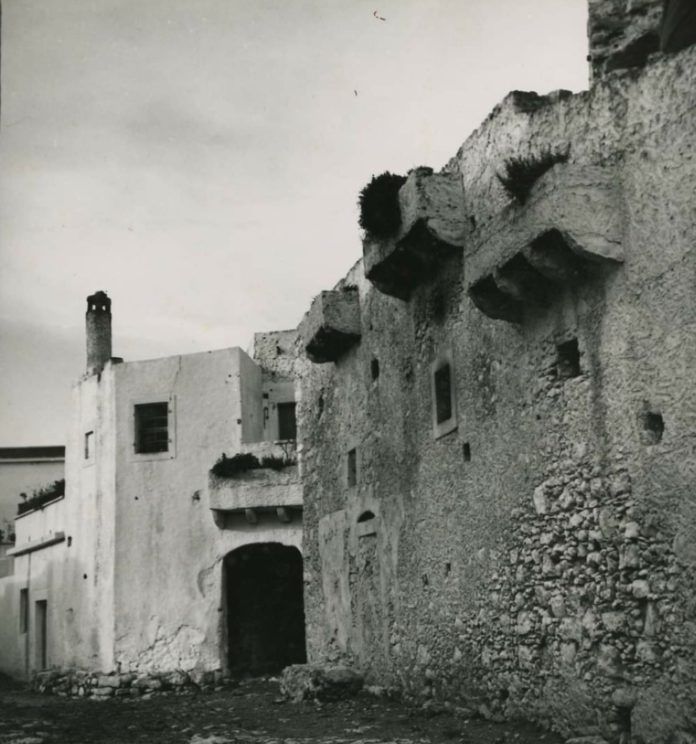
Captain Sixteen
The offender arrived at his house and spent the night on the roof. The village was in panic as no one could formulate the identity of the culprit with certainty. The next day, the perpetrator's neighbour went up to the roof of her house, spotted the bloodied A.L. and called the police. Within minutes he was arrested.
He was driven to Nafplio, where the trial was held. Although everything indicated that he would not escape the death penalty, he was nevertheless sentenced to life imprisonment. It is said that the court decided on this sentence in order for the perpetrator to take on the duties of an executioner, which was only applicable to murderers with a large number of victims.
In the prison of Nafplion he was found a fellow prisoner with some Maniates. As in other penitentiary institutions, the unwritten law of superiority of the one with the most serious criminal record applied there as well. A.L., with 15 deaths on his CV, was already «one of the strongest». When he committed another murder in prison, the number increased and he acquired the nickname «Captain Sixteen». The Maniots set out to eliminate him, probably because his 16th victim was from Mani.
So they colluded with the prison barber and at their scheduled appointment, he stabbed him with a razor....
Popular tradition has created the following verses:
On the Summer the great state
...L. has done a great job!
On the Summer Wilds on Ponente
L. slaughtered fifteen people.
In July 2020, the author Panos Dimakis decided to shed light on the unknown story. The novel «Seventeen Threads» from Kappa Publications, which is based on the horrific crime of Kythera. The author gives a different perspective of the events, examining more the reasons that led the perpetrator to the mass murder of his fellow villagers...

As stated in the book's synopsis, it is «a fascinating dive into the psyche of a man who had everything he wanted in life, who relied on the acceptance of those around him and gave it back to them generously. But sudden rejection, ongoing injustice against him and a whole world crumbling around him turned him against his fellow countrymen and led him to commit the greatest crime ever committed in Greece.»....