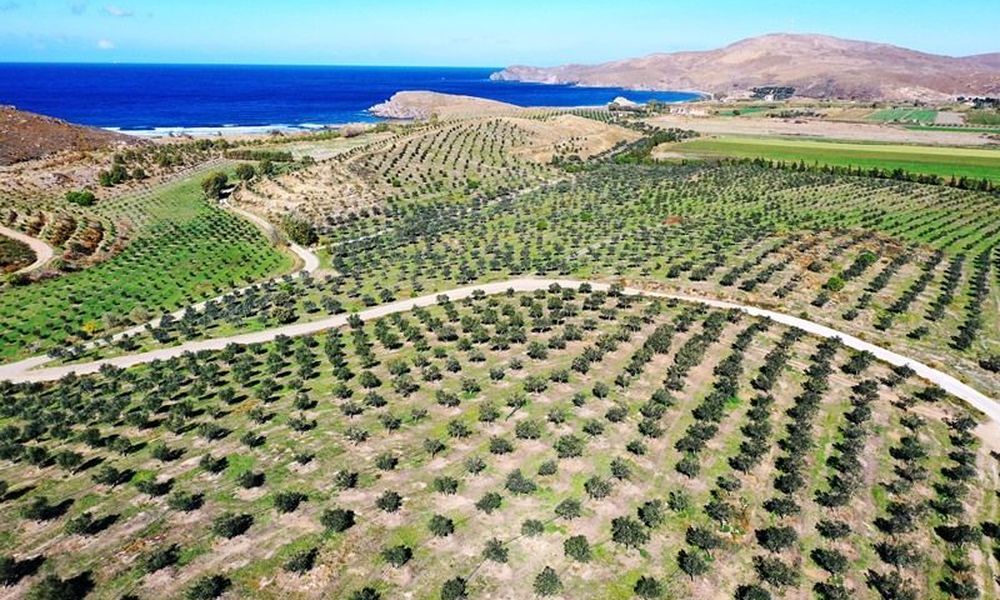
Can a deserted piece of land be turned into a little paradise? Can something like this work symbolically to reopen a «deserted» small community? And finally, can all these things together teach us that what man has destroyed can be rebuilt if man wants to?;
Antonis Tripintiris comes to answer these questions. In a few years and overcoming many difficulties, he transformed deserted land in Sigri into an olive grove with 40,000 olive trees and more! With inspiration, vision, passion and love for his land that had been deprived for years, he created an innovative and at the same time sustainable production unit.
Antonis Tripintiris, a child of Asia Minor refugees, found when he visited the village of Sigri, at the westernmost tip of Lesvos, that year after year it became empty. The residents were dwindling, the schoolchildren were dwindling, there was no prospect of development. The land as a result of volcanic processes millions of years ago had been abandoned, the cultivation and processing of oak trees had been abandoned, the oak trees had been cut for firewood. The land around Sigri was rocky and not a word about job prospects for the young people who lived in the village.
That's how the idea was born. On 2,000 acres of land that Mr. Tripintiris owned or bought, literally by digging up the petrified lava, a multi-diverse estate with the best local, Greek and Mediterranean olive varieties was born. The main focus of the estate is on the local varieties of adamantine and columbine olives and the aim is to cultivate them properly. «We have plenty of sunshine, we also have the rain that first rains us in Sigri,» Mr. Tripintiris tells APE MPE. He continues: «Today on the estate there are a total of 12 olive varieties, trees from one to 12 years old. We planted them by digging in the rock, we fertilized them naturally, compost from the poseidonia that comes out on the coast (seaweed from the sea) organic manure from poultry farming and the island's bushes and the product of pruning, leaves and branches. At the same time inside the olive farm we created a biodiversity with fig trees, almond trees, pomegranates and even many palm trees. Thus we created an olive grove that is cared for throughout the year by excellent scientists and staff, such as agronomists, experts in dactyl protection, leading Greek chemists for the quality and aromas of olive oil, trained pruners, trained staff». This is how a unique product is born, prepared each time, tailored to the desires and taste needs of each customer. The 12 olive varieties? They help in this direction.».
But the process of oil production also helps in this direction. The most innovative technology in Europe is applied in a unique architectural mill that wants to be a centre for the promotion of the olive culture at the same time. «We apply a linear production process, we maintain a controlled temperature in all machines and production stages, we minimize the use of water in order not to remove the antioxidants of olive oil, polyphenols and other sensitive ingredients of high nutritional importance» says Mr. Tripintiris.
«The pinnacle of innovation,» he continues, "is linear production, with roller and vertical conditioners, regulators and special digital programming. Each olive has exactly the same route and production process with olives of the same variety and maturity. Our mill has a memory. It recognises the degree of ripeness and the variety of the olive and shapes the optimal production conditions.".
The olive oil produced is stored in stainless steel tanks, where there is an automatic heating-cooling network, in order to maintain the temperature at 17 degrees Celsius. Finally, the free surface of the tank is filled with nitrogen to avoid oxidation.
Finally, the olive oil is standardised. During packaging, nitrogen is injected to prevent oxidation even in the container. In addition, it is possible to add various extracts of herbs, fruits, vegetables, spices to enrich the olive oil with flavours and aromas, but also to add health claims and additional nutritional value.
The olive needs less water than other crops, is more resistant and better suited to local conditions. It is a perennial, evergreen tree that reduces its carbon footprint. As Mr Tripintiris tells APE MPE, «the 40,000 olive trees planted in Sigri erase the carbon footprint left by 2,000 people. It reduces greenhouse gas emissions. It protects the soil with its roots from stripping. By shading the trees, it reduces the temperature and intensity of the air. The soil becomes fertile, rejuvenating the flora and fauna of the village.».
We ask Mr Tripintiris how much this environmental and at the same time innovative agricultural miracle he has set up cost. He smiles. «Many millions...» he replies. He doesn't tell us how much. Doesn't he want to say? He probably doesn't think all this can be costed, is the answer.
Sigri, the whole of western Lesvos has gained another lever of development. Next to the new road axis of Kalloni Sigri, the new port under completion, the natural history museum and the richness of the fossils of the area, now a new innovative «green» investment with the scent of olive culture.
S. Balaskas