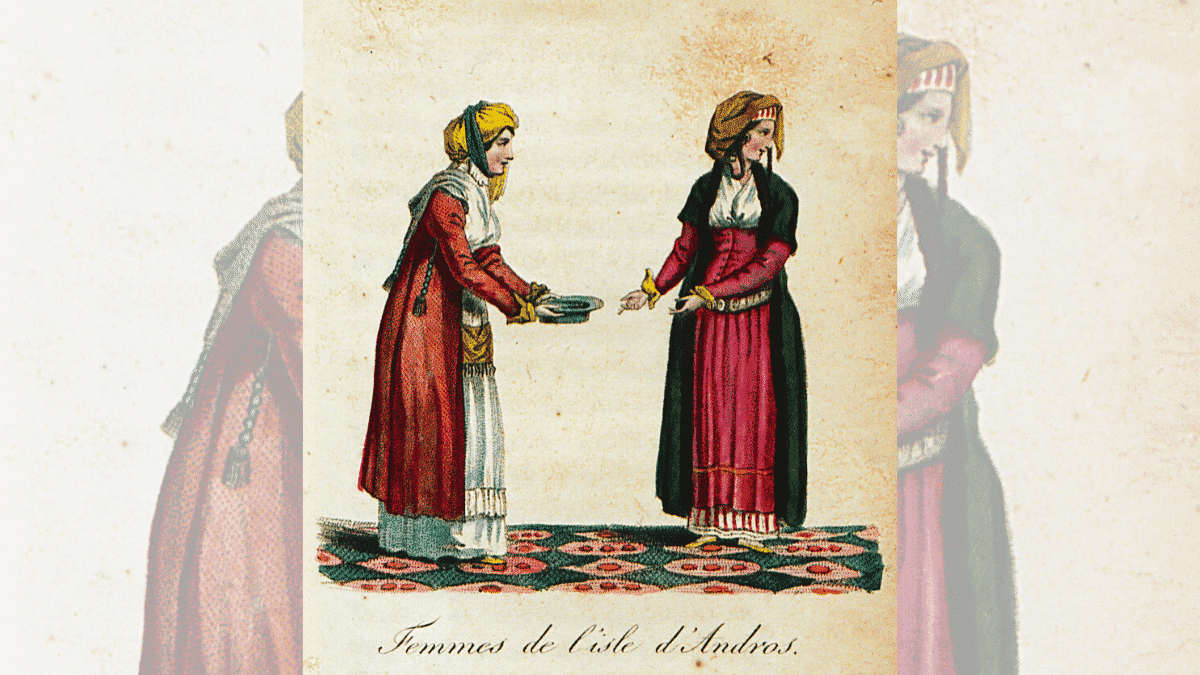
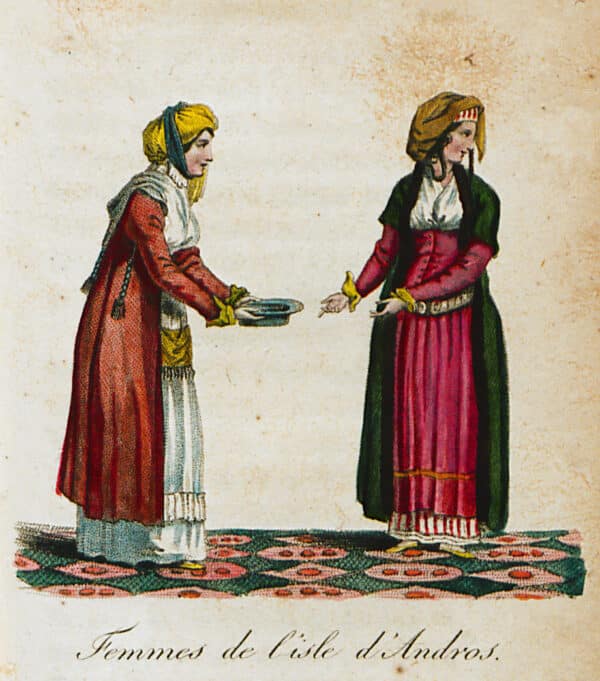
It is important to acknowledge, apart from the practical participation in the struggle of the Greeks in general for their liberation, the contribution of women to the spiritual strengthening of the Greek Revolution. Also, to identify the awareness of the Greek Diaspora and citizens in Europe and America who supported the Greek Struggle. I will refer in particular to the women who emerged through their writing and other activities in the reconstruction and rebirth of the nation and to the more broadly educated women who contributed to the field of letters and the arts. Women, who came from the circle of the Phanariotes, from the Ionian Islands and from the wider Ottoman-ruled Greek area, contributed greatly to the formation of the national consciousness of the Greeks from the pre-revolutionary years and the period of the Greek Revolution. Most of these women writers were engaged in translating works from European languages, especially French, Italian and German, in order to convey the ideas of the Enlightenment, especially works related to the education of women and the formation of their character.
A typical example is the work of Evanthia Kairi, who was born in Chora of Andros in 1799 and died on the island in 1866. Kairi, like other women, who belonged to the upper social strata of the Ottoman-occupied Greek area, as well as the Fanariot women of the Paradunavian Dominions, having received a broad education, contributed to the development of literature, mainly through the translation of works of the European Enlightenment. Through translation, they participated in the male literary world, but without directly exposing themselves through their writings in the public sphere, thus compromising their moral and personal integrity. Kairi undertook important translation work, as she aimed, through this activity, to contribute to the dissemination, to the «metacentesis» of the ideas of the European Enlightenment in Greece. In a letter to Adamantios Korais, she stated that her aim was, through her translations, «to profit our nation according to my power.». Cairi dedicated her life to supporting the Greek Revolution through her writings and highlighted the contribution of «silent women» to it. Her ideal remained throughout her life the acquisition of freedom and independence for Greeks and Greek women and the necessity of spreading education and the ideas of the Enlightenment to all Greeks, and more so to the women she felt were most in need, so that they would become more capable of helping to build sound and solid foundations for the emerging Greek state.
Kairi translated into Greek the work of the French enlightener Antoine Léonard Thomas entitled Mark the Emperor of Aurelius the Epistle of Mark, inscribed in French by Thomas the orator (Éloge de Marc Aurèle), which had been published in French in 1775, which he completed in 1819 but was nevertheless published in 1835. Cairi also translated (at the age of 18) the work of the French scholar François Fénelon, entitled On the upbringing of young women by the French priest and poet François Fenelon (Traité sur l'education des filles), published in 1687. It enthusiastically argued that women in general should be able to receive an education, and especially Greek women, mainly because of their glorious ancient Greek origins and the special importance they had as mothers in raising future Greek citizens worthy of their past. With the aim of encouraging women to receive an education, she translated selected parts of Jean-Nicolas Bouilly's work, Conseils à ma fille, published in 1811 in Paris. Its translation entitled Advice to my daughter, was published in Kydonia in 1820, at the encouragement of her brother Theophilos. Cairi, although she continued her translation work, devoted her writing almost exclusively to highlighting aspects of the Greek Revolution.
On 17 April 1825 he wrote the Letter from Hellenic women to the philhellenes composed by some of the greatest Hellenic women. Part of the letter was published anonymously a few months later on July 31 of the same year and signed by thirty-one Greek women in Hydra in the newspaper The Friend of the Law. For the excerpt of the letter, published in this newspaper's Summaries, the editor, the Italian philhellene and ex-carboonist, Giuseppe Chiappe, refers to the patriotism of the anonymous author, describing her as «one of the greatest Greek women of the Aegean Sea Islands», naming her as «fruit of the Evantian tree of Evantheseros». With this last characterization the writer was of course alluding to the name of the author, through the use of the above adjectives.
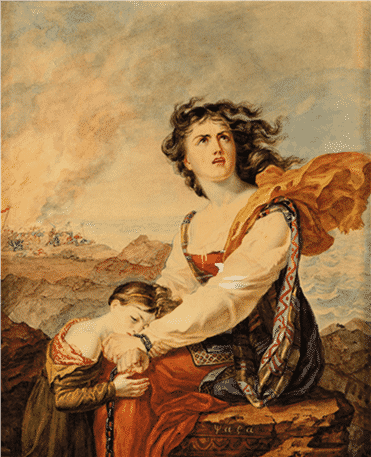
The style of her letter to the Philhellene women abroad is characterized by genuine and authentic patriotism and is imbued with the belief and conviction that for the ideal of freedom one is worth sacrificing even one's own life. Characteristically, she states in her letter: «Greece shall obtain perfect freedom and independence». He further noted that the Greeks, despite the difficulties of the Struggle, are leaving life «pleasant», why they die «for our Fatherland free, and no longer the slaves of the inhuman tyrants». Her letter was widely disseminated through its translation into French and English. But it was more widely disseminated in the English philhellenic environment, through the English language and the translation of her letter by the British philhellene George Lee, who also translated part of the Hymn to Freedom of Dionysius Solomos.
Cairi, however, does not hesitate to condemn the neutrality of the Great European Powers towards the Greek Struggle. In her letter she criticizes these European countries, accusing them that by maintaining neutrality and by other actions they did not support the Greeks as they should, as «fellow Christians», but on the contrary, up to the time of the publication of her letter, they remained on the side of the Turks. She singles out, however, with emphasis all those who by every means, sacrificing even their own selves, contributed to the struggle of the Greeks for their independence. This observation by Kairi coincides with the accounts of other European scholars of the period, who refer to the hostility of some Europeans towards the Greek Revolution, particularly during the first five years of the Greek liberation struggle, and to the support of the Turks by certain European powers and their rulers. Her brother's active and crucial participation in the Revolution, right from its beginning, was very important for her, as even though she retired to the private sphere, either in Andros or Syros, through her written word, which was her «weapon», she wanted to actively participate in the Greek struggle for national independence.
At this point we should also note the international impact of that aspect of the Greek Revolution that was linked to the suffering and pain of the civilian Greek population. The issue of this Greek «drama», which the war had caused to a multitude of unprotected women, pregnant women, mothers and their children, as well as to unworthy men, sick or elderly, who either suffered the consequences of the war in their own country or had come as refugees, mainly to the Ionian Islands, which were under British protection, in order to save themselves from the consequences of the war, caused waves of support from philhellenes abroad. The outbreak and general martyrdom of the Greek Revolution caused a strong philhellenic movement in many European cities and in cities in the United States of America.
The late 18th and early 19th centuries saw a significant increase in American women's access to education, with the result that women began to gain a more powerful presence in the public sphere. Furthermore, women in America organized themselves into philanthropic societies, contributing through them to a variety of causes, for example, to provide substantial assistance to the economically sick and other vulnerable groups in their country. This philanthropic American women's movement extended beyond America, with American women enlisting in support of the Greek Struggle and joining the dynamic movement of Philhellene men, aiming for national independence for Greece and securing freedom in the West and aiding Christian populations in general in their struggle against the Ottomans. The Philhellenes, both in Europe and America, felt that it was imperative to provide aid to the rebellious Greeks.
The philhellenic movement was based on the ideals of Christian charity and humanism. The American Philhellenic Women, through their actions, managed to sensitize the general public and especially other American women to assist the Hellenic Struggle, mainly by providing financial aid to support women and children belonging to the vulnerable social groups due to the war. Having as a common goal the support of the Greeks and Greek women, because of the admiration they had for them, mainly due to the tradition of their ancient Greek culture and the faith of the new Greeks in Christianity, this philhellenic movement of American women united many in this common vision for the freedom of the Greeks. It managed to bring together women from the upper and prosperous economic strata as well as women from the economically weaker strata. As they state in a letter to the Greek women, «The rich gave out of their surplus, and the poor contributed their portion to your tale.». American women admired Greek women because their struggle was considered worthy «for imitation», recognising the sacrifices of Greek women, as the rebellious women lost their husbands as well as their children in the struggle for the independence of their country. Especially as they were informed that they were left without food and shelter and «covered with branches of mercy.», because they preferred to have «an honorable death rather than an honorable life.».
American women sent mainly clothes and essentials to the rebellious Greeks and tried in various ways to support the first schools that had been established in Greece. The Philhellenic Women of America stated in a letter to the Greek women, published on April 12, 1828, that their aim was to support the Greek Struggle, since, as they stated, «we followed with impatience the changes in the fortunes of Greece that had taken place during the seven years of the cowardly struggle’. About three hundred American women offered, through the Philhellenic Committee of New London in Connecticut, USA, dresses that they sewed for the Greek women as a sign of support for the pain and suffering that the war conflicts had brought to their lives and their families. Supporting them morally in a letter they wrote in 1828 about the Greek Struggle: «Let us praise the pitiful god that after four centuries of darkness and slavery, the bright star of liberty has come to your crushed breastplate.».
Evanthia Kairi, in a letter of thanks that she herself wrote (and 29 other Greek women signed), highlights the fortitude with which Greek women seem to have faced the suffering of the war. Characteristically, she states that those who «afflictions» and if they encountered during the Race can be tolerated, as the «slavery» was more unbearable. In this letter of thanks, she further states that this practical support and the female solidarity of American women provided courage, as «The tears for us have made our own tears short.». It is also particularly important to stress the need for Cairi to spread and keep in the memory of people in the future that, although the Greek Struggle was not supported but fought by various European powers, there were men who helped in the Struggle, but above all, there were «philhellenic women», who supported and helped as much as they could the Greeks, the Greeks and the «starving children of our struggling homeland in the struggle for freedom».
* Η Maritina Leontsini received her PhD in Modern European History from the Department of History & Archaeology of the University of Athens. She is currently a Postdoctoral Researcher on the role of women in the Greek Revolution, at the Department of History & Philosophy of Science of the University of Athens, working on the research project «The Newspapers of the Greek Revolution (1821-1832)».
Bibliography
Dalakoura, Katerina, & Sidiroula Ziogou-Karastergiou, The education of women. Women in education. Social, ideological, educational transformation and women's intervention (18os-20os ae.), Kalippos, Athens, 2015.
Olympitou, Evdokia, Bouboulina, Kairi, Mavrogenous. The Women of the Struggle, 2nd edition, Ta Nea, Athens 2019.
Perlorentzou, Maria, «Evanthia Cairi, Letter of Greek women to the philhellenes. 1825, ElladaEurope: Reflections and Remarks», Parnassus, vol. ME΄, (2003), pp. 299-332.
Sporidis, George P., Bonds of Freedom: American Philhellenism during the Revolution of 1821, private edition, Athens 1968.
Repousis, Angelo, «“The Cause of the Greeks”: Philadelphia and the Greek War for Independence, 1821-1828», The Pennsylvania Magazine of History and Biography, 123:4, (October 1999), pp. 333-363.
Santelli, Maureen, «“Depart from That Retired Circle”: Women's Support of the Greek War for Independence and Antebellum Reform», Early American Studies: An Interdisciplinary Journal,15:1, Winter 2017, pp. 194-223.
The Friend of the Law. Gazette of the Administration and the island of Hydra, Hydra 31 July 1825, p. 3-4.
Author of the article:

PhD in Modern European History from the Department of History & Archaeology of the University of Athens. She is currently a Postdoctoral Researcher on the role of women in the Greek Revolution, at the Department of History & Philosophy of Science of the University of Athens and is working on the research project «The Newspapers of the Greek Revolution (1821-1832)».