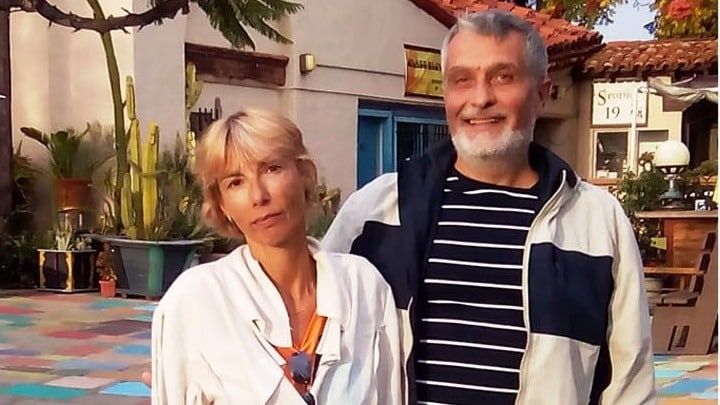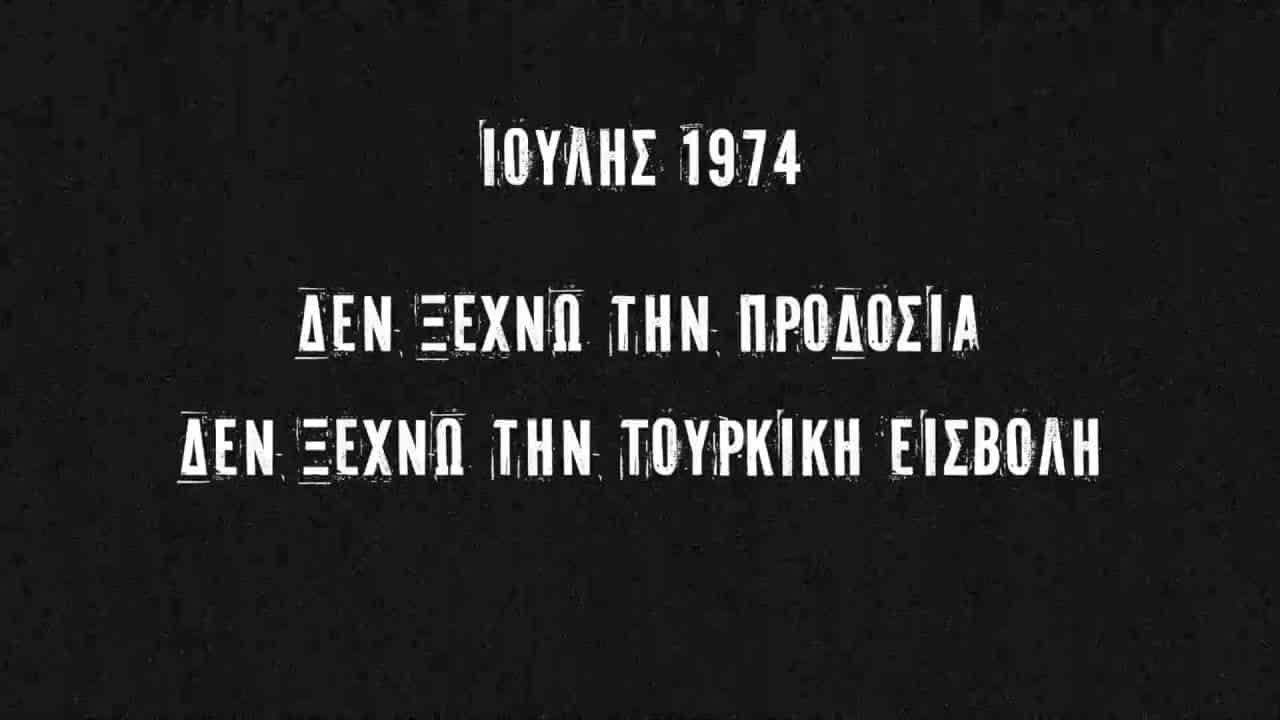
He was a brave officer and a heroic leader.
He sacrificed himself, in order to save his men, in the unequal Battle of Kyrenia in July 1974, and has been missing ever since!
Some 20 years later his traces were found in a concentration camp in the depths of Turkey. He was in a deplorable state. There was a secret operation to rescue him - and 12 other prisoners - but it failed...
Since then his traces have been lost!
Lieutenant Colonel Paul Kuroupis.
He fought with self-denial until his arrest by the Turks in Cyprus and justly - those who remember him - call him the «Dávakis of Kyrenia...»
ON THE FRONT LINE OF BATTLE
Pavlos Kouroupis was born in 1929 in Ditra, Messinia. He was a child of a rural, large family. His dream was to become an officer, which he achieved in 1952, graduating from the Evelpidon School.
He continued his studies and graduated from the Law School of the Aristotle University. He also excelled at the Higher School of War.
At that time he married Maria Karvouni and had a daughter, Evangelia.
In 1972 he was sent to Cyprus, where he took command of the 251 Infantry Battalion. At the head of his battalion, he found himself on 20 July at Pendemili, facing the Turkish forces preparing to invade.
The night of 19 to 20 July was a restless one.
At dawn some Turkish frogmen arrived swimming from a speedboat on the coast of Piedmont. Their objective was to reconnoitre the coast, searching for minefields, both sea and land. They found nothing.
The Turks were spotted by a Greek patrol, whose men opened fire. The Turks retreated without loss.
At 06:00, paratroopers began dropping parachutists to reinforce the Nicosia (Kioneli) enclave.
At the same time, Turkish commandos were being transported to Agirta by helicopters, which, according to testimonies, were refuelled on the British aircraft carrier «Hermes», which, «quite by chance», was patrolling that morning off the coast of Cyprus.
Turkish air strikes continued throughout the day.
At Pendemili, a platoon of the 2nd Company of the 1st Marine Battalion landed first. The Turks met no resistance. So the entire battalion landed without any disturbance. Then, forces of the 50th Infantry Regiment began to disembark, with M-113 TOMPs and an artillery squadron.
Against the Turkish forces, there was only one Greek battalion of reduced composition, the 251 TP, led by Lieutenant Colonel Pavlos Kouroupis. The 251 TP received orders to deploy to Pendemili only at 07:00.
The problem, however, was that to the rear of the battalion's positions was the Turkish Cypriot village of Templos, the outermost boundary of the Turkish Cypriot enclave of Nicosia-Agyrtas-Templos.
Thus, Kouroupis was obliged to allocate part of his forces in this direction. Against the bridgehead, he deployed only the 1st Company and the Support Company (heavy weapons company). To these small forces, he allocated men of the command company, scribes, cooks and some conscripts who had since arrived.
The GEEF also placed under its command a squadron of 5 T-34 tanks.
The two Greek companies were facing a regimental force, which was supported by the Artillery and the guns of the warships, not to mention the Air Force. Despite the difficulties, the Greek divisions opened fire, pinning the Turks down in a zone 350 yards wide and 1,000 yards long on the coast.
Unfortunately the Greek Artillery did not participate in the battle.
STRONG RESISTANCE
The Greek weaknesses were quickly perceived by the Turks, who gradually began to attempt to enlarge the bridgehead. The first attempt was repulsed by the men of 1/251 Company. However, under the pressure of the strong Turkish forces, the two Greek companies were forced into a slight contraction.
On the coast, Kouroupis with his 250-300 men was still holding 3,500 Turks of the «Tsakmak» landing brigade pinned down. Fortunately, the Turks did not manage to land on the coast the M-47 tank convoy that was intended to reinforce the brigade.
The Battalion, according to the plans, was to be immediately reinforced by the 3rd Tactical Group (306 and 316 Recruiting Battalions). During these critical hours, the 3rd Tactical Group failed to reinforce the fighting 215 TF. The 306 TF was never actually formed and only one platoon was formed from the 316 TF.
The situation for the Turks changed in Pendemili with the arrival of the commander of the 39th Infantry Division, Major General Demirel, who managed to put things in order and organise the next movements of the landed forces. Time was pressing on the Turks.
At 11:00, the Turkish forces moved towards their original ANSK, namely Kyrenia. Facing them were the overworked two companies of the heroic 251 TP, which had been fighting continuously for two days, and some conscripts of 306 TE in Kyrenia itself. To these forces were added some 150 cruisers of the 33rd Commando Squadron; the cruisers were elite, but they had neither serious nor enough anti-tank weapons.
And the Turks attacked exactly against them, simply hooking the other Greek sections. The outcome of the battle was predictable. Despite the heroic and bloody struggle, the commandos were forced to retreat. Their lines were broken and individually the men began to retreat towards Kyreneia.
So did the men of the 251st, who were in danger of being surrounded. The retreating divisions had no hope of holding the city. Nevertheless, they fought bravely and sacrificed themselves.
This was also the case of Lieutenant Colonel Pavlos Kouroupi, the sub-commander of Major Tsiakkas and the captain of the commandos Nikolaos Katounta.
Shortly before the entrance of Kyrenia, Kouroupis' group, consisting of 11 men and Major Tsiakkas, were surrounded by a company of Turks, and the battle began immediately.
THE ARREST AND THE OPERATION
Kouroupis, with Smith & Wenson in hand, ordered his men to break the deadly circle, in a small stream to the east, which the Turks had not yet reached. They refused to abandon him. Then he ordered them to leave.
And only then these lads excitedly decided to leave.
But their commander and deputy commander stayed behind to cover for them. «As the soldiers were leaving, they could hear the shots from the area where the two Greek officers remained, slowly thinning out until they were completely silenced» (account of a rescued soldier).
Lieutenant Colonel Pavlos Kouroupis has been missing since then, along with Major Tsiakkas.
On 27 March 1995, the journalist Petros Kasimatis revealed to the newspaper «Eleftheros Typos» the most shocking document to date.
The secret services had identified, through a Greek colonel who pretended to be a fishmonger, six missing persons in Bolou, Turkey, and seven others in Denizli.
The colonel, named C., talked briefly with the first group after bribing the prison guards. All of them were in a miserable state. One of them was Paul Kouroupis. According to Kasimatis, an operation was organized to free them, during which one man was killed in an exchange of fire with the Turks.
Since then, the traces of the heroic lieutenant colonel have been lost...