Dear Stratos,
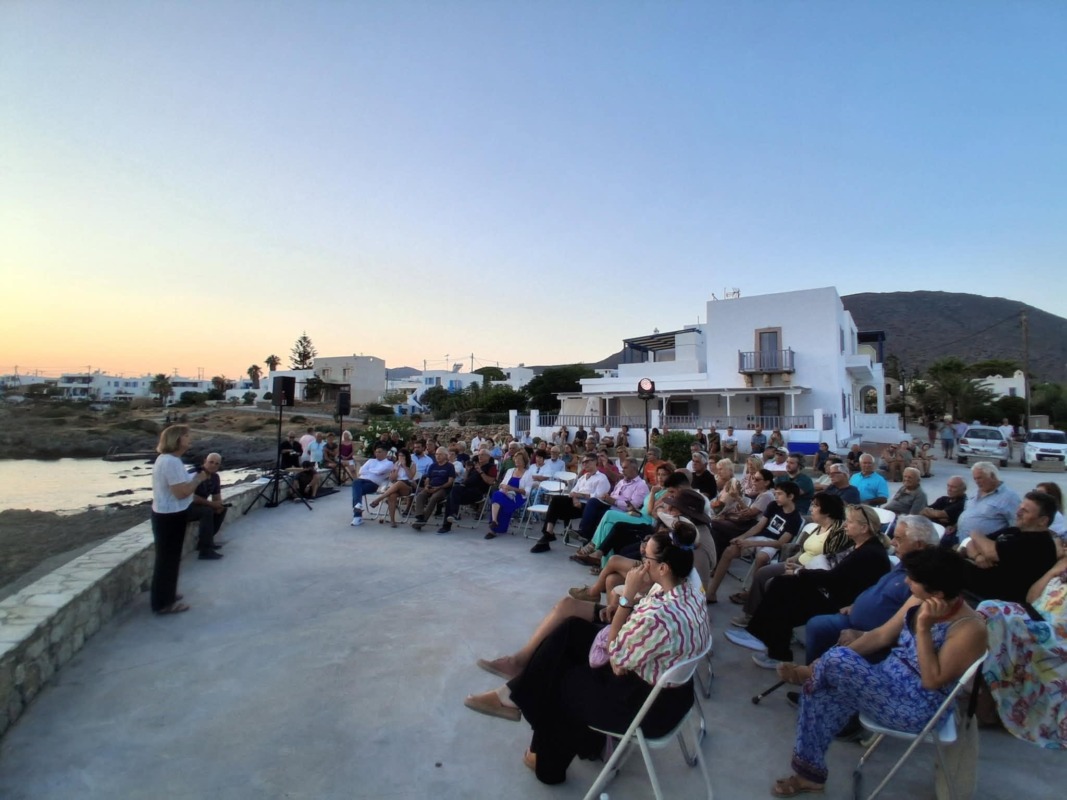
I admit that I had a sincere—and, as it turns out, perhaps naive—hope that you would be present at the first ELAS event in Kythira. An event that brought together more than 200 of our fellow citizens, who devoted their time and attention to discussing the problems, concerns, and prospects of our island.
I believed you would come—not because you agree with or feel obligated to agree with the Hellenic Police, but because someone who holds the office of mayor has good reason to be present in any forum where views, concerns, and proposals regarding the future of Kythira are voiced. This is all the more true when it comes to a political force that aspires to play a leading role in the governance of the country. One would expect that a mayor would want to listen, speak up, influence, and rally support for his community.
Unfortunately, you chose to be absent. And even more unfortunately, you subsequently chose to speak out publicly in a way that, in my opinion, does not primarily reflect the Mayor of all Kythirians, but rather a New Democracy party official.
I believe that a local leader must act in a way that unites, not in a way that divides. They should seek to build bridges, not dig trenches. They should recognize that differing opinions are an essential component of democracy, not a threat that must be countered.
There were no restrictions on participation at the ELAS event. There were no special invitations or party-specific invitations. It was an open gathering of citizens. People from different political backgrounds, different ideological perspectives, and different social backgrounds participated. They were there not to hear slogans, but to talk about their island.
And that is precisely what makes this effort so interesting. The Hellenic Police does not claim to know all the answers. It does not treat citizens as mere spectators. Instead, it invites them to actively participate in shaping its proposals—to help shape them, not just to watch from the sidelines.
I would urge you, even at this late stage, to attend the event. You’ll see the deep concern many Kythirians feel about the future of their island. You’ll hear about problems that can’t be solved with press releases and celebratory lists of projects. You’ll hear ideas, suggestions, and concerns from people who love the island and are trying to contribute creatively.
Unfortunately, your post confirmed my worst fears. It gave me the impression that you view every political initiative that differs from your own as an opposing camp, even when it isn’t personally directed against you. Instead of acknowledging that there was a serious public debate about Kythira, you chose to create an artificial battleground.
And, unfortunately, this isn’t the first time this has happened. From time to time, you’ve found yourself at odds with people who dared to express a different opinion. With educators, with people in the cultural sector, with active citizens. Disagreement often seems to be taken as an insult rather than an opportunity for dialogue.
In your post, you refer to projects, funding, and infrastructure. No one at the event denied that things have been accomplished in Kythira. However, the crucial question is not how many projects are listed in a press release. The crucial question is what the overall impact is on the lives of the residents.
Is the island’s population decline being reversed? Are health services improving? Are there more opportunities for young people? Is the cost of living being addressed? Is local production growing? Are people returning to live and work in Kythira?;
Unfortunately, the reality faced by many of our fellow citizens is not one of prosperity. The island continues to face serious social, economic, and demographic challenges. And these challenges cannot be hidden behind lists of projects, especially when many of them are still only at the planning or announcement stage.
There is one more thing that is often overlooked. These projects are not personal gifts from any mayor or any government. They are funded by the taxes and sacrifices of the citizens. Carrying out necessary projects is not a favor granted to the people of Kythira. It is the obligation of the state and local government. What is important is that these projects be part of a long-term strategic plan for the future of Kythira—a plan that, in my personal opinion, is still lacking.
You also spoke critically of Yiannis Ioakeimidis and his political faction in the Regional Council. I believe the reality is quite different. Those who follow regional affairs know very well that Ioakeimidis’s faction, with the contribution of officials such as Maria Kazakou and Katerina Logothetis, has, from time to time, brought significant issues concerning Kythira to the forefront—from the water supply for Agia Pelagia to the expansion of the airport and other critical matters. Political disagreements are entirely legitimate. However, this does not mean that reality can be ignored or that the contributions of people who have worked to bring the island’s problems to light can be called into question.
Even more troubling, in my opinion, is the fact that you saw fit to call out citizens who participated in the event, making pointed remarks about their political and ideological stances. Since when is it wrong for a citizen to participate in a public discussion about their community? Since when has attending an open political event become a matter of ideological scrutiny?;
Democracy does not function on the basis of certificates of political beliefs. Citizens have the right to listen, discuss, disagree, change their minds, or stick to their views. No one is required to ask for permission to participate in public discourse.
I truly regret this stance. Not because you represent a different political faction. That is perfectly legitimate. I’m sorry because I see the mayor’s institutional role becoming increasingly conflated with a narrow partisan mindset. And this confusion benefits neither you nor the island.
In closing, I'd like to tell you something honestly and without a trace of personal animosity.
People who have different opinions than yours are not your enemies. A mayor is not judged by how well he rallies his supporters, but by how effectively he can listen to, reach a consensus with, and work together with those who disagree with him.
If you choose the path of cooperation, the community will benefit.
If you choose the path of partisan division and the «with us or against us» mentality, I’m afraid you’ll be disappointed. Because the people of Kythira know how to think, judge, and decide for themselves.
It’s obvious that the political party you serve and represent (as a top official of New Democracy, as you’ve told me) fears the Hellenic Police. And it’s probably right to fear it, because it advocates policies that I believe will pave the way for a different Greece and “other” Kythira—one of productive reconstruction, sustainable and equitable development, support for citizens—especially those in island regions—and the well-being of their residents.