Bellardia trixago (L.) Allioni
Bartsia trixago L.
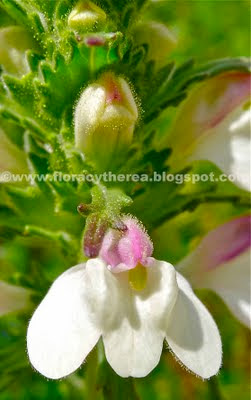
An annual plant quite common throughout the Mediterranean. Its flowers are usually white with a pink upper lip or yellow. In other parts of the world, such as Australia, New Zealand, and Western America, it is probably an epigeal plant and is considered a weed. The plant is considered a semi-parasite because it performs photosynthesis but takes many nutrients from the roots of other plants.
It was named in honor of the Italian physician and botanist Carlo Antonio Bellardi (1741-1826), by his professor of botany at the University of Turin, Carlo Allioni (1728-1804). The adjective trixago probably comes from the Greek θριξ – τριχός = hair, and the suffix -ago, which indicates similarity, referring to the fluffy appearance of the plant's leaves.
The first name given to the plant by Carl Linnaeus was bartsia trixago in honor of his friend Johann Bartsch (1709–1738), a physician and botanist from East Prussia who died at the age of 28 on a mission sent by Linnaeus.