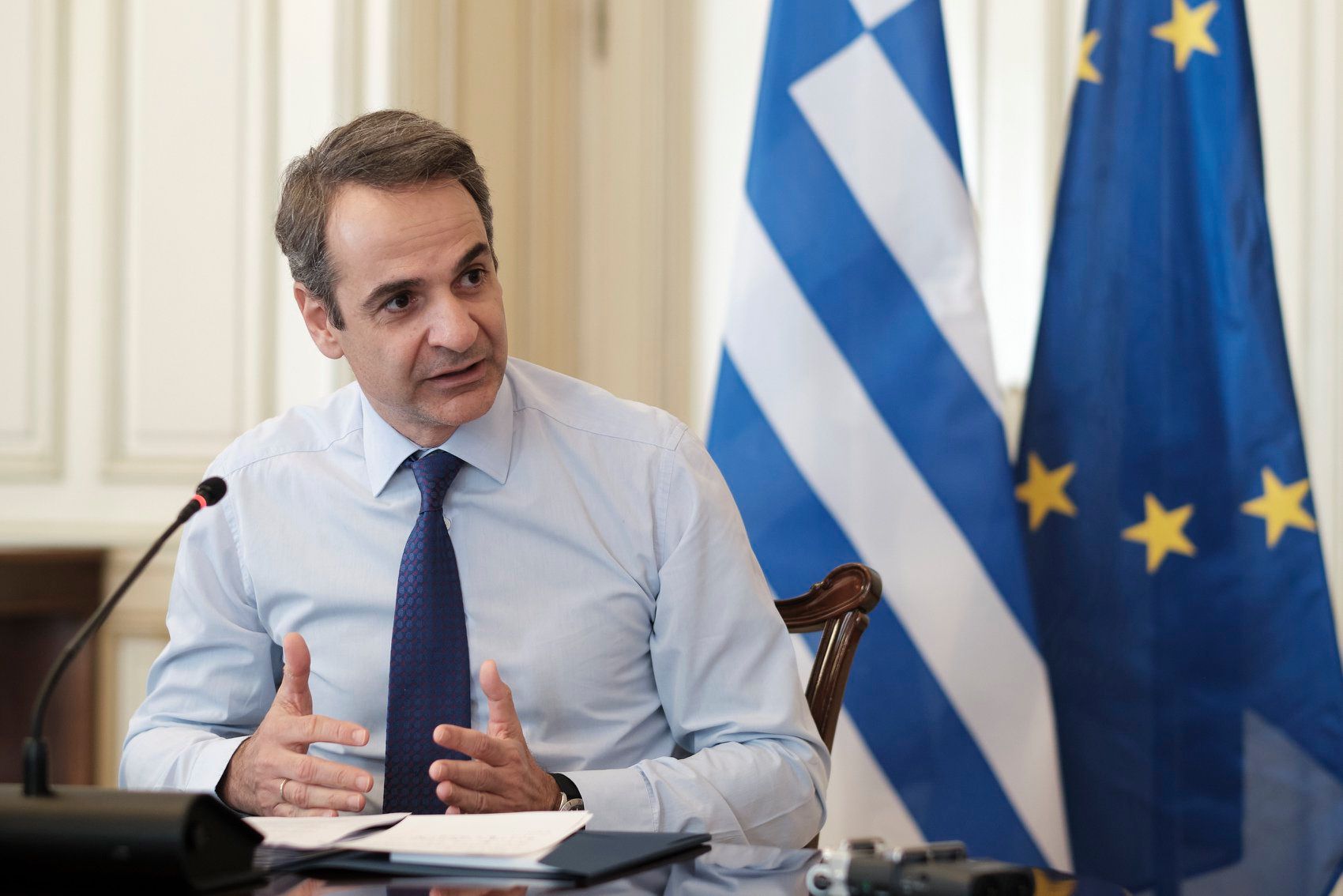
New household support package, businesses, and farmers affected by rising prices, as Prime Minister Kyriakos Mitsotakis announced during his address to the Cabinet.
«Let me reiterate our commitment that support Support for businesses, households, and farmers will continue for as long as the energy crisis lasts. In fact, over the next ten days, I believe that we will be in a position, together with the relevant ministers, to announce and launch a comprehensive additional support program, drawing on both national and European funds», he said.
The prime minister also referred to the lunch he will have this coming Sunday with Turkish President Recep Tayyip Erdoğan: «My long-standing position, after all, is that the «channels» of dialogue remain open.” always open, just as the doors remain closed »to protect us against any threat," he said, and continued:
«So, I'm traveling to Turkey on Sunday in a constructive spirit, all the more so when our two countries are already grappling with broader regional issues. Consequently, as neighbors on the map and as NATO partners, we are called upon to prove ourselves in the arena dictated by the current international situation. To keep, that is, to keep our region free from any additional geopolitical crisis and, of course, to align ourselves with the spirit of alliance that condemns historical revisionism and the violation of international Justice, but also borders».
«As I've said, the fact that we disagree doesn't mean that, especially in this Given the current situation, we shouldn't discuss this. ». In fact, Greece has every reason to seek this discussion, as our positions are grounded in international law,” the prime minister emphasized, adding:
«My expectations, therefore, are measured and realistic. That is why I am coming to this meeting with the confidence that our well-documented national positions give us.’.
The Prime Minister's remarks at the cabinet meeting:
«Good morning, ladies and gentlemen, my colleagues. I would also like to wish a speedy recovery to the Minister of State, who is ill with COVID-19 and is at home. As the geopolitical environment is still reeling from the Russian invasion of Ukraine, the military situation there is triggering a chain reaction in the energy sector and the global economy.
The International developments are thus having an increasingly dramatic impact on the domestic challenges facing each country. And in a world that is changing rapidly and is at the same time interdependent, all these problems become even more complex. Solutions can be found, however, if they are bold and coordinated.
Consequently, the political landscape is becoming more intense, bringing new priorities to the fore: the struggle for peace and legitimacy must, first and foremost, be combined with initiatives—bold initiatives—regarding Europe’s defense and energy policies. The military tension in Ukraine must be contained by regional security zones on our continent. And, of course, politics must intervene, restoring the energy markets to their proper role and shielding the incomes of citizens and businesses from excessive international price hikes.
With these priorities in mind, the government is taking action on the domestic front, while at the same time acting within the European framework and in our immediate region.
As for the first issue—the domestic front—I would like to reiterate our commitment that support for businesses, households, and farmers will continue for as long as the energy crisis lasts. In fact, over the next ten days, I believe that, together with the relevant ministers, we will be in a position to announce and launch a comprehensive additional support program, drawing on both national and European resources.
However, a pan-European problem requires a pan-European response. So, before I attend tomorrow’s extraordinary summit in Versailles, in a letter to the President of the European Commission, Ms. Ursula von der Leyen, I proposed a six-point policy framework to regulate the commercial value of natural gas in the wholesale market. This is because, despite the fact that there is essentially no real problem with production, supply, or availability of the fuel, prices have skyrocketed due to speculation, under the pretext of the crisis in Ukraine.
And, obviously, the consequences of this situation affect not only consumers’ electricity bills but also the economies of all countries. I would like to point out that most European Union member states generate a significant portion of their electricity from natural gas.
It is therefore time for European policy, which—under extreme circumstances—and I emphasize, under extreme circumstances, such as those we are currently experiencing— —must take bold, radical measures that will decouple geopolitics from the energy crisis. These must be emergency measures as well as immediate actions.
If we consider that natural gas prices were 30 euros per thermal megawatt-hour before the crisis and have now reached 300 euros, then we realize that our enemy is not just the war, but a fundamental dysfunction in the natural gas market driven by speculation.
This is an initiative that goes hand in hand with the need to establish a special fund to absorb energy price increases. And, obviously, it is part of the broader European plan to wean EU member states off Russian oil and gas. Moreover, the European Commission yesterday submitted a series of proposals for public consultation, which will also be discussed tomorrow at the extraordinary summit.
However, our proposal has a specific and realistic goal, which is to decouple military developments from the price rally and to break the vicious cycle between these two crises.
It is therefore clear that Athens is actively engaged in the agenda of the European Council, to be held tomorrow in Paris, with positions on all the issues to be discussed. On strategic autonomy—and I would remind you that we were among the first countries to highlight its importance—and on the need to strengthen the defense budgets of member states. But at the same time, we will also present our positions on reducing our energy dependence, on the resilience of our economies, on how we can achieve the fastest possible transition to a green economy, and the faster integration of renewable energy sources into the energy mix.
I would also like to point out that today, renewable energy sources are by far the cheapest form of energy and the only one capable of driving down the overall cost of energy in Europe. For these four pillars ultimately form a new European vision that our Union is called upon to build, so that it can play a leading role in the new geopolitical environment.
At the same time, beyond the national and European contexts, on another level, on Sunday—as you know—I will be visiting Istanbul to honor the Ecumenical Patriarch on Orthodox Sunday. I will also be meeting with President Erdogan, whose invitation I have accepted. It has always been my firm position, after all, that the «windows» of dialogue remain open at all times, just as our doors remain closed to any threat.
So, I am traveling to Turkey on Sunday in a productive frame of mind, all the more so since our two countries are already grappling with broader regional issues. Consequently, as neighbors on the map and as NATO partners, we are called upon to prove ourselves in the arena dictated by the current international situation. In other words, to keep our region free from any additional geopolitical crisis and, of course, to align ourselves with the spirit of alliance that condemns historical revisionism and the violation of international law, as well as the violation of borders.
As I have said, the fact that we disagree does not mean that—especially at this juncture—we should not engage in dialogue. In fact, Greece has every reason to seek dialogue, as our positions are grounded in international law.
My expectations, therefore, are measured and realistic. That is why I am coming to this meeting with the confidence that our well-documented national positions give us.
Finally—to turn to the agenda of today’s Cabinet meeting—important government initiatives are continuing, in accordance with our annual plan. Among the major issues we will be addressing today, allow me to focus on—and ask for your attention regarding—the critical issue of the reorganization of primary health care.
A bill that aims to ensure that all Greek citizens can now have a personal doctor who will monitor their health and provide them with advice.
We have spoken many times about the need for the Covid crisis to serve as a catalyst for significant reforms in the National Health System, and obviously, no major reform is possible without a substantial upgrade ofprimary health care is inconceivable. Therefore, we will await the Ministry of Health’s recommendations and proposals with great interest.
In closing, I would like to say that the war in Ukraine has shifted the public discourse exclusively to the tragic developments in Eastern Europe, but we are not yet done with the pandemic. In recent days, we have again observed a slight increase in cases. Consequently, we should not assume that we can in any way ’call it a day« on this public health crisis simply because it has ceased to be the focus of current events.
We must continue to follow the basic safety guidelines, and, of course, our focus will remain on the need to continue the vaccination program. As we move toward spring and summer, it is certain that the situation will improve, but we will begin preparing a plan now to get the country ready for what will happen starting in September, which we will have the opportunity to discuss at the next Cabinet meeting.».