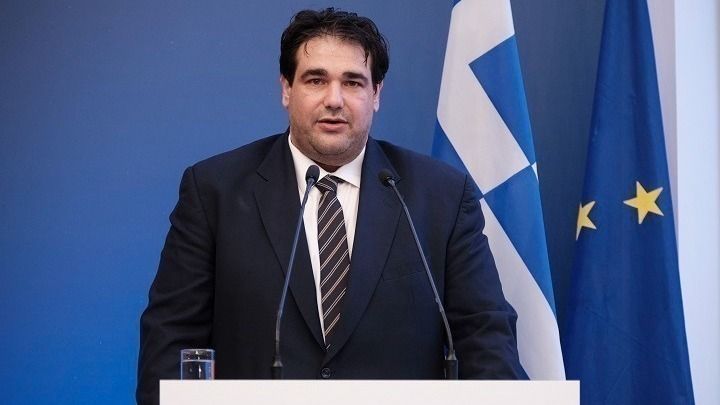
Significant changes in the system of election of municipal and regional authorities, as well as in issues of governance, supervision, financial management, statutory position of elected officials and responsibilities are included in the proposal of the Ministry of Interior for the reform of local government, presented by Minister Thodoris Livanios, speaking at the annual regular conference of the Central Union of Municipalities of Greece (KEDE), which takes place from today until Saturday in Rhodes.
The 20 proposed changes will be the subject of consultation on the new unified Local Government Code and include, among other things, the abolition of the second round of municipal and regional elections, the introduction of electronic voting, the possibility of early elections and the appointment of candidates without cross preference, along the lines of the state ballot papers.
The dialogue on the updating of the institutional framework of local government has begun, as the competent committee, which will process all the proposals of all stakeholders, met for the first time on Monday 4 November. The Commission was set up by the Ministry of Interior with the participation of representatives of local government, the judiciary, academics and officials from both local government organisations and the relevant ministry. He said that the Commission «will have an intensive work ahead of it» and that it will complete its work on 31 March 2025.
«Today we presented specific proposals for the reform of local government, which set the tone for the dynamic that the government is seeking for the country's municipalities and regions. What is certain is that the changes we are ready to introduce are not going to be a reform that will remain on paper, but a real tool for local authorities to stand more firmly on their feet, cure dysfunctions and problems and mature, for the benefit of all citizens,» the Interior Minister said.
The most important changes, which form the basis of the dialogue for the drafting of the new Unified Local Government Code, are the following:
Α. Changes in the electoral procedure for local authorities
Election of municipal and regional authorities in a single round
The country's municipal and regional authorities will be elected in a single round. The voter will be able to choose a second candidate on the same ballot paper. In case no combination obtains 50% + 1 vote out of the valid votes of the first choice, the two combinations with the highest number of votes will qualify for the second counting phase. The second votes (second choice) of the ballot papers of the combinations that are left out of the second phase shall be added to the votes of the first two combinations. The successful combination will be declared the one that has obtained a) in the first phase, 50% + 1 vote on the valid first choice ballots or b) in the second phase, the most votes between the first two combinations, including the second votes of the ballots of the combinations excluded from the second phase.
The proposed change in the electoral system solves the problem of reduced voter participation in the second round of local elections and eliminates the significant cost of conducting the second round.
Optional electronic voting in municipal and regional elections
Providing another tool to facilitate voters in exercising their right to vote, following the successful introduction of postal voting in the 2024 European elections, the Ministry of Interior announced the introduction of electronic voting for local elections for any voter who wishes to do so, while maintaining the traditional voting with physical presence.
Call early elections, within the first 3 years of the 5-year term of office, for the remainder of the term of office
This possibility can be used if 4/5 of the total number of members of the municipal or regional council and the mayor or regional governor respectively agree. This change puts an end to the phenomena of administrative paralysis that arise in cases where councillors become independent.
Appointment of additional candidates without a cross
Each combination will be able to nominate additional candidates up to:
-1 candidate in councils with up to 19 members
-2 candidates for councils with 25 to 39 members
-3 candidates to councils with 43 members.
These candidates are elected only if their combination is declared the winner of the election. The aim of the change is to attract competent scientists and candidates of recognised standing who can contribute to local communities.
Creating a quota for the participation of candidates aged up to 30 years old in local government combinations
The aim is to strengthen the participation of young people in the management of local affairs.
Abolition of the possibility of posting elected civil servants by election
Election is an attitude of giving back to the public and should not be instrumentalized as a vehicle for secondments, unduly weakening the staffing of public services.
Reduction of the number of candidate consultants to up to 50% in addition to the current 150%
With the reduction of this percentage, a combination of municipal elections on a 31-member council, instead of up to 78 candidates, which it could have had in 2023, will have 47.
Election of councillors uniformly in the whole municipality and not per municipal unit
Fifteen years after the implementation of Kallikrates and the mergers of the Kapodistrian municipalities, there is no longer any reason to maintain a distinct constituency.
Single combination fee
The amount of the fee will be proportional to the population of the municipality or region.
Elections to be held on the last Sunday in November
This change will reduce the time between the holding of elections and the new authorities taking office, thus reducing the potential power vacuum.
Β. Changes in the system of governance, the statutory status of elected officials, supervision, responsibilities and financial management of local authorities
Mandatory public consultation for all regulatory acts before they are introduced in the municipal/regional council.
Exclusive electronic local referendums on issues within the competence of municipalities.
Establishment of the post of the official secretary in municipalities with more than 200,000 inhabitants.
Increase in the salary of mayors and deputy mayors, suspension of the professional activity of mayors in municipalities with more than 20,000 inhabitants and compulsory leave for the entire term of office.
Abolition of the territorial jurisdiction of the Legality Auditors. Every transaction that comes in for a legality check will be randomly allocated to a Legality Enforcement Officer of another territorial jurisdiction. Coordination of the 7 Legality Auditors by the General Supervisor of Legality of OTAs.
Speed up the adoption of decisions on legality checks within 10 days.
Maintain the Municipal Tax to cover the cost of services and establish a Local Development Fee, incorporating the Municipal Tax and the Real Estate Tax. The TDF will be freely determined by municipalities and will be used to cover all types of expenditures and investment activities.
Reinstatement of the Court of Auditors' preventive control for warrants over EUR 15,000.
Establishment of a Municipal Revenue Management Centre under the Central Union of Municipalities of Greece, which will post all kinds of confirmed debts to municipalities. This Centre will be the interface of the Local Government with the AADE, EFKA and all the necessary registers of the Greek State, while it will provide the possibility of electronic payments of debts, which will be directly attributed to the municipalities, without abolishing the possibility of payments directly to the municipalities.
Redistribution of responsibilities between Municipalities, Regions, Decentralised Administrations and the Central State according to 3 criteria:
-Local, regional or national nature of the competence
-Who can exercise it more effectively for the benefit of citizens
-The scope of competence by policy package.