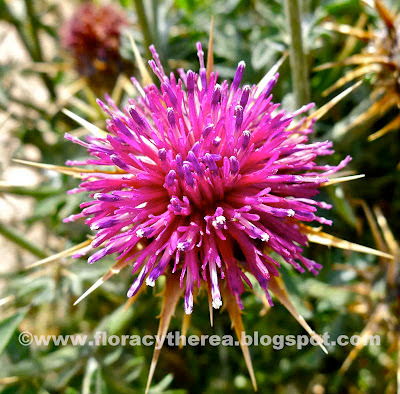
Centaurea cytherea
Centaurea redempta subsp. cytherea (Rech.f.) Routsi & T. Georgiadi
The plant was first identified in the 1960s by German botanist K.H. Rechinger and was considered to be the Centaurea redempta Heldr., a species endemic to western Crete
However, it was subsequently registered in the Berlin herbarium as a separate species under the name Centauria cytherea, with its habitat in Kapsali, Kythira.
In the 1990s, Routsis and Georgiadis described it as Centaurea redempta subsp. cytherea.
The species is protected (Presidential Decree 67/81) as it is rare and endangered according to the IUCN 1993 and 1997 international lists. It is a pity that in Kythira Castle it is considered a nuisance and is cut down like weeds. This year, I found at least ten plants destroyed at the root after the annual cleaning of the outdoor areas. Perhaps the authorities should take measures to ensure that centaury is not cut along with other weeds. Many would travel miles to see it, as it is endemic to Kythira. There are records of its existence in the southern Peloponnese, but these have not been scientifically confirmed.
The species is protected (Presidential Decree 67/81) as it is rare and endangered according to the IUCN 1993 and 1997 international lists. It is a pity that in Kythira Castle it is considered a nuisance and is cut down like weeds. This year, I found at least ten plants destroyed at the root after the annual cleaning of the outdoor areas. Perhaps the authorities should take measures to ensure that centaury is not cut along with other weeds. Many would travel miles to see it, as it is endemic to Kythira. There are records of its existence in the southern Peloponnese, but these have not been scientifically confirmed.
This centaury, referred to by some locals as petrokali*, begins to bloom in early spring in Kastrou (February–March). The thorny buds open at different times, so the plant remains in bloom until the end of April. (That is, if it escapes being cleared away, of course!!)
*On the rest of the island, petrokali, kakarakia, or agkinarakia is the name given to the edible species Centaurea raphanina.