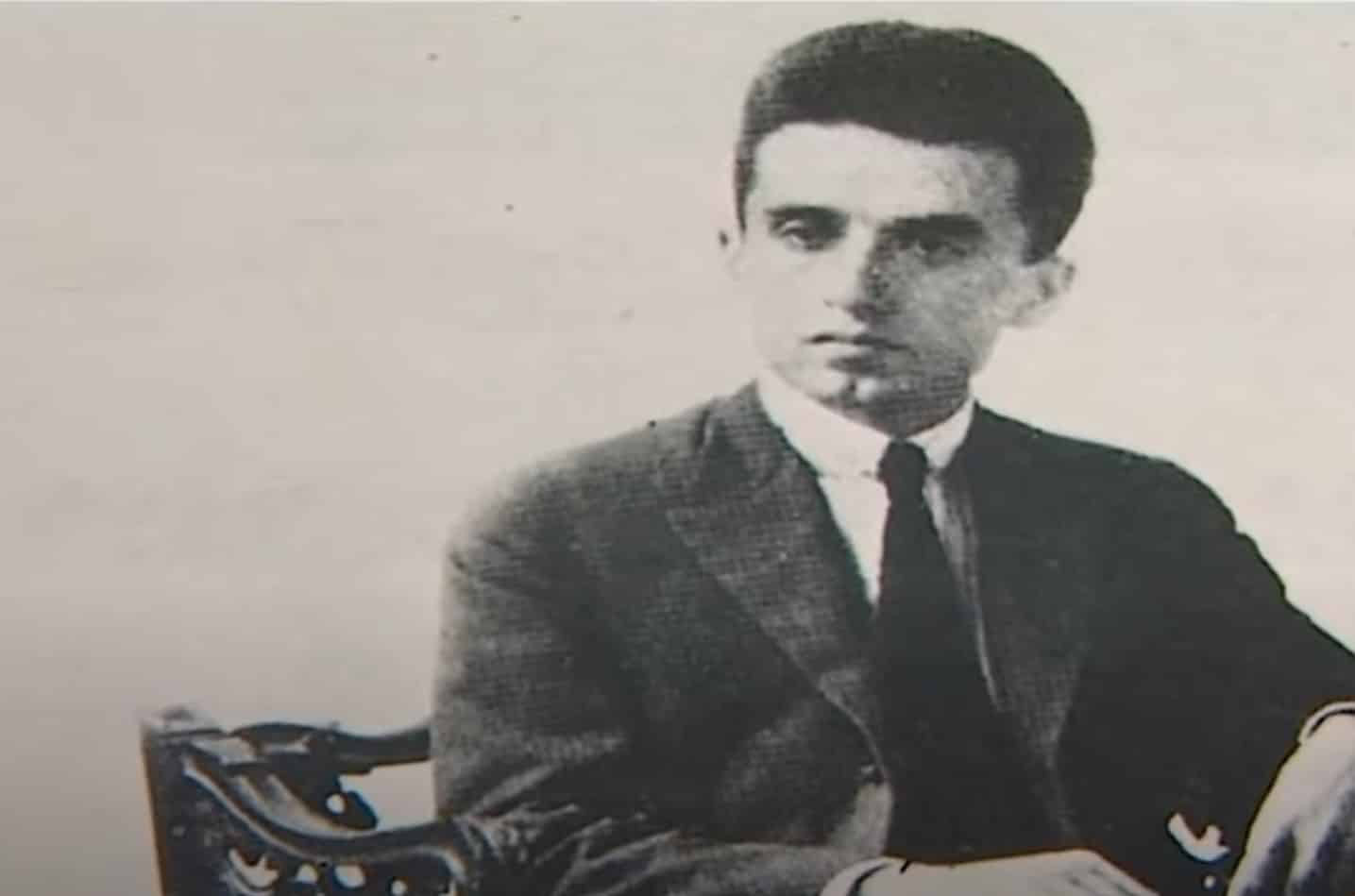
K.G. Karyotakis «Catharsis»
- Of course. I had to bend down in front of one of them and, caressing the black sebium with pleasure-paf, paf, paf, paf-, «you have a little dust» I say «sir Alpha».
- Then I had to wait around the corner, and when I saw the other guy's belly, after having watched her feelings and heartbeat for so many years, I had to bend down once more and whisper confidentially: ‘Ah, that Alpha, sir...« Beta…».
- He had to, behind his glasses Gamma, to watch his gentle gaze. If he granted it to me, I would unfold my best smile and accept it like a royal infant in a knight's cloak. But if he delayed, I would bow for the third time, full of despair, and utter: ’I am your servant, my lord.«.
- But first I had to stay in his circle. Delta. There, the robbery took place under brilliant international auspices, in luxurious offices. At first, I would not be there. Hidden behind my short, stout department head, I would observe. I would be subtle and elusive. I would learn their secret language. A tap on the left side of the parting would mean «five hundred thousand.» A persistent tap of the cigar ash would mean «agreed.» I would win everyone's trust. And one day, leaning on the glass of my desk, I would write the answer myself: «Our autonomous organization, Mr. Prosecutor...».
- I had to bend down, bend down, bend down. So much so that my nose touched my heel. Curled up like that, I rolled and arrived.
- Kanagies!
- The bread of exile nourishes me. Cuckoos knock on the windows of my room. And in the tormented hearts of the peasants, I see the breath that will bring you scan.
- Today I took the keys and climbed up to the Venetian fortress. I passed through three doors, three towering yellowish walls with battlements. When I found myself inside the inner, third circle, I lost track of you. Looking down from the battlements, at the sea, the plain, the mountains, I felt safe. I entered ruined barracks, crypts overgrown with fig and pomegranate trees. I shouted in the silence. I walked for hours, breaking large, dry grasses. Thorns and strong winds stuck to my clothes. The night found me…
seviot∙ woolen tartan fabric.
cannabis∙ a vulgar person, a bastard.
The writer and the reader
There are writers and some creations those who stubbornly accompany you throughout your life, especially at times when you are forced to make important decisions. These are the moments when you must refuse them. compromises and the concessions in everything that social norms and your interpersonal relationships impose on you. Often, the moment of a big decision is accompanied by pressing dilemmas for the «practicable». Dilemmas that test both ethical us background as well as mental endurance Dilemmas that highlight our social sensitivities but also our general worldview regarding «art of living» ours.
There are literary texts—poetic or prose, it doesn't matter—that clearly and vividly describe the social environment and how it shapes the deeper «is» of the individual. Literary works that, through confessional their tone is an informal biography of the writer. Creations that do not only reflect personal experiences of the literary subject, but at the same time aspire to become a manifesto about how an individual should assert those conditions for personal of freedom. When these literary works accurately portray the structures and mechanisms of contemporary society and the position of the individual within it, then everyone feels associate the author's experiences and choices.
The individual adventure
The above remarks find their perfect application in the prose of K. Karyotakis. «Catharsis». This is because in this poem, the poet, with an intense confessional tone interwoven with rage and lyricism, records the «exit» by the inhumane mechanisms of a system that, for the survival and advancement of the individual, require annihilation of the ego through a series of acts of servility and self-humiliation. The ultimate goal is catharsis in the full sense of the term, not just in the Aristotelian sense. «...passing through the catharsis of such sufferings».
In «Catharsis» are combined irony, the sarcasm but also the despair about the obstacles that society puts in the way of an individual's dreams. We have a escalation emotions and attitudes towards life. From the need for social adaptation and compromise to rupture. One rupture whose ultimate goal and limit is purification first on an individual level and then on a social level. Catharsis involves personal adventure of Karyotakis, combined with his deep sensibilities and extreme idealism. In the final analysis, the «Catharsis» recommends one complaint of the bankrupt values and ideals of a society that erodes moral antibodies of citizens. A society that weaves its web mental isolation and social exclusion in individuals who internally feel free and incurable idealists.
The persons and «had to»
Using the cinematic technique of Close-up (close-up), we can easily see the two sections of the prose, separated by a dividing line. «Kanagies» which in itself constitutes a abusive outburst by Karyotakis.
In first section – level (§1-3) describes the downward slope, submission, and the individual's fall to the commands of the social environment. At this level, the theme is dominated by faces – the «gentlemen» A, B, C, D all five «had to».
The persons depict with great irony characteristic types of the ruling class and its mechanisms. Through the description of these characters—so familiar to us today—he sharply denounces the society of immorality, decay, and material gain. The characters express the particular aspects of a society steeped in hypocrisy and Machiavellianism.
Karyotakis« five »oughts" clearly highlight the need for «social adaptation -> social recognition -> recognition -> integration -> acceptance of decay and rot in society». A process – not unfamiliar in our times – that leads to leveling any trace of personal dignity and self-respect. The verbs «to bend down...to roll» are indicative of the necessity imposed as an obligation by the society of decay.
However, the «had to» recommend one case and predispose them to rejection, rebellion, and «deviation» by Karyotakis. Thus, «had to» together with the second section (§6-8) form the diagram Position – Removal and prepare the ground for catharsis.
The catharsis
In second section – level (§6-8) Karyotakis' final response is given with an abusive cry – accusation «Kanagies». It succinctly describes the vision for a social uprising from the poor (§7). Thus, personal adventure and protest take on a universal character, teaching the value of collective struggles. The «social catharsis» prefigures the personal.
Karyotakis' final reaction – choice is that of escape and of rebound with the ultimate stage being purification through an understanding and awareness of the society in which he lives and his own role within it. The successive passage—wandering through the three doors of a Venetian castle (a symbol of the past) suggests his deep desire for autonomy and inner liberation. The first person singular is a form of confession but also self-awareness.
This achieves «Catharsis» which for many has elements of spiritual uplift as well as psychological, moral, and emotional purification. It is a unique and genuine stance, but also one that is consistent with the general worldview of the suicidal poet. A man who experienced painful social exclusion and mental isolation.
Schematically, Karyotakis's career could be summarized as follows:
Rejection of the society of «shoulds» -> inner loneliness -> existential autonomy -> inner freedom ->
CLEANSING = Suicide (?)
The night found me...
The final sentence «The night found me...» and the ellipses that follow have many interpretations. One of the most convincing is that of prejudice. suicide that will follow.
Certainly, Karyotakis was not the political revolutionary or social activist or the arsonist of the establishment. It was a personal and unique case. In his prose, he avoids didactic moralizing and leaves the reader to choose their own response to whatever humiliates them and turns them into a subhuman. The poet did not compromise but also did not rebel in the manner of a grassroots activist.
Every person is a uniqueness and cannot be accommodated in simplistic classifications. That is why we must evaluate each person's reaction separately, based on their individual sensitivities, strengths, and visions. And that is the final lesson of the prose.
In our time, the following is paramount: conservation and rescue, but also the defense of authenticity of man against the diverse and invisible mechanisms that tend to alienate him and turn him into a lifeless tool…
By Elias Giannakopoulos