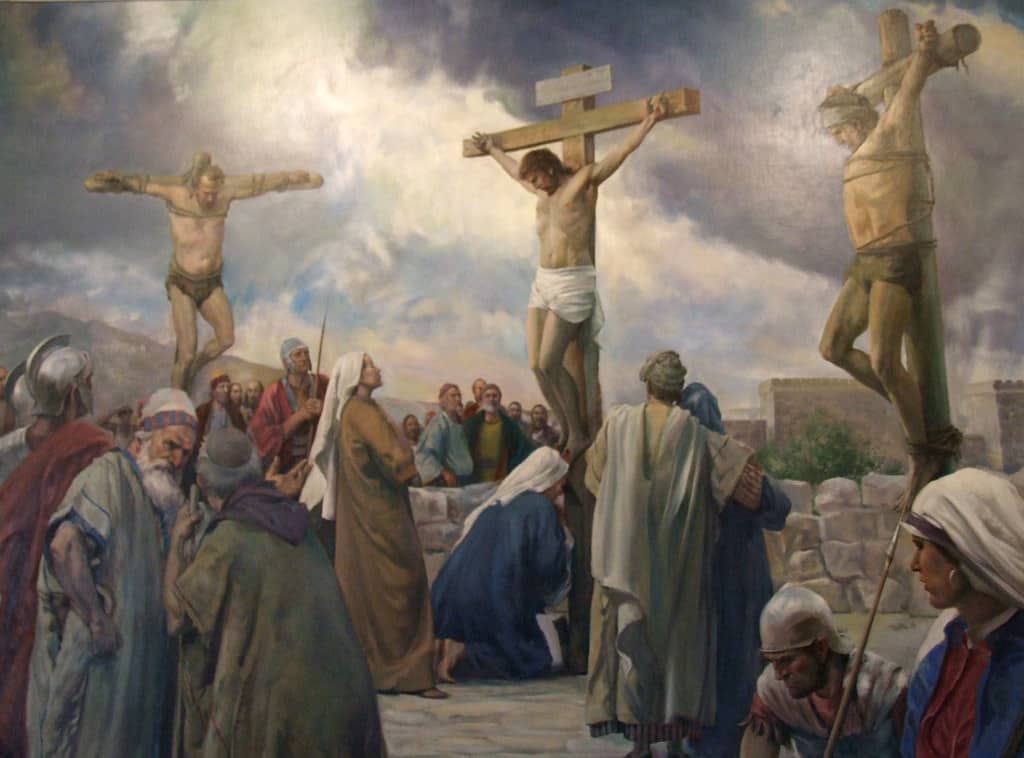
Ο Philip Koutsaftis describes step by step the effects of the Passion (with six interrogations and four tortures) and explains how his death came about. Christ in Cross.
Mr. Koutsaftis has conducted an in-depth study (systematically over a long period of time) on the subject, examining all sources and analyzing the Passions and His death Jesus Christ in a scientific manner. In «Sunday Democracy» analyzed the causes of Jesus' death, the impact of each torture, and the mental and physical condition of Christ.
Finally, he answers why all theories that dispute that Christ died on the Cross are refuted, with the ultimate goal of disputing the Resurrection His.
Question: Mr. Koutsaftis, do the information we have from the Scriptures, Church tradition, and historical sources give us a complete picture of Christ's sufferings?;
-Absolutely. We know a great deal of information, and one could say that we can draw a conclusion. I hope this bold statement does not sound disrespectful to some, because it is bold. It must be understood that divine passion is voluntary.
The Lord accepted everything according to His own will, so even when the nails were tearing His flesh and piercing His bones, He prayed for those who crucified Him, which was unprecedented.
Q: So what was the impact of the Passions?;
-What everyone needs to know is that Passions are psychosomatic.
Christ, when he leaves Secret Supper and goes off to pray, leaving the three disciples a little further away. (Peter, James, and John), appears in the Scriptures as something unpleasant to look forward to.
At the end (while the disciples have not realized what is happening), Jesus prays for the third time and sweat and blood run down his forehead. This point in the narrative about «bloody sweat» has been hotly disputed for centuries.
Ο Evangelist but he writes something that was unthinkable and unprecedented, without caring whether people will question him or say that he is writing fantastical things. Indeed, 2000 years later, the Gospel was vindicated, as Medicine has recently concluded that there is a rare accompanying symptom of the body with these characteristics when someone experiences great psychosomatic tension.. We now know from modern science that sweat glands are scattered throughout the body, but the most numerous are found on the palms, soles, neck, cheeks, and forehead. When a person experiences high levels of stress, it is possible for a large number of capillaries in the glomerulus of the kidneys to rupture automatically.. The blood that is released mixes with sweat, turning it red, and then the resulting mixture gushes onto the skin.
That is, the Evangelist Luke wrote the truth. However, does anyone understand the extent of the tension Jesus was under even before His arrest?.
The next day, he knew that he would take on human sin as a substitute for fallen man and face divine justice on the Cross. He did not want to lose sight of His Father, who was watching over Him. His anxiety was not about the whipping or the nails.
Q: What were the torments before the Crucifixion and what impact did they have?;
-After his arrest, Jesus underwent six grueling and malicious interrogations.
From Anna, Caiaphas, the Council, Pilate, Herod, and again from Pilate.
In the intervals was subjected to four hours of brutal and barbaric torture. Between interrogations and torture, he was dragged away in chains and flogged six times. The distance he covered with the chains was about six kilometers. And all this while hungry, thirsty, and sleep-deprived..
Q: What role did pressure play?;
–He was subjected to intense physical and psychological violence. They stripped Him three times, dressed Him three times, whipped Him, placed a crown of thorns on His head, and loaded Him with a heavy cross. During the interrogations, they reviled and humiliated Him. They wanted to break Him down by any means necessary.
Q: Among other things, he was whipped.
-Yes. The flogging was carried out with a whip that had straps with ball-tipped ends and bone tips. Each time the whip fell on the body, these objects would pierce the flesh, and when the torturer pulled it back to strike again, they would tear the skin. The wounds they caused were terrible across the entire back and the side of the abdomen and chest, which must have been covered in blood. Christ must have lost a great deal of blood from this alone.
Q: What about the cross he carried?;
-When the Lord took up the Cross, he had to carry a piece of wood that was not planed (as we see in the hagiographies). They were two trunks full of hard bark and thorns, and you can imagine what happened when they threw the horizontal part onto His back.
His back already bloodied from the whipping. This heavy trunk entered the wounds, causing unbearable pain. Then Jesus literally drags His steps and suffers. He can no longer breathe and does not have enough oxygen. His blood is running low, and at some point His knees buckle and it is impossible for Him to continue.
Q: You describe a situation that is almost unbearable by human standards.
-Yes. I believe that if he hadn't been there, he would have died. Normally, based on logic, that (on the way to Golgotha) should have been the end.
Q: However, Christ ultimately reaches the Crucifixion. What exactly happens there?;
-There, the crucifiers lay Jesus on the Cross and nail His hands and feet. There are two versions of the exact point of nailing: the inside of the palm, which can be seen in many images, or the center of the inner surface of the fruit.
The first version is the most accessible to me. The palm is thin, has a large surface area, and thanks to the tendons and peritoneum, the skin does not tear. There are also the metacarpal bones, which can support weight. However, if the nail has penetrated between the two bones, the radius and ulna, we experience intense pain because the median nerve has been injured. Consider that if we touch the nerve in the elbow even slightly, we feel intense pain. Imagine a nail passing through this nerve. As for the nailing of the feet, there are two versions: either the feet were crucified and the nail passed from one foot to the other, or they were nailed parallel to each other. Finds from 1968 in tombs in East Jerusalem show us that there were others who were crucified on their feet in the first way.
Q: What ultimately caused the death? Do we know?;
–We can say that it was a slow and very painful death. With the raising of the Cross, Christ faces a series of adverse factors: – Compulsory standing, which causes orthostatic hypotension. – Compulsory immobility, which prevents venous blood from returning to the heart. – A specific posture of the chest, with the weight of the body constantly pressing down and making breathing extremely difficult. He can only inhale, not exhale.. This hastened his death. In addition, he is facing complications from trauma, bleeding, dehydration, hunger, thirst, and exhaustion.
Q: The final «conclusion»?;
-It was about multifactorial death. Many factors contributed to the outcome., with the ultimate cause being asphyxia along with circulatory failure. An important detail is also the infestation of carnivorous insects. Blood attracts insects from far away, which cut pieces from the wounds of an immobile person! The most terrible moments for the Lord were after He was nailed to the Cross.
Q: How do you explain his resilience?;
-Christ did not die before the Crucifixion because there was a reason. He exceeded human measures, And for me, the fact that He endured and ascended to the Cross is yet another sign of His divinity.
Q: Can you describe how Jesus felt when he wore the crown of thorns?;
First of all, let me tell you that this was an unprecedented response. Nothing like this had ever been done before, and it has never been repeated since. It was horrific! They made it from a flexible plant that thrives in the area, with very large and hard thorns. Until then, the crowns of convicts were made of iron and adjusted according to the diameter of the skull. This was torture. The scalp is rich in blood vessels. It has very good blood supply and special innervation. The bleeding was heavy, and the pain from the thorns on my nerves was unbearable.
Q: From time to time, theories have been put forward that Christ did not die on the Cross and that this (logically) justifies his Resurrection. In your opinion, is this plausible?;
-Do you think the stab wound to the side was accidental? Not at all. This fact is the death certificate. The spear pierced his side and «blood and water» flowed out.». No matter which side the attack came from, with this heavy two-and-a-half-meter weapon, there is no way anyone could have survived. No way!
Q: So everything is being demolished?;
Interview with Filippos Koutsaftis by Dimitris Rizoulis, published in the newspaper “Kyriakatiki Dimokratia.” .